We're in it, says Steven Pinker. And the evidence is striking:
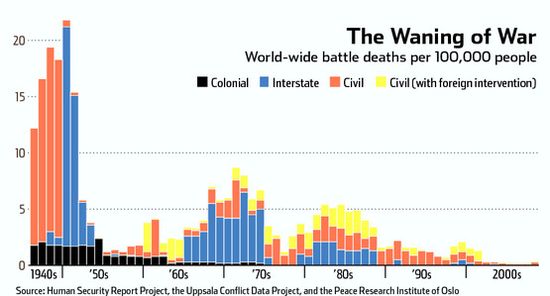
When you put this alongside the collapse of domestic crime – at historic lows and still not soaring again despite brutal economic times – the modern world really is less nasty, brutish and short-lived. And yet we would never think of the world this way – because, I suppose, the news always highlights provocative violence over the daily humdrum. (One reason for our View From Your Window project was to inject a moment of calm and normality in a blog so often covering crises and conflict.) Pinker thinks we have simply learned our lessons, and have not escaped our evolutionary genes:
A third peacemaker has been cosmopolitanism—the expansion of people's parochial little worlds through literacy, mobility, education, science, history, journalism and mass media. These forms of virtual reality can prompt people to take the perspective of people unlike themselves and to expand their circle of sympathy to embrace them.
These technologies have also powered an expansion of rationality and objectivity in human affairs. People are now less likely to privilege their own interests over those of others. They reflect more on the way they live and consider how they could be better off. Violence is often reframed as a problem to be solved rather than as a contest to be won.
That's an interesting take on why so many of the recent revolutions have been more self-consciously non-violent. Maybe the Internet played a role.
 The Dish