Did you know that the US is the only Western nation with zero legally mandated vacation days? More not-so-fun facts about our workforce in the infograph below:

Created by: Online Masters Degree
Did you know that the US is the only Western nation with zero legally mandated vacation days? More not-so-fun facts about our workforce in the infograph below:
Created by: Online Masters Degree
Shika Dalmia explains how the Texas governor can answer for his in-state tuition policy in economic terms (according to the WSJ, "state tax officials estimated that increased college enrollment by illegal immigrants would be budget neutral"):
In-state tuition is not a welfare program. … Public universities are supported by the taxes of state residents—legal and illegal. In-state rates are simply an acknowledgement of the fact that residents have already pre-paid part of the fee when their children go to college. Asking any resident, regardless of status, to pay the full tuition would be requiring them to pay twice for the same service. Yet this is precisely what denying unauthorized aliens in-state tuition does.
Matt Lewis suggests that Texans are more tolerant than the country at large.
They're becoming harder and harder to afford:
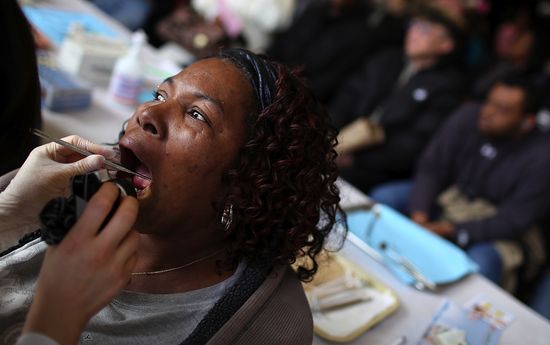
Access to dental care stands as a remarkably stark divide in American life, but it shouldn't come as a surprise. More than four in ten Americans pay their dental bills themselves, compared to just 10 percent of doctor’s visits, and the past decade or so has seen a vicious "oral cost spiral," as June Thomas points out, with the costs of dental care far outpacing both the rate of inflation and overall medical cost increases. With incomes falling, unemployment rising, and poverty increasing, dental care has become a "luxury" that fewer and fewer Americans can afford—and this despite the high premium that we put on appearance.
(Photo: Annette Jeffrey has her teeth examined by Remote Area Medical (RAM) volunteer dentist during a free clinic held at the Oakland-Alameda County Coliseum on April 11, 2011 in Oakland, California. By Justin Sullivan/Getty Images)
Balko observes:
[A] number of experts say death by firing squad is swift, relatively painless and less likely to go wrong than other means of execution. [Jonathan Groner, the trauma medical director of Children's Hospital in Columbus, Ohio] told ABC News the least painful method of execution may be the guillotine. But the idea of bringing back firing squads or the guillotine would make most Americans cringe — even ardent death penalty supporters.
That we'd recoil from the idea suggests that we're gauging the humaneness of state executions not by the swiftness and painlessness they provide for the condemned, but by the amount of discomfort they arouse in the rest of us. We prefer the method of execution least likely to remind us that it's actually an execution. And that suggests that we may not be as comfortable with executions as we think.
Keith Boyea has some existentialist thoughts about his career as a bureaucrat:
I prefer to think of humans as courageous–In the face of absurdity and meaningless, we go on. It’s nuanced, I admit; the difference between scorn and courage may not even matter. But in my attempts to make my own life meaningful in the face of all this, I think courage is a far better place to start than scorn … If all our character is a lie, created to keep us from recognizing the circumstances of our existence, then we can choose our own course. We can choose to love, live, work, and play because those things matter to us. We need not be bound to scorn, or to roll the Sisyphean rock at all. We can altogether forget about the absurdity and live happy, well-adjusted lives. And what’s more courageous than that?
Inflicting random cruelty and laughing hysterically about it?
The Yemeni dictator, who had been convalescing in Saudi Arabia, has reemerged to assault his subjects into submission. Bruce Riedel despairs:
Ali Abdallah Saleh’s return to Sana takes Yemen to the brink of civil war.
Chaos on the Arabian Peninsula’s southern tip is dangerous for the Saudis and America and good news for al Qaeda. Saleh has licked his wounds in Saudi Arabia since he survived an assassination attempt in June. Now he’s back. His sons and relatives have held on to parts of the capital and elements of the Army, waiting for this moment of return. Rival warlords have seized other parts of both the country and the Army, and peaceful demonstrators have grabbed other slices of the capital and the country. The economy has collapsed. Unemployment is now more than 40 percent. Division Gen. Ali Muhsen al-Ahmar, the rebel commander of the First Armored, and Saleh’s oldest son, Ahmed, who commands the Republican Guard, now are poised to start a full-scale civil war. Both are well armed.
Charles Schmitz is equally gloomy. Gregory Johnsen tries desperately to develop a strategy that could stave off the worst.

Nantucket, Massachusetts, 10.40 am
Today on the Dish, Palin criticized the media for not vetting the 2008 candidates and insisted she wasn't in it for the "shackle-y" title. McGinniss defended his verified sources and Janet Maslin missed the mark in her review of The Rogue. Fundraisers got nervous about Perry, Bachmann connected some crazy dots from Hezbollah to Cuba, and neocons ignored Chris Christie's notion of American exceptionalism.
John Judis urged the US to do the right thing for Palestine like it did in 1947 for Israel, neocons aren't funny when they try to be, and Netanyahu swayed Spain and France to his side. Andrew reconsidered his stance on Libya after the fall of Qaddafi in today's Ask Andrew video, with more of your thoughts here. Getting rid of Assad isn't as easy as calling for him to go, the Arab Spring bloomed in Palestinians, and RtoP advocates needed to clarify whether they're after regime change or civilian protection. Dreher wanted to see European localism win somehow with the collapse of the Euro, even as William Hague's predictions proved true. We tracked Putin's "run" for the presidency, and pointing lasers at planes can blind a pilot.
Douthat drew a distinction about the decline of the death penalty about our incompetency in implementing it, the Supreme Court might be able to abolish it, and readers considered redemption. Bruce Bartlett reminded the GOP once again that lower tax rates on the wealthy doesn't spur growth, macroeconomics can't always make sense of a messy world, and killing the electoral college isn't a partisan matter. Jan-Werner Mueller defined populism as an unhealthy coalition between elites and marginal groups that don't belong, and James McBride nailed Bill Clinton and Newt Gingrich as literary figures. It's not so easy for a Muslim American to join a Republicans' executive committee, and Jim Burroway disapproved of Lady Gaga's tribute to a gay suicide victim. Kevin Sessums found God in Helen Keller's situation, paper money screws blind people, and Machiavellian types make for good politicians.
Urban density mirrored free trade, the fertility rates for professional women plummeted, and snacks and alcohol are socially transmitted. Readers delighted in transcription errors, Amazon stepped up to Apple, and we contemplated our next short book venture. A college education remains a good investment for future jobs, and city kids defended their playgrounds from the 'burbs. Coffee averts depression for women, South Park starred on 60 Minutes, and Bart Simpson pranked the LA City Council. Doctors only accuse others of over-prescribing drugs for money, robots will steal our high-paying jobs too, and we yearned for the yogasm.
Happy Rosh Hashanah guide here, MHB here, FOTD here, VFYW here and the beautiful coincidences of yesterday's contest here.
–Z.P.
Kristian Coates Ulrichsen and David Held see the revolutions as but the start of a broad process of uneven, patchy and fragile democratization:
The course of events since the dramatic ousting of Presidents Ben Ali and Mubarak from power in Tunisia and Egypt, and subsequently Colonel Gaddafi in Libya, suggest that we may be witnessing a transition of elites rather than a democratic revolution. Elsewhere, autocratic regimes are fighting hard for their survival and Saudi Arabia is spearheading a counter-revolutionary pushback in the Gulf States while attempting to manage the direction of change elsewhere.
Joschka Fisher thinks they've already reshaped the dynamics of the Israeli-Palestinian conflict:
The pressure of the Arab revolutions is transforming the Palestinians into a dynamic political factor. For example, in view of the looming fall of Syria's President Bashar Al Assad, the pressure of the Egyptian revolution, and the new role of Islamism in the region, Hamas' alliance with Iran is becoming increasingly problematic. It remains to be seen whether, in the end, the ‘Turkish course' will prevail against the radicals in Gaza or not. In any case, Hamas faces some risky and consequential decisions of its own — all the more so should its main rival, Abbas's Palestinian National Authority, succeed in its current diplomatic campaign at the United Nations. Obama had promised a Palestinian state within one year, and Abbas is now building upon that promise.
Meanwhile, the far right government in Jerusalem continues its policy of ethnic and religious social engineering beyond the 1967 borders in order to create a permanent Greater Israel. (For the perversity of that provocation, read Tom Friedman.) And Hussein Shobokshi tries to substantiate the claim that Assad's fall is, in fact, looming.
(Photo: More than a thousand Jordanian protesters demonstrate during a rally in support of the Palestinian cause, calling for the closure of the Israeli embassy, on September 15, 2011 in Amman, Jordan. By Salah Malkawi/ Getty Images.)
The basics of the Jewish New Year celebration (which begins tonight) explained.
Stan Collender, who led the team to "increase consumer awareness of the [Sacagawea] golden dollar" when in was introduced in the '90s, counters the Tea Party's call for the coin:
[I]n spite of the consumer demand, the golden dollar was a huge flop. Why? The problem was that consumers wanted but couldn't get it. …
What Congress didn't realize or care about when it authorized the golden dollar was that it costs businesses more to get coins than bills because they're heavier and the delivery charges from Brinks or some other armored carrier are higher. Plus, you had to order dollar coins in bags of 2000, which is way more than most retailers need and want to keep in their safes. Because consumers ultimately didn't care whether they got a dollar bill or dollar coin when they made a purchase, businesses saw no reason to pay extra to have the coins delivered or to take the extra risk of having them in their safes. Ultimately, therefore, they didn't order them and you didn't get one in change.
It's one issue where Dan Savage and the Tea Party agree.

 The Dish