First, things can still get worse for the president. One personal scandal or account of presidential pique could drive his numbers down further. Second, the temptation to make the election a personal choice and to run against a Republican's character, not his policies — playing to the incumbent's strength — will be close to irresistible.
They are poles apart on the numbers of uninsured. Perry's Texas has 27.2 percent of its population without health insurance – the worst record in America. Massachusetts has an uninsured rate of 5.2 percent – the best. And yet Romney is still apologizing for this achievement.
Tell me: is it actually a Republican goal that people cannot have decent access to healthcare? Do they have any proposals to help? So far, the examples seem to be yes and no.
Unless I need spare dollars to feed the worst heroin addiction mankind has ever known, or am conducting a social experiment to see how many times I can be strangled to death, I don't want strangers in my apartment using my bathroom.
The conceit is that advocates of choice-based education reform really want to privatize public education, to make a profit off young people and embrace the latest corporate fads. But history tells us that today’s public schools are the legacy of corporate fads from the 1900s, when large industrial enterprises were keenly interested in securing a docile workforce that recognized and respected hierarchies. The tinkering, self-starting spirit that had been a necessity in a frontier society was snuffed out by design. We’ve been taught that education is this constricted, standardized and homogenized thing that happens in buildings called schools in between the ringing of school bells.
He loves Skillshare, a startup that facilitates peer-to-peer learning, which has been covered here, here and here.
[A]s a general point, it's entirely possible for the initial investment to have made sense and for the company to have eventually failed. If we're going to try to support young companies doing risky things in sectors that we're hoping to dominate, we're going to have to be prepared for some of them to fail. In fact, we should be hoping some of them fail. If our success rate is too high, it means government is making bad investments.
Doug Mataconis critiques Klein's list of public investments that paid off:
The Internet started out as a DARPA project to create a communications network that could survive a nuclear attack. Nuclear power, quite obviously, developed out of the research undertaken during World War II to build the Atomic Bomb (although it’s worth noting that research in the atomic energy field was taking place before the Manhattan Project). To a small degree, microchip technology advanced as private contractors worked to fulfill the needs of the Defense Department and NASA, although for the most part it was the private market that drove chip technology to push the boundaries of Moore’s Law further and further. Radiotelephony, what most people call wireless communications, received some benefit from government spending but, again, it was private technology that was driving technology forward to the largest degree.
To the extent each of these technologies benefited from government investment, they did so because they were fulfilling a specific need, not because the government had decided to invest public money to pick winners and losers in the market place.
Here's a brutal but persuasive piece on why unemployment is likely to stay where it is possibly for the rest of our lives. If you think of American innovation, you often think of Apple, an astonishingly innovative, brilliant industrial high-tech company. The iPhone has been a massive success – but has created jobs mainly … in China. Apple could manufacture the iPhone in America, but its profit margin would drop from 64 percent to 50 percent. And Apple isn't alone, of course. Which is why China's high-tech exports to the US keep growing in number and value. Most of those high-tech products are designed and developed by US companies.
Amazon’s Kindle 2 couldn’t be made in the U.S., even if Amazon wanted to:
– The flex circuit connectors are made in China because the US supplier base migrated to Asia. – The electrophoretic display is made in Taiwan because the expertise developed from producting flat-panel LCDs migrated to Asia with semiconductor manufacturing. – The highly polished injection-molded case is made in China because the U.S. supplier base eroded as the manufacture of toys, consumer electronics and computers migrated to China. – The wireless card is made in South Korea because that country became a center for making mobile phone components and handsets. – The controller board is made in China because U.S. companies long ago transferred manufacture of printed circuit boards to Asia. – The Lithium polymer battery is made in China because battery development and manufacturing migrated to China along with the development and manufacture of consumer electronics and notebook computers.
As China and India develop even faster, I see no way American skilled workers can truly compete without CEOs hurting their own shareholders. The prospect of a continued corporate profit boom, higher and higher economic and social inequality and persistently high unemployment is real and probably inevitable, absent brutal protectionism. And Perry's response – creating piss-poor service jobs for lower and lower wages – does not address this core problem.
Maximilian Popp reports on the dangers of a sub-state justice systems in Germany:
Politicians and social workers tend to focus on forced marriages and honor killings, but the baleful influence of these Islamic arbitrators has gone largely unnoticed by the public.
Joachim Wagner, an author and television journalist of many years, has taken a closer look at the phenomenon in his book "Richter ohne Gesetz" ("Judges without Laws"). Reconstructing Mustafa O.'s case, he reaches the conclusion that "the Islamic parallel justice system is becoming a threat to the constitutional legal system." These justices of the peace don't wear robes. Their courtrooms are mosques or teahouses. They draw their authority not from the law, but from their standing within the community. Most of them are senior members of their families, or imams, and some even fly in from Turkey or Lebanon to resolve disputes. Muslims seek them out when families argue, when daughters take up with nonbelievers or when clans clash. They often trust these arbitrators more than they trust the state.
Eugene Volokh thinks the activities of these courts are criminal.
A tough one. Modern casement window and the absence of pick-up trucks suggests Europe, but the buildings look North American. The roofs have too low a pitch to handle lots of snow. This, plus the grass, puts it in a relatively warm climate. The doorways are recessed, however, which suggests a windy/rainy area. The lack of people on the street and in the playground, plus the heavy curtains, means it could have been taken on a summer night in a northern latitude. So, because I’m out of time and ideas, while Norway and Scotland were my first choices, I am going to go for Wrangell, Alaska. Go figure.
Another writes:
I spy the Mendenhall Glacier in the background. Juneau’s public schools and airport are also in the Mendenhall Valley, which would account for the playground-foreground and what appears to be a long, flat concrete space behind that. As for the precise vantage of the actual window shot, all I can say it’s not from neighboring Douglas Island. (Fun fact: if the VFYW contest existed 500 years ago, the glacier would fill the shot. I only know this because I spent the spring of 2005 doing a play at Juneau’s Perseverance Theatre.)
Another:
No time for a detailed search – we’re actually heading out the door in a few minutes for a “crack of dusk” start on a Labor Day river trip up towards the Alaska Range, where I’m guessing this View was taken. Glacier in the background is the big clue, with the American playground equipment behind some government-issue apartment buildings the other. I suppose it could be somewhere down in SE Alaska, but my gut tells me we are looking at the back side of the Alaska Range near Delta Junction, which would make this Fort Greely. My guess is we are looking out toward Trident Glacier coming off of Mt. Hayes from some new apartment buildings they are putting up as they ramp up expansion of an anti-ballistic missile program (North Korea is the apparent threat, perhaps to the nearby pipeline). I’ll leave it to your Google sleuths to nail down the school or the apartment building and hope we hear from someone who works on base to tell us good stories about 1) how damn cold it gets there in the winter or 2) how damn muggy and buggy it gets in the summer.
A teaser of the correct location (city names are blurred):
Another:
I feel strongly that I’ve been there before. The closest thing I can imagine is a stopover in Rapid City, South Dakota nearly 20 years ago during an exhausting coast-to-coast move. This image looks like what I remember of the area around the Ellsworth AFB Air and Space Museum. The photo has an aura of military industrial complex, so I’m going with the air base hoping an air force lodge or child development center is somewhere on the property – though web searches refuse to confirm. Wish I had more time since this is probably Montana or Yugoslavia!
Another:
This is a photo of the United States Army Garrison Yongsan located in Seoul, Korea. The photo was probably taken on base. The red building might be one of the multiple child development centers available on base. I’m probably not even close, but by submitting an answer I will be forced to take my mind off of the contest for now.
Another:
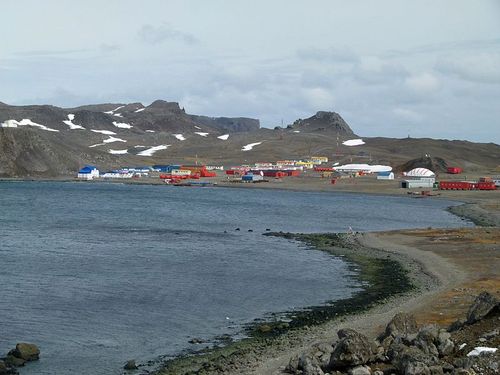
I know a composer who wrote the soundtrack to a short documentary featuring an outpost in southernmost Chile, called “Das Dorf am Ende der Welt”, and the scenery looks just like the village in the film, which was Villa las Estrellas. This is a picture from Wikipedia that looks like the village:
Another:
This one seems quite difficult, but I’ll take a guess.
The mountains seem newly formed, particularly off to the right. The window itself seems simple in design – almost has a modern English feel to it. The land is too sparsely populated to be England proper. The cars are small in size, eliminating the US from contention. It could be a Norway / Finnish area, but I’ll go to the opposite side of the world and guess Greymouth, New Zealand. I recall taking a train ride across the South Island of NZ a decade ago, and the winding river below looked a bit like the river in the picture. Worth a shot.
Another:
Window knobs remind me of my Bavarian childhood. Doubt it is German Alps, so I will go with the Swiss and say Schwyz, Switzerland.
Another:
I’m not spending another damn afternoon google-earthing trying to find this place. Summer is ending here in NH and I want to enjoy what’s left of it. I have no clue where this image is, but it reminds me of the music video for Lifelines from A-Ha:
A-Ha are from Norway. Norway has glaciers. I believe there is a glacier in the distance in the image. The architecture also looks right from pictures I have seen of Norway. The window frame looks like a typical double-glazed European window my parents have in Ireland. Ireland is in Europe. Norway is in Europe. Therefore it has to be Norway.
Hurry up and send me another book. Christmas is coming and I need a new gift.
Another:
I’m sure you’re getting a nice variety of Arctic guesses for this contest, so I thought I’d throw another one in the ring. Not too much to go on here, but the absence of trees, the presence of glaciers, and the fact that you can see the sun means we’re probably somewhere in the far north. And I don’t see any of the tell-tale yellow Alaska plates. So I’m guessing Sisimiut, in the hopes that the Labor Day weekend guesses will be fewer than usual.
Surprisingly not. Another:
I am probably way off the actual city location, but this is definitely Iceland! I never got to go up to the northern part of the country, but everything in this photo (from architecture, to landscape, even to interior decor) is Icelandic. The mountains though are what’s messing me up. I can’t think of an angle around Reykjavik or its suburbs that would provide that view, and the northwest of Iceland has less settlements. There’s a mountain range right outside of Akureyri, and there’s a large body of water in the fjord there that leads up and out to the Arctic Sea, so I’ll go with Akureyri.
Iceland it is. Another:
Keflavic, Iceland? Just a feeling. But it looks like the housing that used to be part of the airforce base there.
Another:
The buildings are reminiscent of what one would see in the towns along Iceland’s Ring Road. Certainly the backdrop is as well. As far as which town – well, that’s hard to say. I’ll pick Hvolsvollur, which is big enough to have a motel and buildings the size of what’s seen in the photo.
Another:
I feel good about this one. It’s the Vatnajökull glacier in Iceland, shot from a second story window of what I believe is the Hotel Edda Nesjum. I’ve spent a lot of Google hours on some of these, and this one only took my about 20 minutes. My mother and I narrowed it down to a pretty high latitude by the vegetation and types of buildings pictured, we live in Southeast Alaska and have lot of glaciers, but everything else is pretty different. I did some googling and found a picture of the glacier on a National Geographic blog, which only identified Iceland. The curtains in the photo really screamed hotel to me, so I did some searches for glacier view hotels and matched the Edda Nesjum to that location and glacier.
I hope this puts me in the running. I’m about to start grad school and wont have time to get tied down on my addiction to figuring out these puzzles.
It is indeed the Vatnajökull glacier, but wrong hotel. Another:
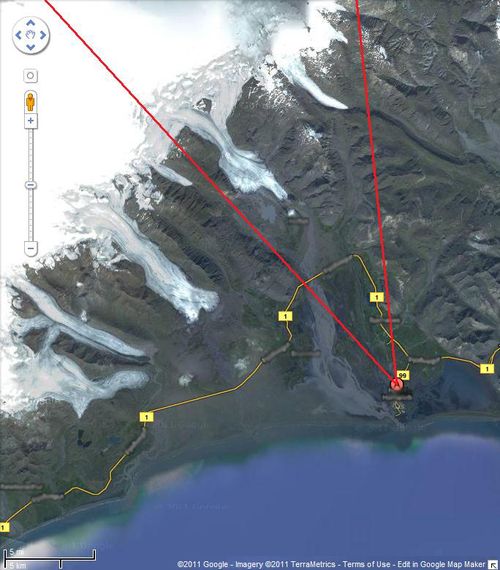
I knew the second I saw this picture that it was from the window of a hotel in Höfn, Iceland, based on the architecture and the view of the glacier in the background. From there it was just the matter of finding which hotel is next to one of the two preschools in Höfn. This preschool is Krakkakot, located at Víkurbraut 26. Hótel Höfn is next door. Its website actually shows two rooms that both have essentially the same view. I have never stayed here, but I do believe I had an unmemorable generic Icelandic lunch there 10 or 15 years ago. A much better choice is to eat langoustine (miniature Icelandic lobster) at Humarhöfnin.
I know I have no chance at winning a book, since I’ve never even entered before (though I did have a view from my window last December), but on the very long odds that few people get this, maybe you could take into account the time that my answer arrived?
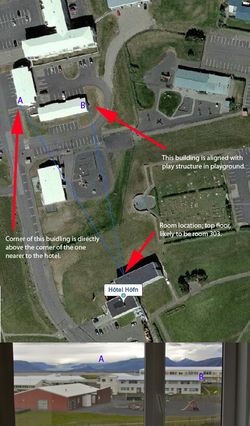
The reader was indeed quick on the draw, sending her entry at 12.43 pm on Saturday. Another sends a photo of the hotel:
Another:
This is the first one I actually knew the second it came up! I ended up in Höfn semi-randomly in September 2000. It was 113 degrees in Dallas one day and I just snapped and booked a trip to Iceland. Two weeks and a puddle jumper from Reykjavík later I was in Höfn. I stayed in another hotel just north of this one and was the last guest of the season.
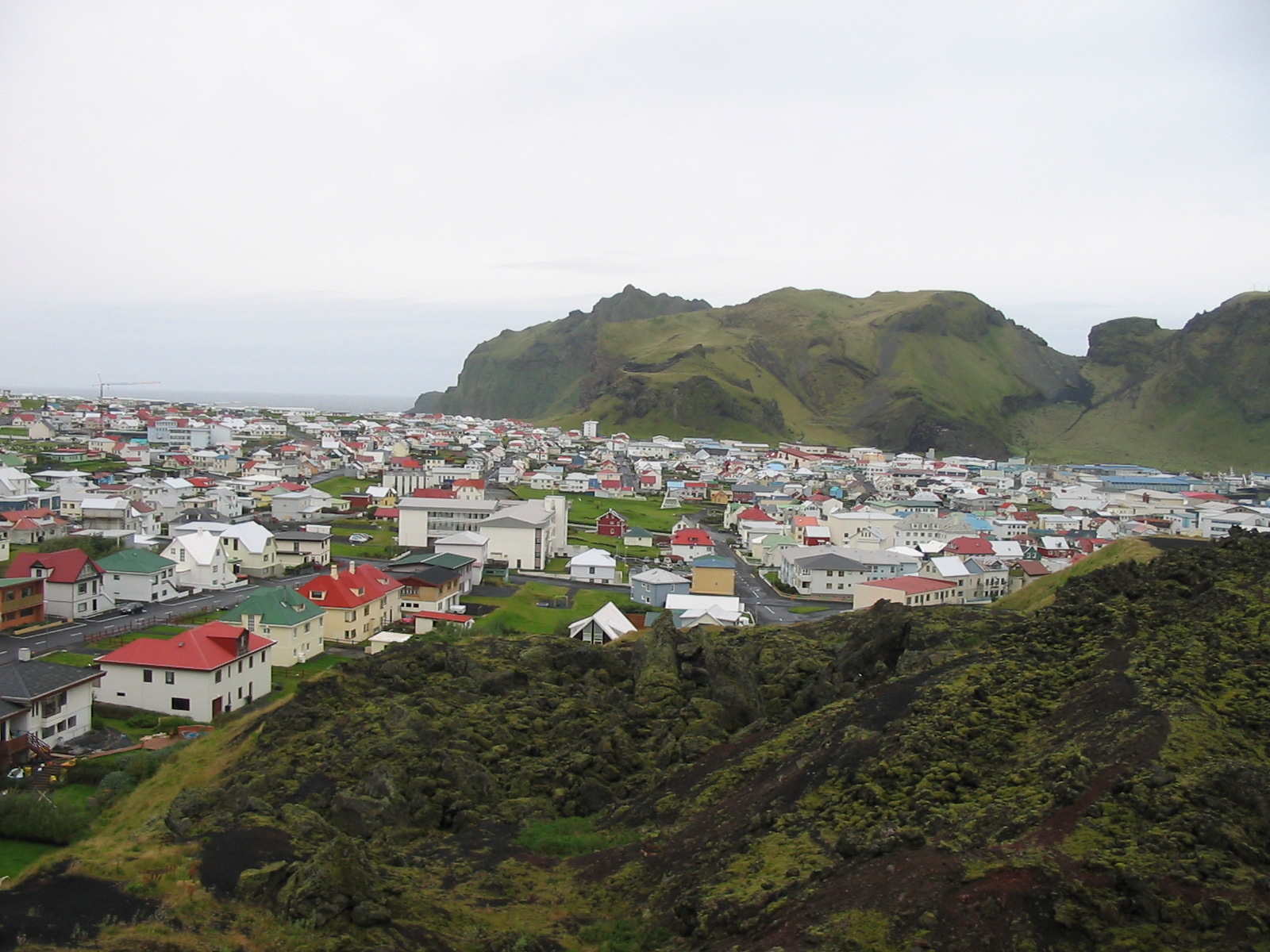
It was semi-random in that I am Icelandic-American and had never been to the old country. Two years later I went back and took my father so he could visit the farm where his grandmother was born on Vestmannaeyjar island, but it had been buried in the 1973 Edfell volcano eruption. The attached photo would be the VFYW if the house was not buried under 100′ or so of lava:
Another:
This looks just like Hofn, Iceland, looking northwest towards the glaciers Iceland is a beautiful and strange place. I was on a fishing trip to Hofn in 2007, right before their economy and banking sector completely blew up. I remember being shocked at how high the prices were for everything, our hotel room in Reykjavik cost $500 a night and the meal prices were like being in New York. Knowing that Iceland only has three natural resources – fish, volcanic steam (which provide free heat and hot water for everyone) and grass (which is grown during the four long summer months and cut for hay to feed their horses and sheep through the eight dark months) – I didn’t see what could be so expensive about this place. I hear it’s much cheaper these days.
Another sends the schematics on the right. Another writes:
I stayed in Höfn on June 15-16 of this year and instantly recognized the glacier in the background. Because this place is at 64°N latitude, it doesn’t get dark around the solstice and so we could see the glacier all night from our hotel room. And when I say hotel room, I mean boarding school dormitory room. In Iceland, the tourist season coincides with summer vacation and all over Iceland’s countryside, there are boarding schools that convert their rooms to guest lodging from June-August.
I’m pretty sure the glacier is Flàajökull, which is one of many tongues emanating from the gigantic (as in 2/3 of the size of Connecticut) Vatnajökull icefield. A quick search of Google Maps pointed me to the schoolgrounds in the photo. The school – I believe it may be both a primary (Grunnskolin) and secondary school (Framhaldskolin) in one complex – is located at the north end of Vikurbraut, one of the two or three main streets in Höfn, and which bascially translates to Boulevard of the Bays (I became somewhat fluent in Icelandic place names during my stay there). Wow, I can’t tell you exciting it is to recount a portion of my Scandinavian vacation.
Another tourist:
In 2009 my boyfriend and I drove the ring road that circles the country. Iceland has about 300,000 people and 2/3rds of them are in the Reykjavik area. Once you get outside of the capital built up areas are few and far between. We arrived in Hofn pretty late in the evening and were very disappointed that after almost two days of eating hot dogs at filling stations (the pylsur is a national staple) all the restaurants in town were already closed. Resigned to yet another gas station meal we bedded down at a hostel for the night. The next morning we were overjoyed to find a proper restaurant at Hotel Hofn. Never have scrambled eggs and toast been so welcome! (Our late arrival in Hofn was due doubling back and forth along the south coast all afternoon to make sure we got to see both the Jökulsárlón iceberg lagoon and Svartifoss waterfall. I’ve attached a few snaps from that leg of our trip.)
To me, this view seems so unique that you’ll get dozens of responses, but I guess not that many people have had encounters with Hotel Hofn. Iceland is an amazing and beautiful place. Thanks for taking me back!
We did get dozens of responses for Iceland, and more than a dozen for Höfn. But here is the winning entry, from the only Höfn guesser who correctly answered a difficult window in the past:
Either I’m lucky, or glaciers really narrow it down, but I found this one in 15 minutes on GoogleMaps. The photo was taken from a window on the north side of the third story of the Hótel Höfn in Höfn (also known as Hornafjarðarbærgives), Iceland. The glacier that gave it away is Vatnajökull (the largest ice cap in Europe by volume, Wikipedia tells me). If you visit the hotel’s website at you can see lots of pictures from inside the rooms, including one that – based on the shape of the window and the view over the playground – looks to be the very room:
Woot! Third time right … third time lucky?
From the submitter of this week’s photo:
I was delighted to come home from traveling over the long holiday weekend to see my picture of Höfn, Iceland, as this week’s contest. I noticed that some of my Flickr pictures of the town were viewed over the weekend based on people searching for “Hofn” so I’m hoping those were intrepid Dish readers and not just coincidence.
In case you need further information to determine the winner, the picture was taken from the third floor of the Hotel Höfn (counting the floors American style). I believe it was room 202, but regardless of the number, the room was on the far western side of the north face of the main building. The full address and google maps location is here.
My thoughts on the developments of the last two weeks here. My reflections on the 9/11 anniversary here. Money quote:
We often talk about terror in terms of the terrorist. We do so less in terms of the terrorized. But it was how this act changed those of us who were bystanders that made this event more awful than a mere mass murder. It was mass murder as theater and as threat.
It took months for this initial trauma to ebb, years for my psyche to regain its equilibrium. And it took me close to a decade to realize just how slickly Osama bin Laden had done his evil work, how insidiously his despicable performance art had reached into my mind and altered it, how carefully he had set the trap and how guilelessly I—we—had walked right into it.
We need to understand that 9/11 worked. It worked as a tactic to induce American self-destruction, even if it failed spectacularly as a strategy to advance Al Qaeda—and its heretical message of suicidal warfare—across the globe.
The latest poll is brutal for Barack Obama, as the public is close to despair on the economy. He has an all-time-low approval rating of 44 percent (slightly better than most polls), and only 19 percent think the country is on the right track. As I wrote this morning, the debt ceiling debacle, the downgrade and the jobs numbers explain much of this. All this is rightly the leading news, but it's worth noting how resilient the president is personally with the American public:
If there's a silver lining for Obama, it's that a combined 70 percent of respondents still find him likeable (though nearly six in 10 say they disapprove of many of his policies). And 50 percent approve of his handling of foreign policy.
It's also useful to see how even despite the horrific numbers, Obama is still beating or matching his likeliest GOP opponents, even if he is slightly trailing a generic Republican:
Obama leads Texas Gov. Rick Perry by five points, 47 percent to 42 percent. And he leads former Massachusetts Gov. Mitt Romney by one, 46 percent to 45 percent, though that margin is down five points since June.
If Obama is beating Perry now, before Perry's extremism has been fully aired, the Republicans should be jittery. And on the critical long-term issue of the debt, voters are overwhelmingly behind Obama's position and against the GOP's:
In the poll, 60 percent say it would be acceptable if the "super committee" considers reducing the deficit by ending the so-called Bush tax cuts for families earning $250,000 or more per year. Moreover, 56 percent say it would be acceptable if it considers reducing the deficit by a combination of tax increases and spending cuts.
By comparison, just 37 percent believe it’s acceptable for the committee to reduce the deficit by only cutting spending and not raising taxes on corporations and the wealthy. And only 20 percent say it’s acceptable to lower the deficit by reducing spending on Medicare.
All of which is to say: everything is to play for. But at this point, when the polls are clearly reflecting a referendum on Obama's legacy, not a choice between him and a specific opponent, the GOP is arguably on better ground than it will face next year. And Obama's still beating Perry.


 Iceland, based on the architecture and the view of the glacier in the background. From there it was just the matter of finding which hotel is next to one of the two preschools in Höfn.
 background. Because this place is at 64°N latitude, it doesn’t get dark around the solstice and so we could see the glacier all night from our hotel room. And when I say hotel room, I mean boarding school dormitory room. In Iceland, the tourist season coincides with summer vacation and all over Iceland’s countryside, there are boarding schools that convert their rooms to guest lodging from June-August.


 The Dish