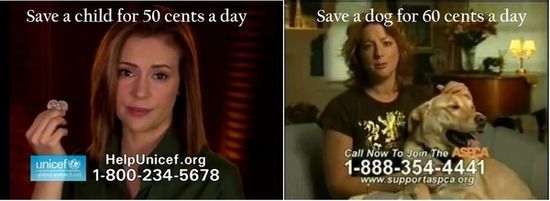
by Chris Bodenner
A reader writes:
Although I like dogs, I have never owned one. I'll say this though: for almost every letter from the anti-dog people, especially that first reader, replace the word "dog" with the "child" and you'll have my position. Exactly. And I'll bet a lot of your readers feel the exact the same way.
Another demonstrates:
So, the third letter here had me thinking that I know lots of people who don't like kids say nearly the same things about dogs. Let's change the appropriate words…
I'm sorry, but parents are the very worst at judging where they should and shouldn't take kids, even when their kids exhibit terrible behavior. I have encountered terribly behaved kids at coffee shops, at bars, even at rock shows (which are probably incredibly damaging to kids' ears). Parents are so myopic about their own children's behavior and presence. "Oh, it's okay that she's throwing things at you…she's a sweetheart, trust me."
You are bringing a child into other peoples' personal spaces and asking them to deal with it. Have a little bit of respect. Not everyone thinks your kid is okay or cute or a real sweetheart.
Another does the same thing and adds:
No, I'm not arguing dogs = kids. Dogs shouldn't be allowed (and are not allowed) inside restaurants and most other establishments for health reasons. On the other hand, my experience is that inconsiderate and non-empathetic parents outdo rude and non-empathetic dog owners in both number and degree. In misbehaving children and dogs, the problem is the adult caretaker. The solution is generally 1) to politely ask that they control their charges, and 2) accepting the fact that some people are just assholes.
Circling back to the original debate, a fellow Brooklynite testifies better than I can:
Your reader writes: "The only regulation I would favor would be that the default be dogs not allowed unless the ownership posts a dogs allowed sign. Dog owners could then congregate at doggie diners as they do now at dog parks, and the rest of the public can dine without the bother and the threats to health and safety posed by many dogs."
This is basically the way it works in New York City already, and people who complain about dog owners who think they can take their dog "anywhere" are knocking down a straw man. Any responsible NYC dog owner knows that dogs aren't *technically* allowed in any bar. Nonetheless, in my neighborhood in Brooklyn there are three or four bars (none of which serve food) that are well known as the "dog bars." They have water dishes. One of them sometimes writes "We Love Dogs" on the sidewalk chalkboard. I occasionally take my dog to those bars. I don't take him to any others – and there are many, many others. The community has already done an excellent job of answering the dogs-in-bars question … no intervention from the city necessary.
Another great place for dog people: Germany. I lived in Stuttgart as a kid and have fond memories of meeting dogs in restaurants almost every time we went out to dinner. German dogs tend to be super well-behaved; my family would often have a entire meal without noticing that a pooch was resting at the feet of its owner in the adjacent booth. A reader backs me up:
I went to Germany a few years ago to visit my brother and was surprised to find dogs everywhere. Malls, restaurants, bars etc. All of them were very well-mannered and the owners kept them in line.
Another perspective from Europe:
I have two dogs who have traveled the world with us, and we especially love going to France, where dogs can go just about anywhere (except museums, churches, and, 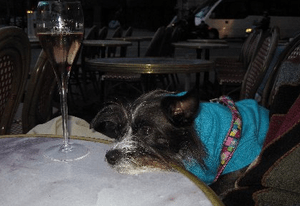 oddly enough, most parks). But we made damn sure they had good "cafe manners" before we even thought of taking them to restaurants. And we always ask the folks at the neighboring tables if they mind the dogs being near. No one has ever objected. To be honest, our dogs behave better than most kids I've seen in restaurants. Which is why I always have to laugh when I see parents getting their panties in a knot when a restaurant owner tries to enforce a "no child" policy. My dogs might shed a few hairs but at least they don't scream and throw food.
Our reader adds, "That's Phoebe having a kir in a Paris cafe after a long day." Another cultural anecdote: When my mother adopted our dog Scooter from a German pound, officials required that she and my stepdad take a week off work – each – to housetrain and discipline Scooter. An official would show up to our house several times, unannounced, to make sure Scooter was being adequately cared for. From how my mom explains it, Germans were very wary of American expats buying dogs, particularly US servicemembers like her, because of high rates of dog abandonment when expats moved back to the States.
On that note, and segueing back to New York, check out this fantastically titled story from the summer, "Drunk Puppy Buying Banned By West Village Pet Stores":
"I feel like they always come in drunk," said Fernanda Moritz, the manager of Le Petite Puppy at 18 Christopher St. which has implemented a policy against letting customers buy — or even hold — animals if they've been drinking. The shop is surrounded by bars, and Moritz said many of her would-be customers stop in after happy hour around 6 p.m. "They come from there and say 'let's stop by to see the puppies,'" said Moritz. …
Even though turning down drunken customers might seem bad for business, Moritz and Jacoby both say they'd prefer to lose the sale. "We make sure they can take care of the dog. We make sure they go to a good home," Jacoby said.
(Image via J.P. Moore)


 The Dish