A Time To Remember

by Zoë Pollock

The 9/11 remembrances have picked up steam, and you can read Andrew's in Newsweek tomorrow. Frank Rich's larger takeaway:

Sacrifice was high among the unifying ideals that many Americans hoped would emerge from the rubble of ground zero, where so many Good Samaritans had practiced it. But the president scuttled the notion on the first weekend after the attack, telling Americans that it was his “hope” that “they make no sacrifice whatsoever” beyond, perhaps, tolerating enhanced airline security. … By portraying Afghanistan and Iraq as utterly cost-free to a credulous public, the Bush administration injected the cancer into the American body politic that threatens it today: If we don’t need new taxes to fight two wars, why do we need them for anything?

Goldberg analyzes al Qaeda's relationship to Islam:

Islam, like any great and complicated religion, contains a thousand streams. And Muslim Arabs in half-a-dozen countries have this year signaled their disapproval of al Qaeda's agenda by seeking the overthrow of dictators not the Bin Laden way — through murder — but through protest. I like to believe that Bin Laden, in his last year on earth, was a depressed man: He was forced to watch as Arabs by the millions ostentatiously rejected the path he had carved for them. The existence of a thousand streams of Islam; the Arab revolts; the loathing of al Qaeda that has spread wide through the Muslim world (the majority of of Qaeda victims by now have been Muslim); none of this has convinced some in the West that we are not, in fact, engaged a clash of civilizations with Islam itself, that if there is a clash, it is taking place within Islam.

“If They’d Known More…They’d Have Voted Differently”

by Zack Beauchamp

Political theorist Ari Kohen tells the story of his friendship with death row inmate Ronnie Frye on the 10th anniversary of the latter's execution:

Ronnie Frye’s death was meant to bring some measure of comfort to the victims of his crime, the family of Ralph Childress. Perhaps it did; I know Ronnie sincerely hoped that it would. But it also created another innocent, grieving family: Ronnie’s. As I have written a great many times on this blog over the past couple of years in one way or another, the death penalty is not a solution to the problem violence; it is violence. I know this from first-hand experience; it is not theoretical or abstract to me.

Living The Impossible

by Zoë Pollock

Kevin Kelly is awed by our collective knowledge:

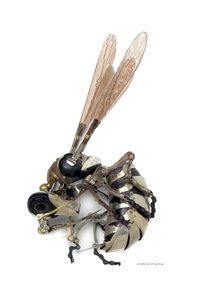
Guepepapier A single bee lives 6 weeks, so a memory of several years is impossible, but that's how long a hive of individual bees can remember. Humanity is migrating towards its hive mind. Most of what "everybody knows" about us is based on the human individual. Collectively, connected humans will be capable of things we cannot imagine right now. These future phenomenon will rightly seem impossible. What's coming is so unimaginable that the impossibility of wikipedia will recede into outright obviousness. Connected, in real time, in multiple dimensions, at an increasingly global scale, in matters large and small, with our permission, we will operate at a new level, and we won't cease surprising ourselves with impossible achievements.

Relatedly, Richard MacManus argues that collective intelligence projects need more women.

(Image by French sculptor Edouard Martinet, constructed using old bicycles, cars, and mopeds)

Is Opting Out Possible?

by Zoë Pollock

Adam Frank draws an interesting comparison between mechanical clocks and Facebook and Twitter:

The first public mechanical clock appeared in Orvieto, Italy, in 1307. One hundred years later public clocks had evolved into the standard even in smaller settlements. … Once a technology settles in to the point where it begins shaping the dominant metaphors of a society (the 17th century's "clockwork universe" for example), then there is no going back, no opting out. You and everyone you know will be assimilated.

The Theater Of Religion

by Zoë Pollock

Kristin Dombek ferrets out one reason for The Book of Mormon's success:

[The Book of Mormon] teaches us what secularists don’t get about what makes religion so awesome: it’s like a musical you live in, and it can actually be more fun if it seems a little fake, if you have to work a little to believe. There tend to be so many gaps that the thrill of it is filling them in, making them fit. While to outsiders, religious people seem to believe despite the obvious manufacturedness of their religion, The Book of Mormon suggests that believers believe (at least in part) because of the pleasure of revoicing, adapting, and even inventing stories and then treating them as sacred.

Conflicted Grieving

by Zoë Pollock

V. V. Ganeshananthan remembers the deaths of Tamil civilians at the end of Sri Lanka’s civil war:

These deaths require, among other tasks, ongoing announcement and explanation – and because certain authorities have failed to fully acknowledge that the casualties occurred, saying I grieve means stating, repeatedly, I believe that they did. It is a kind of complicated voting. This recitation of the facts means a commitment not only to how definitively these people are gone, but also to hearing it over and over again as I am forced to argue for it. I resent this more than I could ever have thought possible, because in this country of grief, the best kind of shelter is to be understood, to have someone stop next to me and without asking anything, put their umbrella over us both, between us and the rain.

The Jack Mormon? Ctd

by Chris Bodenner

A reader writes:

I think you overlooked a key insight of Mark Hemingway’s piece:

But I also think the [Jack Mormon] comparisons to Reform Judaism are curious — barring a really, really radical change in the culture of the laity and Mormonism’s governing structure, a similar movement would a) probably not emerge and b) if it did, it would be unlikely to remain in the LDS church. But it is an attractive concept to a lot of liberal Mormon intellectuals (yes, they do exist).

As someone whose Mormon roots go back to before they came to Utah, whose family literally helped found Salt Lake City, and who has polygamous ancestors, I might be considered a Jack Mormon (except of course as a gay man who long ago left Mormonism behind, I doubt I’d be granted that status).  As a result, I’m something of an insider in the world of Mormonism (for a deadly dull read, check out James Stephens Brown’s book Giant of the Lord – he’s my grandfather’s grandfather and was among the earliest Utah settlers).

Stories emerge very few years in Utah about a new openness in the church or evolution of church members attitudes; these stories are the expression of an often inchoate yearning on the part of liberal Mormons for a more tolerant, less authoritarian church, and they are unlikely to be realized in our lifetimes.  The hierarchy in the Mormon church has repeatedly demonstrated its willingness to sacrifice members in the name of orthodoxy and order; they will gladly disfellowship and even excommunicate someone who openly questions church leaders, no matter their public stature.  Mormonism is a deeply rule-bound faith, strictly hierarchical – far more so than the Catholic church.

That glass of wine Hunstman’s kids drink keeps them out of Mormon Temples, meaning they don’t have access to some of the church’s most important rites.  They are breaking the Word of Wisdom, which Mormons take very seriously.  If you want access to the Temple you must obey the Word of Wisdom – no alcohol, no tobacco, no caffeine (there are more, but those are the big three).  You don’t get a pass on it.  Your bishop will have no problem refusing to give you a temple recommend.  The church leadership is unbending on this issue. There are ways around it – my deeply Mormon grandmother never lost her temple recommend despite being a coffee fiend – she just lied through her teeth and never openly challenged her bishop’s authority.  It’s a strategy lots of Mormons use. 

If you want an interesting take on Mormonism, check out Paul James Toscano’s books The Sanctity of Dissent and The Sacrament of Doubt.  Toscano was excommunicated by the church for daring to question the leadership’s position on a range of issues, including the role of women.  He was a very public figure for a while in Utah.  He was also kicked out the minute the leadership thought he was too heterodox. 

Another writes:

In his novel The Monkey Wrench Gang, Edward Abbey writes about his character Seldom Seen Smith (who is 'Seldom Seen' because he has three geographically-separated wives):

Born by chance into membership in the Church of Jesus Christ of Latter-Day Saints (Mormons), Smith was on lifetime sabbatical from his religion. He was a jack Mormon. A jack Mormon is to a decent Mormon what a jackrabbit is to a cottontail.

For the full version of the great work of fiction on the life of a Jack Mormon previewed above, go here.
Problems With Liberation Theology

by Zack Beauchamp

Peter Berger tracks the global spread of a doctrine and critiques it:

The same themes appear throughout [the world]:The epistemological assumption that the oppressed have a privileged access to reality. The practice of “consciousness raising”, both for the oppressed themselves and for converts from the oppressing classes. The Christian Gospel legitimates and requires action against the oppressors (though the precise nature of this action is differently described). The designated victims of course vary—inhabitants of Brazilian favelas (or jungles), the minjung in Korea, African-Americans and (rather less plausibly) middle-class white women, and so on. But the oppressors tend to be the same—the agents and institutions of global capitalism, supported by American imperialism and its local allies.

Christian liberationism can be criticized both theologically and empirically. Theologically, it politicizes the Gospel in a way that deviates sharply from the New Testament—the Kingdom of God announced by Jesus and the early church was not a political program. (One does not have to be a Christian believer to say this—a Jewish, a Buddhist, or an atheist historian can come to the same conclusion.) Empirically, there are problems with the diagnosis, the recommended therapy, and the consequences for churches that espouse the liberationist agenda. The diagnosis of contemporary society in quasi-Marxist terms is essentially false.

I'm both Jewish and an atheist, making me doubly non-Christian, but his point about empirical conclusions not following from theological (or philosophical) beliefs is well taken. Believing that the weak are oppressed doesn't imply anything about who's doing the oppressing or how to fix it. The blindness bred by thinking it does can produces theological certainty about empirical beliefs, which is not only wrong but also quite dangerous.

Measuring Time In Heartbeats

by Patrick Appel

Sean Carroll made a list of " the things everyone should know about time." Among other observations worthy of contemplation:

A lifespan is a billion heartbeats. Complex organisms die. Sad though it is in individual cases, it’s a necessary part of the bigger picture; life pushes out the old to make way for the new. Remarkably, there exist simple scaling laws relating animal metabolism to body mass. Larger animals live longer; but they also metabolize slower, as manifested in slower heart rates. These effects cancel out, so that animals from shrews to blue whales have lifespans with just about equal number of heartbeats — about one and a half billion, if you simply must be precise. In that very real sense, all animal species experience “the same amount of time.”