“Every Generation Gets The Self-Help Guru That It Deserves”

by Zoë Pollock

Rebecca Mead profiles Timothy Ferriss, author of The 4-Hour Body: An Uncommon Guide to Rapid Fat-Loss, Incredible Sex, and Becoming Superhuman:

Ferriss’s more technical passages sound like an Onion satire of a TED talk. In a passage about losing body fat, he writes, “If you are under 25%, still aim for DEXA, BodPod, or ultrasound. If you cannot find these, opt for calipers with a qualified professional (use the same person for all follow-up visits) and request the 3-point or 7-point Jackson-Pollock algorithm.” But in his more demotic moments he sounds like a staff writer for Maxim: “So cover the baby’s ears. I’m going to tell you something stunning and disgusting. . . . Most guys like pornography. And Santa Claus does not exist.”

Dwight Garner may have said it best, reviewing The 4-Hour Body:

Some of this junk might actually work, but you're going to be embarrassed doing it or admitting to your friends that you’re trying it. This is a man who, after all, weighs his own feces, likes bloodletting as a life-extension strategy and aims a Philips goLite at his body in place of ingesting caffeine.
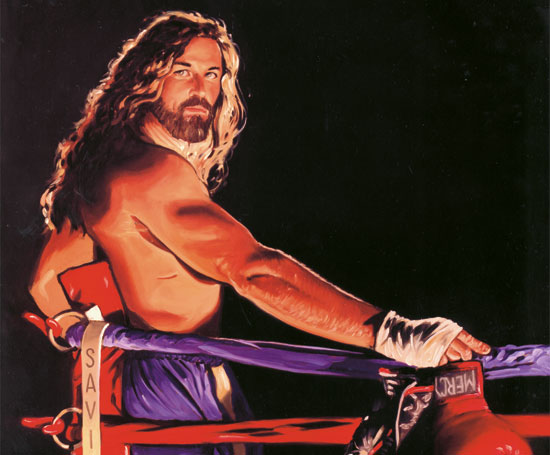

“A Surfer Guy…Built Like A Brick Shithouse”

Jesus_Boxer

by Zack Beauchamp

That's how Stephen Sawyer describes his drawings of Jesus, part of a growing movement to "defeminize" the man's image:

No more cissy Kumbaya stuff. In this testosterone-fuelled theology, the Saviour finally has the rippling biceps he would have developed as a carpenter from a working-class home in Nazareth. The macho Jesus movement has been bolstered by books like No More Mr Christian Nice Guy and The Church Impotent – the Feminisation of Christianity. But it's artist Stephen Sawyer, whose paintings of the Son of God as a tattooed biker and boxer have captured the imagination of Christian men searching for a more manly role model. As Kentucky-based Sawyer, 58, points out: "I scarcely think Jesus could have overturned the tables of the money-lenders and driven them from the temple if he was a wimp.

Adam And Eve Did Not Literally Exist. Period. Ctd

by Chris Bodenner

A reader writes:

I realize this thread is pretty much closed, but I tripped over an encyclical issued by Pope Leo XIII and some lines from the Catholic Catechism that are somewhat relevant. Leo XIII's contribution is from Providentissimus Deus, which was largely focused on reconciling scientific advances with Biblical scripture:

no real disagreement can exist between the theologian and the scientist provided each keeps within his own limits. . . . If nevertheless there is a disagreement . . . it should be remembered that the sacred writers, or more truly ‘the Spirit of God who spoke through them, did not wish to teach men such truths (as the inner structure of visible objects) which do not help anyone to salvation’; and that, for this reason, rather than trying to provide a scientific exposition of nature, they sometimes describe and treat these matters either in a somewhat figurative language or as the common manner of speech those times required, and indeed still requires nowadays in everyday life, even amongst most learned people.

The Catechism states, variously:

The account of the fall in Genesis 3 uses figurative language, but affirms a primeval event, a deed that took place at the beginning of the history of man.

This is one of the few instances I can think of where official dogma does not simply allow, but confirms, figurative language in Biblical scripture.

Methodical research in all branches of knowledge, provided it is carried out in a truly scientific manner and does not override moral laws, can never conflict with the faith, because the things of the world and the things the of the faith derive from the same God. The humble and persevering investigator of the secrets of nature is being led, as it were, by the hand of God in spite of himself, for it is God, the conserver of all things, who made them what they are.

These are official lines from the Catholic Church – I think Catholic blowhards would be wise to remember this, and I think people like Dawkins and Hitchens would be wise to acknowledge this.

Learning From Pain

by Zoë Pollock

In an interview about her recent book on grieving Meghan O’Rourke quotes T.H. White’s The Book of Merlin:

The best thing for being sad is to learn something. That is the only thing that never fails. You may grow old and trembling in your anatomies, you may lie awake at night listening to the disorder in your veins, you may miss your only love, you may see the world about you devastated by evil lunatics, or know your honor trampled in the sewers of baser minds. There is only one thing for it then – to learn. Learn why the world wags and what wags it. That is the only thing the mind can never exhaust, never alienate, never be tortured by, never fear or distrust and never dream of regretting.

She took his advice to heart:

One thing that happens with loss is that I think people feel — I know I felt — the utter fragility of the world. I felt like it could all disappear at any time. Learning became the stay against that. I ended up feeling there was one thing the world couldn’t take away and that was my curiosity, my desire to understand. I just ended up reading and trying to learn. It was a recuperative thing in the midst of all this pain.

Why Are The Non Religious On The Rise?

by Patrick Appel

One theory:

Michael Hout and Claude Fischer, sociologists at the University of California, Berkeley, claim—and I think they are basically right— that [the large increase in non-believers since 1990] is part of the reaction to the religious right’s rising visibility in the 1980s. That is, before 1990, people who were raised, say, Catholic or Baptist, but were socially and politically liberal and already religiously inactive, would still be comfortable enough with their religious background to tell a pollster they were Catholic or Baptist.

And then they saw all this conservative politics happening in the name of religion, in the name of their own religion maybe, and said, “You know what, I’m not that.” It pushed them across the line. They were less comfortable affiliating with the religion in which they were raised. Now, they are more likely to respond to a religious preference question by saying “none” because that is a way to say, “I’m not like them.” Again, we’re talking about the most religiously inactive people anyway. That’s one hypothesis for at least part of the trend.

Where We Confess

Reconciliation10-Our_Lady_of_Angels

by Zoë Pollock

Rosecrans Baldwin interviews photographer Billie Mandle about her project Reconciliation:

I have always been fascinated by the way confessionals become containers—holding people’s voices and secrets. … [O]ne of the things I found interesting was that the confessional is meant to point away from itself, to be invisible. The small rooms should draw the penitent into introspection, which is why most confessionals are completely dark.  When the project started I liked the idea of trying to photograph spaces that are meant to be ignored.

(Photo: Our Lady of Angels)

Grief In Real Time

by Zack Beauchamp

Dennis Whittle had just started writing a series of 100 blog posts appreciating the people who had helped him most in life when his mother died unexpectedly. His first post in the series became her eulogy:

To say my mom was an iconoclast would be an understatement.  She came from a hard-scrabble immigrant family that did not know how to provide warmth to children.  For some reason, my mom decided that she would be different, and she set out to create for herself and her kids a life of love and affection.  Sometimes she drove us crazy with her compliments and encouragement, especially since it was never offset with any criticism.  It was only later in life that I realized how rare it is to grow up with such a mother.  Last week my sister found my mom's calendar, and on it was an entry for the following week that said "Wednesday: make sure to compliment [one of my siblings] on her photographs." That pretty much summed up my mom.

Leveraging Looks

by Zoë Pollock

Branching out from Zack's examination of legal protections for ugly people, Jessica Grose interviewed Catherine Hakim. Hakim's a professor of sociology at the London School of Economics and the author of Erotic Capital: The Power of Attraction in the Boardroom and the Bedroom:

The key point is for women to be aware that there's a sex differential and a sex gap in returns and rewards, and to be aware that they should therefore not be holding back or feel embarrassed about seeking to get value for their contribution, for their attractiveness. As I see it, patriarchal men, but also to a larger extent, radical feminist women, which women seem to listen to more than men, say that beauty is only skin deep, it's trivial, it's superficial, it has no value, and you should be ashamed of yourself for trying to exploit it.

Jessica Bennett challenges Hakim's view:

Indeed, attractive women get ahead at work—the beauty premium has been well-documented. But studies show that good-looking women also face a double-bind: punished for being too sexy, both resented by colleagues and viewed as less intelligent or vain. And let’s be honest: who wants to constantly have to wonder, Did I really deserve that raise/promotion/recognition, or did he just like the way my legs look in that skirt?

Reihan explores the connections between erotic capital and racial inequality. A 2008 study noted that in a speed-dating experiment, women were far more likely to express interest in partners of the same race:

When we think of how we might combat racial inequality, we tend to think of large-scale, society-wide interventions, like tough anti-discrimination laws and affirmative action programs. But strong same-race preferences arguably have much larger implications, as they present a social barrier to members of racial minorities that anti-discrimination laws can’t overcome. … Racial preferences devalue the erotic capital of some while enhancing that of others. If we come to believe that erotic capital really matters, we might come to see this phenomenon as a grave injustice.

(Video: Summadayze Colourfornia from Nick Thompson on Vimeo.)