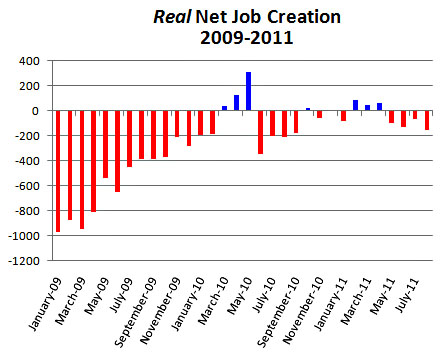
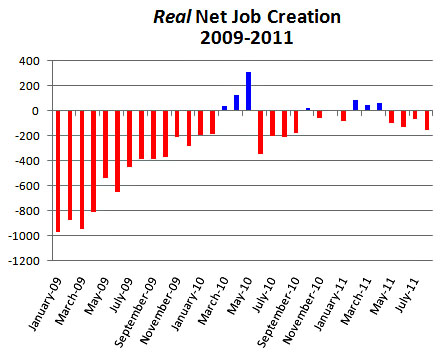
Today on the Dish, the economy boasted zero new jobs for August. Frum and Bernstein went another round on whether the stimulus worked, and we wondered if Congress was going to do nothing about impending spending cuts and tax increases. Palin tried to reassure us she won't be springing a presidential campaign over the holiday weekend, and we weighed what happens if she endorses Perry. Perry insulted our allies, Wilkinson resented Ron Paul for being a posterboy for libertarianism, and Perry's penchant for not commuting execution sentences reaches far beyond Willingham. Shelby Steele earned a Hewitt nomination for turning on Obama, Larison tackled Romney's unapologetic tone, and readers parsed Santorum's Catholicism and his opinions on the American Psychiatric Association. We recalled the recent time in America when the right was for gun control, Matt Lewis grew concerned about the right's obsession with winning, and Timothy Egan connected Prohibition to the Tea Party movement. Matthew Vadum earned a well-deserved Malkin award for connecting welfare recipients, voting and bribery, and Zack and J.F. piled on primal scream policymaking.
Paul Berman reflected on liberalism after 9/11, Bernstein feared an uptick in torture thanks to Cheney's publicity tour, and Joshua Foust chastised Wikileaks for its latest unredacted release. Patrick got the willies from the new 9/11 coloring book, Bryan Appleyard contemplated 9/11 art, and Ai Weiwei described life in an authoritative state. A student spent his summer vacation fighting in Libya, and the visa system is clearly broken when someone has to pay $80K in 12 years for a green card they don't have yet.
Cord Jefferson called out colleges for skewing their diversity numbers with wealthy African immigrants, and a reader shared her own lesson in being pressured to identify an innocent person. Financial advisers should ask us better questions, homeowners aged, loose copyright laws gave us Disney classics, and readers demolished the Preacher who types in tongues. Man leisure-dived in backpack and helmet on bike, Charles Simic relished boredom outside of the technology loop, and we confessed some guilty pleasures.
Cool ad watch here, chart of the day here, VFYW here, MHB here, FOTD here,

Chesterville, Maine, 12.45 pm
Thursday on the Dish, Santorum got frothy over the American Psychological Association, we recalibrated Romney's position on the Mendoza line, and a pro-Bachmann PAC pulled out the big guns (read: attack ad) for Perry. We collected the best reads on Huntsman's new tax plan, Kornacki chalked Perry's success up to the hubris of the GOP, Zack centered in on their blind Christianism, and Austin Frakt reassured us of what the GOP would have to pull off to undo the preexisting conditions reform.
Zack engaged Anne-Marie Slaughter and Joshua Foust on R2P in Libya, and battled Alyssa on True Blood and Games of Thrones. We got the skinny on the Keystone XL pipeline, David Rittgers skewered the DOJ's "Fast And Furious" operation, and all the psychoanalysis in the world couldn't save Dick Cheney from moral condemnation. Ethan Hein exposed our ridiculous copyright system, we contemplated racism and flashbulb memories in police lineups, and Wikileaks sprung a leak. We questioned the numbers behind hospital errors in the US and Europe, and community college exams trump the SAT in high stakes. DC pawned off its cannabis growers onto the federal government, and smart grids could lower the number of blackouts, while the US government picked a solar loser.
Despite all the evidence we still don't know how to make ourselves happy, exercise can treat the depressed if they stick with it, and reading blogs help our brains. A reader shared a heartbreaking story about the flooding upstate, others calculated their Visa fees, and the best way to board a plane is fast but confusing. Some people are addicted to soda, dog-people voted for more dogs in public places, and typing in tongues and leisure diving helped us get through a slow news week.
VFYW here, MHB here, and FOTD here.
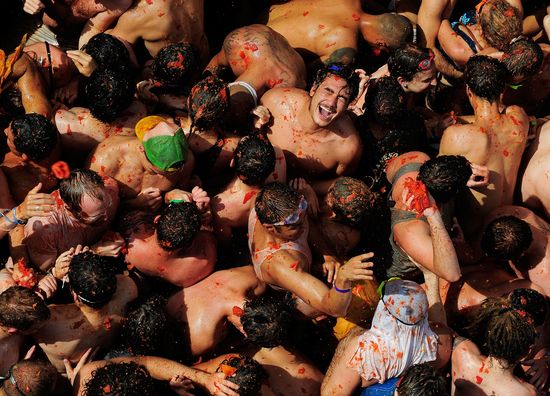
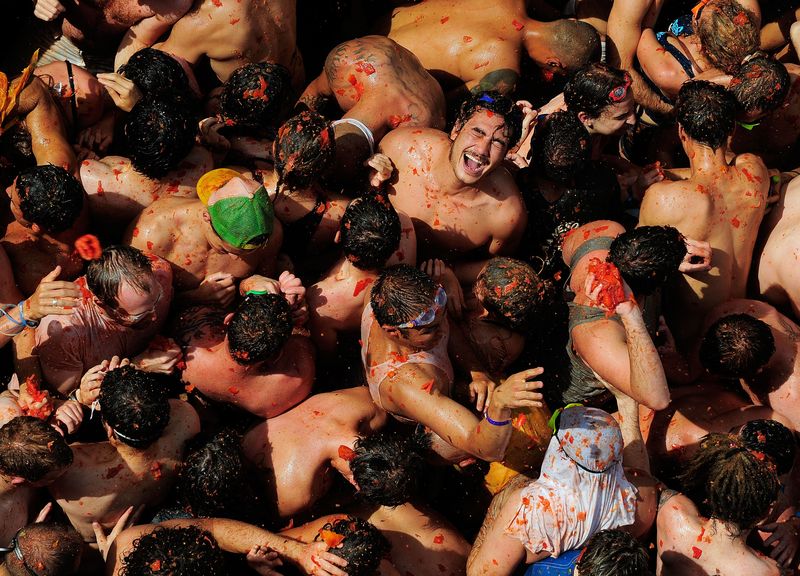
By Denis Doyle/Getty Images.
Wednesday on the Dish, Perry stuck with vague prognostications on foreign policy, we weighed whether he could repeal healthcare reform, and Chait wondered what would take him down. We assessed Perry's instinctive populism, Palin waffled on her appearance at a Tea Party rally this weekend, while some proposed she could be frenemies with Romney. Allan Lichtman predicted Obama won't lose 2012, Tom Jensen disagreed among others, but Steve Kornacki held out hope for the "adult in the room." Jonathan Last reminded us Romney isn't very good at winning elections and Maisie wondered if any candidate would seek the Hispanic vote.
Americans grew less partisan about healthcare reform, we expressed concern for factory jobs lost by technology, and even with the super-committee, the long term deficit didn't look good. The jury was still out on whether the stimulus worked and Ackerman assessed Petraeus' smart counterinsurgency strategy. SCOTUSBlog wrapped up its symposium on the constitutionality of marriage equality, and gay marriage supporters grew, but not in conjunction with pro-choice supporters. Hospitals sometimes make us sick, Wilkinson panned the new MLK memorial, and readers let us know that immigrant visas already cost a good amount.
The NTC opted not to have peacekeepers in Libya, and we feared that the Libyan rebels may be targeting blacks. Streetwalkers in Germany had to buy a sex permit and Alejandro Sueldo analyzed our relations with Russia and China. A Confederacy reenactor shared his sweet, non-violent memories, we burrowed deeper into the infinity hole, and we debated the very serious merits of guilty pleasures.
Cool ad watch here and here, VFYW here, MHB here, and FOTD here.
Tuesday on the Dish, a Marine shared a tender moment with Obama on the end of DADT, and Dan Savage had to coin a new phrase for anti-gay Republicans caught with their pants down. Alex Nowrasteh wanted to charge an immigration tariff for visas, Walter Russell Mead assessed Clarence Thomas' role on the Supreme Court, and Michael Gerson earned an Yglesias award for defending family planning. Irene may not have been over-hyped, and we debated flood insurance provided by FEMA. In international news, John F. Copper thanked Taiwan with saving us from China, and we picked apart our attempts to negotiate with the Taliban. Daniel Serwer brainstormed how to hasten the fall of Bashar in Syria, Ed Carr didn't believe weather causes violence, and we imagined whether the Iraq war would have existed under a President Gore.
On the campaign trail, we brainstormed titles for Michele Bachmann's memoir, Perry's views on Medicare could be a gift to Democrats, and Maisie envisioned the future of imperial conservatism. Yural Levin tried to defend the right's approach to science, Huntsman may not be as moderate as we thought, and bloggers measured Perry's intelligence. Obama's approval rating leveled off at a low point, but calling someone a tea-partier is now an insult for candidates, and American politics devolved into the vacuous.
Friedersdorf listed people whose main crime was trying to sell simple things without a permit, and we debated legal protections for ugly people and the logistics of selling pot in a down economy. A new service matched students to colleges, New York City banned dogs from bars, and John Lennon and McCartney used pronouns differently when collaborating. We glimpsed the future of people voluntarily becoming cyborgs, and analyzed the lasting impact of Steve Jobs on how we look at our own jobs. Perspective is everything when photographing Gambian rats, screwing animals could be just as bad as stewing them, and face recognition software could change the future of photobombing.
Von Hoffman award here, MHB here, FOTD here, VFYW here, and VFYW contest winner #65 here.
Monday on the Dish, in the aftermath to Irene, magic mushrooms bloomed, giant Gambian rats surfaced, and we parsed the reactions of the media and government. Bachmann blamed Irene on bloated government spending (ironically), global warming didn't cause Irene, and the real person behind @Irene remained calm. The right asked Perry to exchange identity politics for some actual policies, Erica Grieder expected him to follow public opinion, and we ran the numbers on a possible independent party bid. We exposed the Islamophobia racket, Peter Beinart eulogized neoconservatism, Zack went after Wehner's attack on the Obama economy, and TNC wasn't having Ron Paul's thoughts on FEMA. Perry compared his brain to chicken pot pie, and Brian Thill dissected the candidates' iconography.
Cameron's support for the Libyan intervention resembled Tony Blair's liberal view, we analyzed the spelling of Qaddafi's name, and we wondered if we'll need a big army if future interventions look like Libya's. The Middle East's bread riots aren't the region's first, one man's story of limbo at Guantanamo stands for many, and the fact that many of the revolutions were leaderless means the future of those countries can be determined in due time.
Humans aren't good at picking people out of a lineup, racists walk among us, and domestic terrorism was curtailed by suspect "preventative" measures. Bisexuality remains taboo even in progressive circles, the history of debt touches on sin and the sacred, and we reviewed a new film on lesbian romance in Iran. Readers connected infinity to Borges and Neil Gaiman and their own terror, attacked junk mail, and didn't want to be your gay best friend. David Sirota was sick of vegetarian foods glorifying fake meat, and Greek yogurt hails from Bulgaria.
Hathos alert here, creepy ad watch here, VFYW here, MHB here, and FOTD here.
-Z.P.




 The Dish