When The Right Was For Gun Control

by Chris Bodenner

In the latest Atlantic, Adam Winkler crafts a concise and compelling history of guns in America. One of the many ironies addressed:

In the 1920s and ’30s, the NRA was at the forefront of legislative efforts to enact gun control. The organization’s president at the time was Karl T. Frederick, a Princeton- and Harvard-educated lawyer known as “the best shot in America”—a title he earned by winning three gold medals in pistol-shooting at the 1920 Summer Olympic Games. As a special consultant to the National Conference of Commissioners on Uniform State Laws, Frederick helped draft the Uniform Firearms Act, a model of state-level gun-control legislation. … Frederick’s model law had three basic elements.

The first required that no one carry a concealed handgun in public without a permit from the local police. A permit would be granted only to a “suitable” person with a “proper reason for carrying” a firearm. Second, the law required gun dealers to report to law enforcement every sale of a handgun, in essence creating a registry of small arms. Finally, the law imposed a two-day waiting period on handgun sales.

The NRA today condemns every one of these provisions as a burdensome and ineffective infringement on the right to bear arms.

Another great nugget:

As the Yale law professor Akhil Reed Amar has observed, “Between 1775 and 1866 the poster boy of arms morphed from the Concord minuteman to the Carolina freedman.”

Then, in one short generation between the 1960s and ’80s, that poster boy morphed from a black urban radical to white rural radical. And who was one of the most consequential advocates for gun control during that shift? Governor Reagan.

Winkler’s whole piece is worth your time.

Did The Stimulus Work? Ctd

by Zack Beauchamp

Jared Bernstein counters Frum:

We see GDP growth, which was almost unprecedentedly negative — down almost 9% in the quarter before the stimulus was passed — immediately falling less quickly, and turning positive by mid-2009. Similarly, we see the same pattern in job growth, which also reversed course soon after passage, and broke zero — net job growth — in March 2010. The addition and subtraction of census workers that year distort the picture somewhat, but they're not included in the private sector data, which presents a clearer view of what happened. The unemployment rate always lags growth by at least six months, but a few months after ARRA kicked in, it stopped growing.

Frum's reply:

Bernstein builds his argument on the assumption that I said the stimulus achieved nothing whatsoever. I didn’t. If I thought stimulus was useless, I wouldn’t complain about its design. There’s no such thing as a good cement boat. There can be such a thing as good fiscal stimulus. But that’s not what we got in 2009. I don’t entirely blame Bernstein for writing as he does. So many people have argued that the stimulus accomplished nothing that it must become almost a reflex in former administration aides to react against the criticism they have learned to expect. They knee kicks too fast for the ears to notice that something different is being said this time.

But I did say something different.

More Dish coverage here.

What Did You Do Over Summer Break?

by Patrick Appel

Chris Jeon fought in the Libyan War:

At first glance, Mr Jeon looked like someone who took a wrong turn on their way to the beach or the Santa Monica Pier. He wore a blue basketball jersey emblazoned with a script “Los Angeles” and the number 44. The rest of his outfit, including army camouflage trousers, a grey-and-black kaffiyeh on his head, clear safety glasses and a bullet hanging on a necklace, came courtesy of the rebels, he said. He had been sleeping in the homes of local families or in the open air with the insurgents.

On Wednesday, Mr Jeon was carrying a Russian-made 12-gauge shotgun, not a typical accessory for a student strolling the country-club campus of the University of California, Los Angeles, where he expects to graduate next May.

Palin Campaign Watch

by Chris Bodenner

Apparently she won't be announcing a bid for the presidency during her nearly-nixed speech in Iowa on Saturday; Palin will merely deliver a "full-throated defense of the tea party". Meanwhile, according to the latest Fox News poll, 71% of Republicans and 66% of Tea Party supporters say she shouldn't run. Scott Conroy, however, hints that she won't heed such numbers and is now setting her sights on Perry:

In her speech at the bucolic National Balloon Classic field in Indianola, Palin will lean on loaded phrases like “crony capitalism” and “permanent political class” in laying out her view of the U.S. political system’s deep-rooted ills, according to a source close to Palin and familiar with the content of the speech. Though she will not call Perry out by name, Palin’s carefully couched rhetoric will leave the impression that she may soon draw more overt attention to one of the Texan’s potential vulnerabilities as a candidate: his history of doling out plum positions and other benefits to generous campaign donors during his nearly 11-year tenure as the nation’s longest serving governor.

Zero Jobs

Aug2011_Jobs

by Patrick Appel

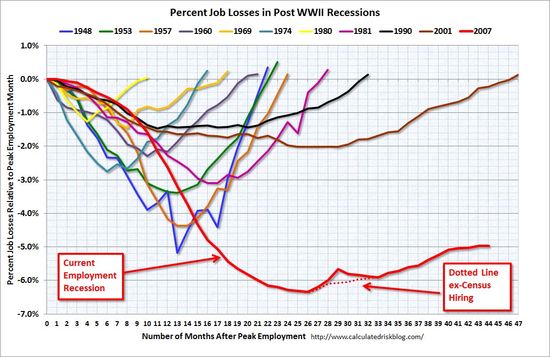
The economy added no jobs in August. Felix Salmon sighs:

You can call this a double dip, if you like, or you can view it as a kind of aftershock of the financial crisis. Either way, the economy is clearly now below its stall speed, and we don’t have access to the mechanisms necessary to get it moving again. That is going to make for poisonous politics, Washington gridlock, and untold human misery among millions of new and long-term unemployed across the land.

Ezra Klein is in a similar mood:

Though the trends might be better than they were in early-2009, the labor market is in much worse shape, and it's clear that more action, and perhaps even big action, is desperately needed. I do not, however, expect that to be the actual response to this news.

Barry Ritholtz disagrees:

Bottom line, the number sucked and looking to the next few weeks we’ll hear more about QE3 and Obama’s jobs plan and the political class will still not understand that short term steroid shots into the economy does not alter long term behavior and a price is always paid when the stimulus wears off, aka debt, taxes and inflation. The US economy needs to FERBERIZED and left alone instead of being attended to every 2 hours.

Catherine Rampell:

There are now 14 million workers who are looking for work and cannot find it; the figure nearly doubles if you include workers who are in part-time jobs but want to be employed full time, and those who want to work but have stopped looking. A broader measure of the unemployment rate that includes these underemployed workers is 16.2 percent.

Mike Konczal:

One thing terrible jobs numbers could do is galvanize public and elite opinion in a way that weak jobs numbers wouldn’t. In the next few weeks, there could be movement in the three major initiatives needed for recovery.

Buttonwood:

Investors are likely to be disappointed, given that the run of data in recent days had appeared to ease fears of recession. The result heaps a lot of pressure on President Obama's jobs speech, due next Thursday, although it is hard to see he can come up with much that will make a difference, in the short-term at least.

Chart from Calculated Risk. More charts on the jobs situation here.

Torture May Return

by Patrick Appel

Cheney's publicity tour reinforces Jonathan Bernstein's fear:

I think we’re likely to see torture and much of the rest of it as unspoken, and perhaps even explicit, Republican party positions going forward. If that’s the case, then people who listen to Rush and watch Fox News are going to share those views. Barack Obama is obviously not the most to blame for that; the bulk of the blame should go first to Dick Cheney and his apologists, and secondarily to Republicans who know torture is wrong and yet don’t speak up. But I do hold Obama to blame for not making more of an effort than he has to date.

Michelle Cottle warns that Liz Cheney is intent on filling her father's shoes:

With her in-your-face promotion of the Cheney worldview, Liz isn’t just defending Dad’s tough-guy ethos; she’s expanding it. In some ways, she is a more impressive—and certainly more impassioned—fighter than the ex-veep.

Hewitt Award Nominee

by Chris Bodenner

"Mr. Obama did not explicitly run on an anti-exceptionalism platform. Yet once he was elected it became clear that his idea of how and where to apply presidential power was shaped precisely by this brand of [post-'60s] liberalism. There was his devotion to big government, his passion for redistribution, and his scolding and scapegoating of Wall Street—as if his mandate was somehow to overcome, or at least subdue, American capitalism itself. 

Anti-exceptionalism has clearly shaped his "leading from behind" profile abroad—an offer of self-effacement to offset the presumed American evil of swaggering cowboyism. Once in office his "hope and change" campaign slogan came to look like the "hope" of overcoming American exceptionalism and "change" away from it. 

So, in Mr. Obama, America gained a president with ambivalence, if not some antipathy, toward the singular greatness of the nation he had been elected to lead," – Shelby Steele, author of the Von Hoffman-esque A Bound Man: Why We Are Excited About Obama and Why He Can't Win (2007). It's disheartening to see someone who once wrote this amazing cover story go off the deep end.

The Bizarre Copyright Takeover, Ctd

by Zoë Pollock

The above video tackles remix restrictions and provides a nice history of how we got lost in the copyright maze. Full transcript here. This seems like a point worth emphasizing:

Remember all the good old Disney movies? Yeah, all of them came from works no longer under copyright protection at the time. The whole of the Disney Empire and all the childhood magic that it produces only exist because there was copyright free work for Walt Disney – you know the guy who actually started the whole company – to rework and update. But the corporate, Waltless Disney was the big pusher of the 1998 life +70 years copyright extension. It made sure that no one could make more popular versions of their movies in the same way they made a more popular version of Alice in Wonderland.