Better Boarding

by Zoë Pollock

Sarah Kliff summarizes a paper (pdf) by astrophysicist Jason Steffen that argues "the fastest way to board a plane is to have passengers line up beforehand in a very specific order":

Trials were run on a mock Boeing 757 parked on a California sound stage. It took 72   passengers 3 minutes and 36 seconds to board a 12-row plane using this technique. … Every minute a plane spends at a terminal costs $30, according to a recent study. Steffen estimates that if airlines implemented his boarding method they could save $110 million annually, netting the industry an extra $1 billion in total.

The Government Picks A Loser

Solyndra_Loans  

by Patrick Appel

Solyndra, a solar startup which was awarded a $535 million dollar federal loan guarentee in 2009, has filled for bankruptcy. Ucilia Wang provides backstory on the challenges Solyndra faced. The takeaway:

By its nature, the loan guarantee program picks winners and losers, offering some companies an edge in the market with its guarantees, while companies that don’t receive the loans are at a disadvantage. That could work OK if the [Department Of Energy] was really good at picking winners. But when the first company out of the lot crashes and burns so roughly, clearly the selection process hasn’t been all that great.

Amanda Peterson Beadle blames Chinese competition:

Energy Department officials cited China’s billions of dollars in subsidies to solar energy companies as one factor threatening American firms. The price of a solar array has dropped, decreasing the profit margins for solar cell manufacturers, while Chinese subsidies have increased rapidly.

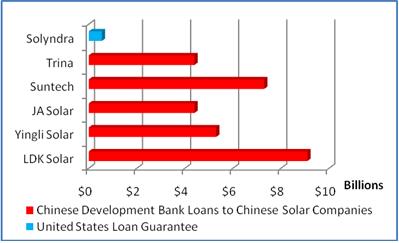
Along the same lines, Green Tech Media posts the above chart:

Clearly, China is providing tens of billions of dollars in low-cost loans to Chinese solar companies. This chart is a bit misleading because the U.S. DOE loan program has spent more than $40 billion on a portfolio of greentech firms and approximately $10 billion on solar. The difference is that, to some extent, the U.S. is betting on new, unproven technologies, while China is banking on the expansion of proven crystalline solar technologies.


So, About This Pipeline…

by Zack Beauchamp

The Obama Administration seems set on building the Keystone XL pipeline, which has created quite a furor. Dan Stone explains the basics:

[The environmentalists'] issue is a new project know as the Keystone oil pipeline that would transport oil from Canada’s tar sands fields to refineries in the Gulf Coast. The State Department has given the environmental go-ahead for the project, leaving it to the president to make the final decision. But environmentalists like McKibben see it as an expansion of America’s dependence on dirty fuels and are trying to pressure President Obama to nullify the permit and halt the Keystone project.

Mark Engler summarizes the Green left's uprising:

The protests don’t need to become front-page news in order for them to have an impact. McKibben correctly notes that the primary effect of this advocacy is to raise the stakes for Obama in terms of his support among his base in the environmental community.

Walter Russell Mead makes the case in favor:

Here’s what the greens ignore: the oil is coming out of the ground whether or not the US allows a pipeline to be built.  The Canadians want to produce it, and if we don’t buy it, the Chinese will.  The pipeline that would take the dirty tar sands oil from Alberta to Canada’s Pacific coast would pass through pristine Rocky Mountain wilderness, across land belonging to some of Canada’s last native tribes, to the beautiful British Columbian coast, home of the amazingly rare “Spirit Bear” and one of the world’s few temperate rain forests, loaded on supertankers and shipped through treacherous coastal waters, very near where the Queen of the North lies on the ocean floor, rusting and leaking diesel fuel, a testament to the perils of sea navigation in these waters. But don’t take my word for it: read it in National Geographic.

Lawrence MacDonald looks at the international implications.

Picking Someone Out Of A Lineup, Ctd

by Patrick Appel

A reader sums up research on the unreliability of memory:

Although racism may infect certain aspects of lineup procedures and lead to more misidentifications, we are not particularly good at remembering anything even when racism is not involved. Psychologists who study memory call memories for important or exciting events, "flashbulb memories," so named because the holders of these memories believe their memories are so accurate that they have a perfect picture in their minds of the events that transpired, as if a flash went off in their brains to capture the memory.

The quintessential flashbulb memory is of the JFK assassination. People always claim to know exactly where they were when they heard the news. Psychologists wondered whether people's memories were really as accurate as their confidence suggested and also what makes people so confident. Many studies have followed in which researchers interviewed people right after a big, exciting event (the Challenger explosion or the OJ Simpson car chase or verdict, for example), recorded their memories, and then interviewed the people again months or even years later to determine whether they still have accurate memories. Researchers almost always find that people are not as accurate as they think they are, and everyone is usually completely confident their memories are accurate.

Researchers are not quite sure what causes us to have so much confidence in our memories, but it does seem that the more dramatic the event, the more confident we are in our memories of it. Some researchers have suggested that the same principles would work if you witnessed a crime. While your memories of the details of a crime might be no more accurate than any other event, you might think you absolutely remember everything, just like we do with flashbulb memories.

To give you an example of how bad our memories are, I will tell you about a woman we called for my college psychology thesis. We interviewed people within one week of 9/11 and then again 4 months later. One woman told us in September that she was in her North Carolina kitchen when she heard the news about the towers in NY. When we called her back in February, she told us she was on a plane to Arizona when she heard the news. In February, we asked her to rate her confidence in the accuracy of her memory on a scale from 1 to 10. She was a 10, meaning she believed with 100% accuracy that she heard about 9/11 on a plane to AZ, not in her NC kitchen.

Another reader shares a personal experience:

I was mugged once some years ago and was called in for a line up. It was night, the mugger was wearing a hoodie and for most of the time during the mugging there was a street light behind him. When I went in to the line up, I said I was 90% sure it was number 5. The officer questioned my 90% saying "Are you sure you're just 90% sure? We know it's the guy". I stuck to my 90%. I simply wasn't 100% sure and explained why (night, hoodie, street light).

After doing the line up, I was taken into an office with a detective to make a statement. When I got to the 90% sure thing, the detective started to get pretty agitated.

So, he stops the tape recorder and starts grilling me about my insistence on not saying I was sure it was the mugger. He got really angry and then said, "Don't give me that bullshit! We know it's the guy. Just say it's him, damnit!". He turns the tape recorder on and again I say I was 90% sure. So, he gets visibly angry, turns off the tape recorder and storms out of the office telling me I can get the hell out of there.

This was all for a string of muggings where no one got hurt and the total take was maybe $100. I wonder what kind of pressure law enforcement puts on eyewitnesses and victims of higher crimes.
Is Rick Perry Unstoppable? Ctd

by Patrick Appel

A pro-Bachmann Super PAC is gunning for Rick Perry. Ben Smith dubs it the first attack ad:

Unlike other pundits, Tim Robinson isn't ready to anoint Perry the likely winner. Joe Klein gives Romney free advice:

[Romney's] real test is going to come on the role of the federal government in American life. John Kerry won his nomination because Dean flamed out, but Kerry remained a weak candidate because he couldn’t quite make up his mind about the most important issue in 2004–the Iraq war. Sooner or later, Romney is going to have to make clear where he stands on the role of Washington–from no-brainers like Social Security and Medicare to more difficult questions (for conservatives) like whether or not to have a Department of Education, whether to have an Environmental Protection Agency, whether to have a Consumer Finance Protection Bureau.

Should We Charge For Immigrant Visas? Ctd

by Chris Bodenner

A reader writes:

I haven’t felt it necessary to chime in on this matter, because I mostly agree with the initial set of responses that came in.  The various filing fees, biometrics fees, anti-fraud fees, premium processing fees, training fees, etc. already constitute a “tariff” on visa applicants.  That being said, the second reader response you just quoted contains so many incorrect statements of fact.  And as an immigration attorney, I can tell you misinformation is one of my biggest enemies.

First, the fees for a fiancée visa petition and an application for adjustment of status do not come close to $5000.  It is exactly $340 for the fiancée visa plus $1070 for the adjustment of status application (which includes the work permit fee), plus miscellaneous fees at the consulate.  To exaggerate the true cost of these petitions doesn’t serve to forward the debate. 

Second, the medical exams are not exorbitantly priced, though admittedly they are not usually covered by insurance.  Depending on where you are, medical exams cost around $150-$500 (and if you’re paying more than that, I have a bridge to sell you). 

Third, students do not have renew their visas every year.  Student visa status is what is known as "duration of status", meaning that as long as they are enrolled as full-time students, they are maintaining lawful status.  Visas (as opposed to status) which are needed only for returning after travel abroad, are usually valid for five years.

Fourth, with regards to H-1B visas, employers who withhold monies from employees to compensate for legal fees and filing fees are VIOLATING THE LAW.  The employer can be subject to fines and penalties, as could be barred from hiring other foreign workers. 

Details aside, your reader’s conclusion is a fair statement.  Immigration is a very expensive and complicated endeavor and is fraught with countless pitfalls.  The complexity of our immigration system is second perhaps only to the tax code, and in many ways, even more complex.  The complexity serves to deter qualified and desirable applicants from even trying to maneuver their way through the system.  It deters not only the poor, but the desirable middle class.

The same reader writes back:

Oh boy, I just got to the third quoted reader response… immigration lawyers lobby to keep the system complex!?!?  That’s absurd. The American Immigration Lawyers Association (AILA), representing over 10,000 members nationwide, has consistently (though perhaps not very effectively) lobbied for comprehensive immigration reform.  It is widely accepted among members of the bar that the system is broken.  Moreover, we make money by starting and finishing cases in a quick, efficient manner.  We do not make money trying to negotiate the complex system that exists now – those are the cases where we LOSE money.

Debating Cheney

by Zack Beauchamp

FP has a fascinating roundtable on Dick Cheney's tenure in office. James Traub attempts psychoanalysis:

Cheney, unlike Bush, was an unillusioned man. He did not believe that American missiles could seed the barren soil of Iraq with liberal democracy (though he did believe that Iraqis would strew petals on arriving U.S. tanks). He does not appear to have believed that God was guiding his hand — the kind of magical thinking that Bush taught us, by example, to fear. Cheney was not transfixed by such lights; and yet he was transfixed by something dark. Perhaps it was what journalist Ron Suskind called "the one percent doctrine": the belief that America could not afford to take even a 1 percent risk of attack. But that was Cheney's own formulation, rearranging the tangled sheets of his nighttime fevers into the semblance of a well-made bed.

Elliot Abrams counters, unconvincingly:

Cheney fervently believed that America was at war after 9/11, and this belief led him to the conclusion that America must fight and win. Such a conviction would have been commonplace after Pearl Harbor but was less so in the years after 2002 — and especially as the wars in Afghanistan and Iraq became unpopular. Many politicians would have flinched, adjusted, tacked; in fact, many did. Cheney refused, and for this he suffered caricature as a warmonger, torturer, and fanatic. Or perhaps suffer is the wrong verb, for though the attacks came they usually made him grin, not grimace. He did not much care, for he thought far more was at stake than his approval ratings.

There's a distinction between conviction and mind-warping obsessions. Abrams uses generalities like "fight and win" for a reason. Cheney's "convictions" about torture and Saddam's tight connection weren't laudably strong moral beliefs – they were theological commitments immune to actual evidence.


Typing In Tongues

A-prayer-post-from-juanita-bynums-facebook-page-is-shown-in-this-screen-capture

by Chris Bodenner

An Internet first? Slog commenters aren't holding their fingers. Fnarf:

Is this called "typing in fingers"? Because I don't think she was using her tongue. God, she probably was — and I probably have to go help her with her computer soon, knowing my luck. Thank Jebus for Clorox hand wipes.

(Hat tip: Joe My God)

Update: A hashtag is born.

How Hospitals Harm Us, Ctd

by Patrick Appel

Kevin Drum backs up this reader:

[A] few years ago the CDC estimated 99,000 deaths per year out of 1.7 million [hospital acquired infections(HAIs)], a mortality rate of 5.8%. For the EU, the European Centre for Disease Prevention and Control estimates 146,000 deaths per year out of 4.5 million HAIs, a mortality rate of 3.3%. That's a modest difference, and it gets even more modest when you read more about these estimates, which are very, very rough and depend strongly on exactly how you count infections and how you attribute deaths.