
Themes In Fantasy

by Zack Beauchamp

Alyssa Rosenberg has an interesting piece explaining why Game Of Thrones is a better adaptation than True Blood:

It's entirely possible that as future seasons of Game of Thrones tackle Martin's progressively longer and more complicated novels, the show will have to dramatically streamline narratives and make corresponding revisions in plots to tie events together in a plausible way. But thus far, the Game of Thrones showrunners have demonstrated something that the people behind True Blood haven't: a sense of what makes a franchise compelling beyond its basic concepts.

She follows up here. Her argument also usefully explains another problem with True Blood: its thematic incoherence. Alyssa argues (and I hope she's right here, as I haven't read the books) that Alan Ball tries to introduce a lot of thematic content in True Blood that's not in the novels, whereas Game of Thrones sticks to the same general themes as the paper version. Alyssa argues that it caused him to rush through the world-building element, but having to balance the two could conceivably have also left the thematic elements half-baked.

For example, though the show draws numerous parallels between vampires "coming out of the closet" and the struggle for gay equality, Ball denies any attempt to make the vampires into metaphors for gays. If anything, as the embedded clip suggests, they're pretty good stand-ins for meat eaters in a pro-animal rights argument. But the show never explores that issue, stumbling along with incoherent gay-rights undertones and lots of trashy, enjoyable nudity.

P.S. Alan Ball, if you're reading this, I still enjoy your show! Don't give up on naming a character after me!

Picking Someone Out Of A Lineup, Ctd

by Patrick Appel

Room For Debate continues the discussion about the unreliability of eyewitness testimony. Sandra Guerra Thompson fingers racism:

Wrongful convictions because of erroneous identifications have mostly involved innocent African-American men. This is partly because of the group’s disproportionately higher rates of committing violent crimes. But that does not begin to explain the disparity. Racism can infect the investigative process — from how much care is taken to arrest someone fitting the description given by the victim, to the degree of police suggestion used with eyewitnesses, to the care or fear shown by eyewitnesses in making their selections.

Racism surely plays a role in some cases, but there is a more basic reason for misidentification of black men by white victims: we have a harder time remembering the faces of people from racial groups we don't have much contact with.

Wikileaks Wikileaked

by Zack Beauchamp

Revolutions, devour, children, summat:

WikiLeaks on Thursday confirmed reports that it has lost control of a cache of U.S. diplomatic cables that it has been publishing in recent months, saying a security breach has led to the public disclosure of hundreds of thousands of the unredacted documents…The fracas has put WikiLeaks in the position of decrying what it called the "reckless" and "negligent" disclosure of information—something WikiLeaks' critics have long accused it of doing itself.

Der Spiegel breaks down the hows and whys of the situation. Unfortunately, this isn't just fun and games – as the WSJ write-up notes, some of the unredacted cables explicitly name confidential informants, who are now seriously at risk. But the irony here is still worth noting.

Should We Charge For Immigrant Visas? Ctd

Stack

by Chris Bodenner

A reader writes:

In addition to the upfront visa and legal fees, as a worker here in the US (technically on a "non-immigrant visa") I pay thousands of dollars each year into Social Security and Medicare, for which I won't be eligible until I have spent ten years here.  I won't get that money back when I leave; and short-term workers (under 18 months), or those from countries without a totalization agreement with the United States don't receive Social Security "credit" for that money when they return to their home country (a list of those countries that do have the agreements here).  Being a pinko leftist type, I don't object to paying into these programs, but the blithe assumption that an immigrant visa doesn't have any adverse financial consequences isn't right either.

Another writes:

This is was clearly written by someone that has never actually had to deal with the US Immigration System, because there already are tariffs on US Immigration. In my own case, I married a European woman. The fees alone for the temp fiancee visa, change of status, work permit, green card, and numerous bio-metric checks were over $5,000.

And those fees have increased since we went through the process. This amount does not include the costs of lawyers to make sure we did everything "legally", the costs of medical checks which can only be performed by special exorbitantly priced doctors, or the lost income that resulted from a pile of lost paperwork that delayed my wife's work permit for five months.

I don't know the details of other forms of immigration, because I haven't the same experience with them, but I do know students pay every year to renew their visa on top of the initial filing fees. I also know that in some case with an H1B workers permit, the company pays many of fees for filing and lawyers by withholding a percentage of the employees check. 

So immigration is ALREADY a hugely expensive endeavor, something that people spend large portions of their savings to accomplish. Raising the price even more might allow for more highly-educated people to immigrate, and I would welcome that, but you would also shut out the poor, who will increasingly not bother to apply for immigrant status to fill a sub-minimum wage job.

Another sends the above photo (blurred to ensure anonymity) and writes:

As a recent green card recipient, I believe that mostly the bureaucracy behind immigration is broken. Attached is my green card application. Shockingly, there are less than 10 pages of only three government forms; the rest is evidence/attachments. It cost me about a year to assemble. It literally cost me my job. THIS IS INSANE. Andrew had his own share of bureaucratic insanity. There has to be a better, smarter way to check whether people meet the very reasonable criteria that the US request of immigrants (are they smart, are they not terrorists, are their skills high and necessary, etc.)

A main reason why the process is so insanely complicated is that lawyers lobby well to keep things are complex as possible. They do the same in the patent and financial industry. Oh, and by the way, there is already a price on immigration. In my case, about 5 grand. For most people, about $10-12K.

Another:

You ask if we should charge for visas … the answer is "no."  (It was originally a two-word answer and the first word was quite impolite.)

Charging for visas effectively means it is impossible for poor immigrants to come to the US and have a chance at a better life.  Rather than "give me your poor, your huddled masses, yearning to breathe free", it is "give me your wealthy, well-educated elite, yearning to make a few extra bucks."  It flies in the very face of who we believe we are as a people.  So many Americans can tell you a story about a parent, grandparent, or great-grandparent coming here with little more than a suitcase full of clothes and going to work at some menial job and eventually opening up their own shop, buying a home, raising a family, seeing their kids go to college, their grandkids go to medical school…

Maybe it's because I'm the son and grandson of immigrants (and on the other side only a couple generations removed from sharecroppers), but I could not begin to fathom why people are so intent on changing something that so many of us believe is a fundamental part of who we are as a people. 

Another:

Despite living here for the past six years (switching between three types of visas), despite graduating with honors here in New York, despite getting straight As in several American history classes, despite watching every single episode of Colbert and Stewart since 2005, and despite assimilating pretty well (as my American friends can attest to), I am still not eligible for immigration status.

So yes, I would welcome a price tag for becoming an immigrant. You've put a price on everything else anyway, so why not this? At least let me get a sense of how hard I need to work in order to get in. Give me hope I'll be able to work my way to become a citizen. Name your price, America.

Could President Perry Repeal Health Care Reform? Ctd

by Patrick Appel

If the GOP takes the Presidency, the House, and Senate they could undo much of the Obama's health care reform law, but without sixty GOP votes in the Senate, Austin Frakt says the "the insurance regulations," which "require insurers to take all comers, independent of pre-existing conditions," aren't going anywhere:

Klein is right that the GOP could pull off the partial repeal he describes. However, practically speaking, one other thing (or set of things) must be in place for them to actually do it. It requires that powerful, interested groups back it. Oh sure, technically, Perry, McConnell, and Boehner don’t require the approval of hospitals and insurers, among others. But, realistically, if those three leaders are controlling the government and if they want their party to remain in power, they can’t cross these interest groups.

Mitt Romney Is Bad At Politics, Ctd

by Maisie Allison

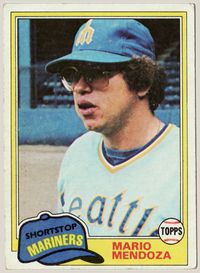
Thanks to the many readers who've pointed out that Romney's electoral average is actually above the Mendoza line. Aaron Goldstein has more:

Last characterizes Romney as being "far below the Mendoza Line" when, in Mendoza tumblr fact, Romney is slightly above it. If we take Romney's 5-18 record as a batting statistic, it means Romney has gone 5 for 23 which translates into a batting average of .217. Even if Romney isn't actually below the Mendoza Line, he is far too close to it. A .217 batting average would only be acceptable if a) you are a National League pitcher or b) are a prodigious homerun hitter like Dave Kingman. In 1982, while with the New York Mets, Kingman batted only .204 but slammed 37 homeruns and posted 99 RBI…I think it would be fair to say that Last thinks of Romney as neither a National League pitcher nor a power hitter. Suffice it to say, Mendoza hit only four homeruns during his entire big league career.
Chait, vigilant proprietor of Romney Death Watchcomes to Romney's defense:

Running as a Republican in Massachusetts is hard. Rick Perry couldn't win statewide office there if he were running against Lee Harvey Oswald…Romney is a below-average presidential nominee, but that this has been obscured by the competition, which he towers above. Rick Perry would be a really bad nominee, and Michelle Bachmann a horrible one. In 2008, I considered Romney the weakest possible nominee of the Republican field. Now he's the strongest, and not because he's done anything better. 

Larison disagrees with Scott Galupo's analysis, arguing that Romney can successfully attack Perry both from the left on entitlements and from the right on immigration:

Positioning himself as the defender of entitlements and borders isn’t that strange of a combination. This is a fairly logical combination for someone running to be the nominee of a party with large blocs of elderly voters and opponents of liberalized immigration laws. It is certainly unimaginative, and no one is ever going to say Romney shows political courage, but that doesn’t mean that it can’t work. Besides, how better to describe Romney than as a “highly unusual creature”?

(Image: Mario Mendoza, via The Derrick Coleman Awards.)

The Bizarre Copyright Takeover

Copyright_Maze

by Maisie Allison

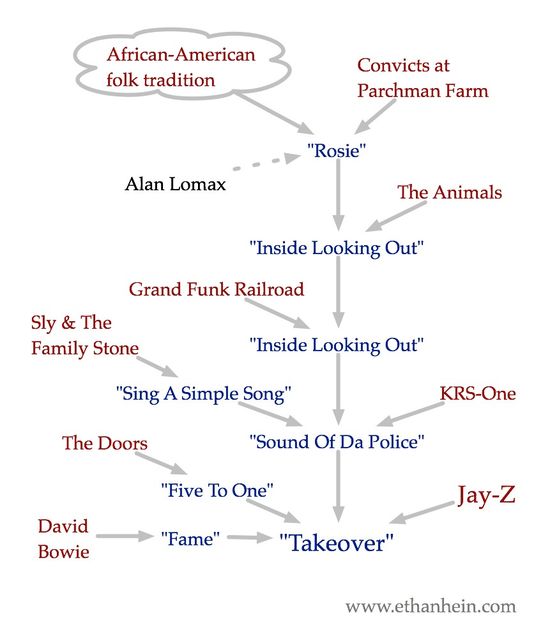
Ethan Hein shows how the folk music collector Alan Lomax, who first recorded and published the song "Rosie," became a legal co-author of Jay-Z's "Takeover." Hein's takeaway:

The copyright maze is no obstacle to Jay-Z — he has the money, lawyers and connections to clear whatever he wants. But what about up-and-coming or unheard-of artists? What if they want to use samples? …[G]rateful as I am to Alan Lomax for recording and disseminating so much great folk music, I remain baffled as to why he was allowed to copyright it. Our creative heritage deserves better stewardship than our current laws provide.

(Image by Ethan Hein. Hat tip: Jesse Walker.)

The Unorthodox Politics Of The Payroll Tax Reduction

by Maisie Allison

Joseph Lawler refutes Bruce Bartlett's case against extending the payroll tax cut (surprisingly, Bartlett's with congressional Republicans on this one): 

[A payroll tax cut] would put money in the pockets of the most liquidity-constrained workers. The payroll tax falls heaviest on low-income workers, many of whom, Republicans are increasingly fond of reminding us, pay little or no income tax — meaning that income tax cuts won't help them. And while it may be true that the recipients of the payroll tax rebates will save the funds instead of spending them, it's not clear to me why exactly it's so much more desirable to have people spend money rather than pay down their debts. The sooner households can crawl their way out of indebtness, the sooner consumer spending will rise.

Steve Benen sympathizes with Bartlett's logic but concludes that given political circumstances, the tax break represents a tactful approach to modest fiscal stimulus.