The Best Investment You Can Make

Education_Over_Time

Derek Thompson fears for the undereducated:

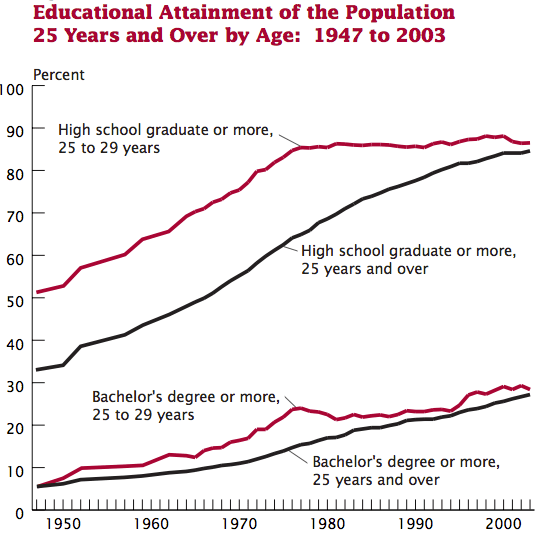
Why should we care that people go to college? Because in a world of immense risk, higher education might be the last slamdunk bet. Seven of the ten fastest growing jobs in the next 10 years require a bachelor's degree or higher. Each additional level of education correlates with lower unemployment rates and higher earnings. Employment for workers with Masters, professional, or associates degrees are expected to grow almost twice as fast as the overall job market in the next decade. The benefits of college are quite clear.

James Joyner agrees. Chart via Kay Steiger.

Socially Transmitted Snacking

Sarah Kliff summarizesnew study:

Drinking alcohol and eating snacks are far and away the most transmittable food behaviors, the longitudinal study finds. In fact, they’re the only food categories in which friends influence one another’s eating habits. Spouses, meanwhile, transmit these eating habits alongside many others: being healthier, avoiding caffeine, and consuming meat and soda. Brothers stand out as the only social relationship studied in which alcohol consumption wasn’t transmitted, but meat-eating was. For sisters, just alcohol and snacks came up as socially transmissible eating habits.

The Fertility Gap

Sharon Lerner breaks down our widening class divide. She warns that "the rates of unplanned pregnancies and births among poor women now dwarf the fertility rates of wealthier women":

The declining fertility of professional women ought to be sounding an alarm, highlighting the extent to which our policies are deeply unfriendly to parents. Low birthrates in Europe have inspired a slew of policies designed to make it easier to simultaneously work and parent, yet here, because our overall birthrate is robust, we've had no such moment of reckoning.

The Internet Won’t Kill Cities

Timothy B Lee compares urban density to free trade:

[O]nline communication isn’t a good substitute for face-to-face interaction. We’re both happier and more productive when we’re interacting with other people in person. And so high-density development patterns have the same kind of productivity-enhancing benefits that free trade does. Tall buildings, walkable neighborhoods, and a good transit system reduce the average cost of face-to-face interaction in exactly the same way that steam ships and low tariffs reduced the average costs of shipping goods to the other side of the world. In both cases, the result is greater wealth, on a per-capita basis.

The Daily Wrap

GT_PALINPEEKING_110927

Today on the Dish, Palin threatened to sue McGinniss but realized she'd have to go under oath and take a DNA test about Trig. The left continued to cower rather than challenge McGinniss' claims, and a Canadian rock band considered selling TeaParty.com for $1 million. Andrew's jaw dropped at the poisonous hate in the book Mearsheimer blurbed, and sadly prepared for the euro's collapse. On the election front, Andrew analyzed why Romney still struggled to win trust within his own party, opened fire on Perry's immigration stance, and tried to undermine Obama with his Believe In America slogan. Perry underwent lip-reading service to hilarious effect, we assessed his leadership weaknesses, and Dan Amira deflated the Chris Christie hype.

Readers poked Andrew about the new Ask him Anything feature, and he shared why P town is a sacred place for him. Readers challenged Hitchens and others on America's penchant for the death penalty, and readers defended Kevin Smith's independent tactics and connected Harvard's kindness pledge to Aristotle and Emerson. Our mission in Afghanistan was all but doomed to fail, and seven months after Egypt's revolution, the country was still waiting for its "free, democratic system." Global warming won't hit most of the countries guilty of giving off greenhouse gases, we debated why dictators last longer than democratic leaders, and dark-skinned Libyans weren't past the war.

Half of all American Jews doubt God's existence, we analyzed whether it's right to be prejudiced against someone for their accent, and Christianism persisted in politics. Obama ably handled a Christianist heckler, and Keith Hennessey complained about Mr. Suskind ability to quote him. Banks needed to be taken down a notch, and we tried to parse whether an insouciant trader was part of a hoax or just horribly real. Medicare fraud robs taxpayers of an estimated $48 billion, cul de sac living endears itself to children playing in the street, and most service jobs aren't located downtown. For some gay servicemembers, the telling wasn't as important as the elimination of fear, and harassment can add up. Water balloons were no match for some faces, technology reconstructed the images that play in our minds, porn boosted Tumblr's numbers, and David Foster Wallace predicted the facial substitution feature.

Creepy ad watch here, FOTD here, MHB here, VFYW here, and VFYW contest winner #69 here.

–Z.P.

(Photo: Former Alaska governor Sarah Palin peeks from behind a curtain before speaking during the Tea Party of America's 'Restoring America' event at the Indianola Balloon Festival Grounds on September 3, 2011 in Indianola, Iowa. Former Alaska governor Sarah Palin headlined the Tea Party of America's 'Restoring America' event. By Justin Sullivan/Getty Images.)

A Fate Worse Than Death Penalty?

A reader writes:

The comparison one of your readers made between euthanizing a person and euthanizing a dog fails to consider one of the most prominent differences between man and dog: self-awareness.  If dogs are self-aware, it is to a significantly lesser degree than humans, and that is what makes the death penalty such a feared, and inhumane, punishment. If execution is a kindness compared to life in prison, as this reader asserts, why do so many alleged criminals agree to pleas just to get execution off the table, and why do so many death row inmates continue to press to have their sentences commuted to life in prison?

I watched an episode of some crime drama – I cannot recall which one – in which a young criminal was executed by lethal injection. As he lay on a steel table, with the tubes hooked up to his veins, the criminal tapped his fingers on the metal, as though he could will himself to resist the deadly effects of the drugs he was receiving. While fictional, I found the perspective credible. I find it difficult to contemplate no longer being part of the world – being nothing. Why else would so many people describe a good death as one where the deceased passed away "peacefully" in their sleep other than our recognition of how disturbing it is to realize that your death is imminent?

Many people who have spent a long time in prison – who no longer cling to any hope of a miraculous release – decide to do some good with their lives. Others strike up new relationships through correspondence, and still others learn to live this new, severely restricted version of their life. I imagine that just as many people not in prison get up at least five days a week to spend 8 or 10 or more hours at a job that they find personally unfulfilling, lifelong prison inmates make it through the daily drudgery of their lives and learn to enjoy the time they have to choose their own pursuits, whether it is reading, working out, socializing, or watching television. Punishment for these prisoners is often solitary confinement.

The world is replete with examples of people who want to live despite what many of us would consider horrible circumstances – the woman in Austria, locked away in a basement by her deranged father; Stephen Hawking, left only with the use of his brilliant mind; the woman whose face and hands were destroyed by a chimpanzee; the hiker who cut off his own hand, rather than perish. Prison sounds like an awful place, but I'd rather be there than dead.

For more on solitary confinement, read Atul Gawande's excellent piece exploring whether the practice is torture. Dish discussion here and here. Another reader:

I am sympathetic to one of your reader's comments that capital punishment can sometimes seem more "humane," or ultimately less painful/vengeful than, say, life in prison.  I still don't think it's our place as citizens to take the life of other citizens without their permission.  (My only exception to this would be figures that instill fear in the overall populace and whose death brings security and cohesion to the general populace, e.g. Osama bin Ladin.)

Here's the thing though.  We can't automatically say that life in prison is way worse for human beings or that capital punishment is way worse.  If someone has an answer to that, he or she is working off of his or her own biases.  Odds are, I imagine, that some people would prefer life in prison while others would prefer to die.  So why don't we make capital punishment a legitimate option?  

Keeping people alive in prison for decades is expensive anyway, and maybe this voluntary procedure would cut back on all of those appeals costs for those on death row, because people would not need to fight against choices they made themselves.  It could also be the most compassionate as it upholds our values of the choice of the individual and rationally demonstrates that keeping the populace safe is more important than vengeance or the generation of suffering.  Also, wouldn't we save money? That's the death penalty I could support.

Another:

Apropos of all the death penalty discussion: The author of this post, a law professor specializing in sentencing, has been on a crusade for more people to pay attention to Life Without Parole sentences, either explicit ("I sentence you to life without the possibility of parole") or implicit (e.g., 160-years-to-life.) These sentences are nearly as barbaric as the death penalty, and imposed by the tens-of-thousands, rather than by the dozens as with death. Yet they get almost no attention.

The Honeymoon Is Over

Dismissing the "new narrative" of Rick Perry's post-debate collapse, Erica Grieder distills his real weaknesses:

He explicitly rejects moderation and bipartisan behaviour, even though his behaviour is occasionally quite temperate, as on the tuition issue. This truculence is slightly unusual in a national politician, at least a winning one. Mr Perry's second major liability is that he has no record of leading people places they don't want to go, on politics or on policy. He usually doesn't even try. This isn't a thoroughgoing drawback in an elected leader—it forestalls crusading—but it does challenge his ability to form coalitions, electoral or otherwise. 

Ed Morrissey wants Perry to "stop acting like a second-tier candidate and start acting like a frontrunner." 

A Guide To Sabotaging Your Own Film, Ctd

A few readers endear Kevin Smith to the Dish. One writes:

As an independent filmmaker currently wrestling with how to distribute my third film, I have been following the Red State distribution saga closely, and your quote from Mr. Bailey about this being all about ego couldn't be more wrong. Like the music industry, 108278046 Hollywood has a long history of screwing over the artists. There's even a well-known phrase for this – "Hollywood Accounting" – where film distributors cook the books to make it look like films don't make any profit; thus no royalties are ever due to the artists.  But now new options exist for self-distribution, and that's exactly what Smith tackled. 

We filmmakers have a choice now: Sell 100,000 copies through a distributor and get 50 cents per unit ($50,000) – if they're honest! – or do it ourselves and maybe sell only 5,000 copies, but make $12 per unit ($60,000). Now, imagine a guy like Kevin Smith, who already has a huge following. He can get thousands of dollars in free publicity just by standing on a street corner and talking. Smith – a filmmaker with clout and powerful agents who can negotiate better deals than us little people can get – still looked at the situation and decided doing it himself was the better option. 

It will be interesting to see if Smith – not the film, but the artist – ends up making more or less from this experiment than if he'd gone through the Weinsteins.

Those themes overlap with our own desire to bypass the publishing industry in putting out The View From Your Window and The Cannabis Closet using print-on-demand. The other reader:

As someone in the Independent film business, I have to take issue with Jason Bailey's indictment of Kevin Smith. Smith can be a pompous blowhard, no doubt, but what he did with Red State was actually a fairly savvy marketing ploy for someone in his position. And, as Bailey admits, the film is in the black: His financiers made their money back plus profit, Smith has made money, and the DVD/streaming money will be pure profit. Let me explain.

The key here is that Bailey posits the existence of "independent distributors who could have given the film proper marketing and circulation", as if there is a burgeoning indie film market where people are making money with dark, chance-taking films. Let me tell you, there isn't. Indie film is struggling ten times harder than studio film at this point. There are a handful of key factors at play here: 1) Too many films are being made. 2) Attendance is down across the board. 3) Independent distributors are losing influence with theater chains, as the studios actively attempt to crowd them out. 4) Marketing departments are run by and staffed by idiots. Seriously.

Kevin Smith has made nine comedies in a row, and now he comes out with a horror film, a genre switch which is, for all marketing intents and purposes, impossible. The film has no stars. (Sorry, Melissa Leo, you were amazing in The Fighter, but teenagers in Asia don't care.) The film is political, at least obliquely. The idea that Kevin Smith or his investors would have been better off if he had sold to a distributor, lost control, and hoped for the best, is just flat-out wrong. The distributor/marketers would have spent millions doing terrible promotion, every penny of which would have been added to the budget, making it basically impossible for the film to get into the black.

Instead, Smith got tons of free publicity by acting like an asshole. (And the Sundance thing was an asshole move, no doubt.) He then took the film out to his dependable audience, and, because he hadn't ballooned the budget with a bunch of posters no one looks at, was able to make money on a totally impossible, quixotic, independent feature. As someone in the same business, I admire that.

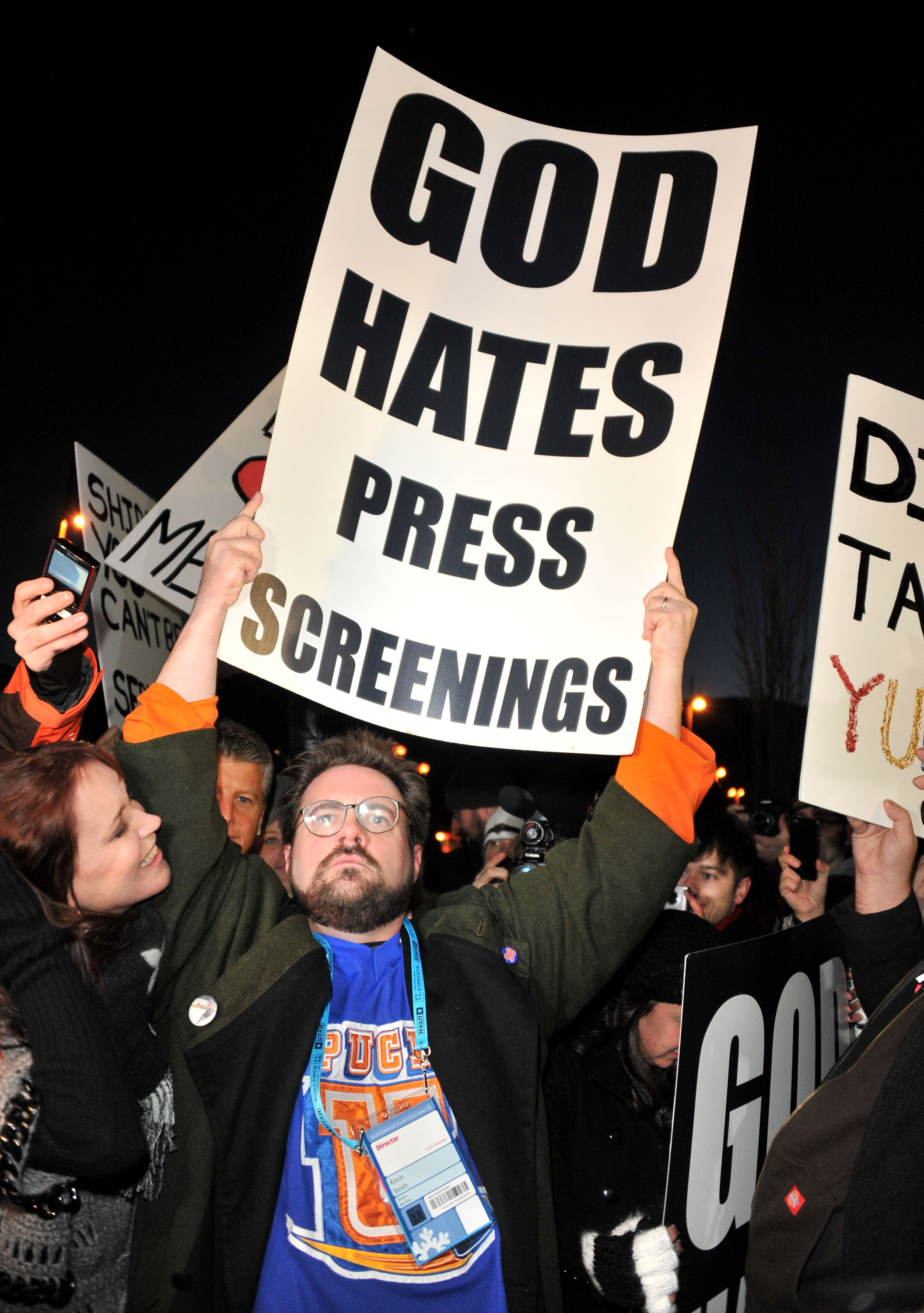
(Photo: Director Kevin Smith stages a counter protest against picketers, including members of Fred Phelps's Westboro Baptist Church, at the 'Red State' Premiere held at the Eccles Center Theatre during the 2011 Sundance Film Festival on January 23, 2011 in Park City, Utah. By George Pimentel/Getty Images)
Hot Internet Real Estate: TeaParty.com

A Canadian rock band called The Tea Party has owned the domain name since 1993. They're considering cashing out:

A sum of $1 million would put the musicians in elite company. Only a few dozen domain names have sold for that much or more, including sex.com ($13 million), vodka.com ($3 million), and poker.com ($1 million). The key to a big payday is marketing and timing. “Domain names are Internet real estate,” says Marc Ostrofsky, author of Get Rich Click! and an entrepreneur who bought Business.com for $150,000 in 1995 and sold it four years later for $7.5 million. "A good way to think about them is like tenants in a shopping mall. You’ve got your anchor tenants like Business.com and mutualfunds.com, and then you’ve got seasonal guys who come and go like teaparty.com."