The Rubber-Necking Bully

Julian Sanchez explains how online harassment can add up:

One reason "cyberbullying” may present special problems is that the Internet and social networks dramatically increase the realistic number of people who can pile on a single victim in a short period of time. Each aggressor might rationalize their own part in the distributed bullying as just one or two comments, though the victim perceives an overwhelming assault when these are all combined.

For an analogy in the physical world, we can look to street harassment, which is enabled by the high volume of anonymous, brief public interactions characteristic of urban environments. Some men, of course, engage in vulgar and intimidating speech that anyone would consider harassing in itself. But often, the harassment is a distributed phenomenon. Many of us would not particularly mind a single stranger yelling out "Hi, gorgeous" or "You look good today!" once every other month—and I’ve seen men (inexcusably obtuse, to be sure, but not obviously malicious) react with genuine surprise when such remarks are not welcomed as compliments, not realizing they’re the tenth person in as many blocks to volunteer a similar comment to the same woman.

Palin Threatens To Sue

Joe McGinniss gets some free publicity. Dave Weigel, one of the few people commenting who has actually read the book, rolls his eyes:

The stories subject to debate here are rumors about the Palins that remain in the book as rumors. The stories of Trig Palin's birth and what Bristol Palin did or didn't do after her son was born appear as rumors, things that McGinniss heard but can't confirm, as opposed to the facts McGinniss gets through sources. The Glen Rice story, the newsiest item in the book, is confirmed cold. The stories of Palin affairs are put in the mouth, first, of a named source who's showing McGinniss around town — he elides the question of whether he believes them.

But if the Palins do sue, there is such a thing as discovery. Is she really going to pull an Oscar Wilde?

Back To Basics, Ctd

A reader writes:

Your Funny-sign-star-wars-children-at-play-e1316566399171 street becomes a potential thoroughfare, and kids have to stay on sidewalks. Go to the burbs and practically every cul de sac is a de facto playground, with basketball hoops, skateboard ramps and bicyles strewn about. (Most suburbs have a pretty high incidence of parks as well, so the rug rats can get their grass fix too.) I'm an urbanite, but every time I take my son to the burbs to visit his in-laws, he gazes longingly at the suburban street culture.

(Image via Funny Signs)

Not Telling

A platoon leader savors the repeal of DADT. But she isn't leaving the closet:

You need the people who stand up and shout it out. That takes a lot of courage. But serving our country, even under a discriminatory policy, also took courage. And yeah, we’re gay. But my friends and I — we’re not making it a big deal. The main thing is there’s no fear anymore. I can hold my girlfriend’s hand.

A Kindness Pledge, Ctd

A reader writes:

This notion that intellectual rigor and kindness do not make good bedfellows is really misguided. It seems predicated on that old unexamined (and heavily gendered) bias between emotion and reason. But it's a false distinction abrogated by both modern neuroscience and some very old texts. I mean, Aristotle's eunoia – a beautiful, friendly mind – is considered in book 8 of the Nicomachean Ethics as not just the basis of a healthy polity, but as the chief means of energizing friendship and intellectual camaraderie. 

So, there is a longstanding consensus that these energies of virtue and intellect are not separate. Emerson, in his great essay "Friendship," even goes so far as to say, "Our intellectual and active powers increase with our affection." I mean, he's straight-up saying that we are smarter and braver the kinder and more affiliative we become. That's extraordinary. And what's even more extraordinary is that modern neuroscience is bearing these things out.

Richie Davidson's lab at UW-Madison, the Laboratory for Affective Neuroscience, has conducted some pretty fascinating studies that show an almost identical match in the blood flow patterns observed in the brains of advanced meditators who were asked to induce mindstates of both courage and compassion. What does that mean for doubters? That having a mind characterized by kindness actually *increases* the likelihood that one will speak it. Speaking one's mind, especially if it contains an insight that countermands or gainsays or thwarts received wisdom, takes courage. How could that induce intellectual tepidity?

Paul Ekman, a research psychologist specializing in facial expressions, goes even further in a study of some advanced meditators trained in cultivating mindstates of compassion and kindness. His studies suggest that meditators who have trained in inducing mindstates of kindness actually are preternaturally adept at recognizing deception and microexpressions in others – and he even goes so far as to say they are better at this than judges and police (who had previously scored the highest in his studies about detecting deception).  See, for this last, Destructive Emotions, a book "narrated" by Daniel Goleman. 

So it appears that, for some reason, inducing compassion in oneself causes one to see the social world more clearly, not back away from it out of shyness. Kindness is not, then, a tactic of avoidance, but a dialogic virtue: it is a skill that enhances relation and discourse.

Another writes:

This topic made me think of one of my graduate advisor's favorite quotes, from Francis Crick:

Politeness is the poison of all good collaboration in science.  The soul of collaboration is perfect candor, rudeness if need be.  Its prerequisite is parity of standing in science, for if one figure is too much senior to the other, that's when the serpent politeness creeps in.  A good scientist values criticism almost higher than friendship: no, in science criticism is the height and measure of friendship.
“The Movies In Our Minds”

Researchers at UC Berkeley are starting to record them:

Using functional Magnetic Resonance Imaging (fMRI) and computational models, [the] researchers have succeeded in decoding and reconstructing people’s dynamic visual experiences – in this case, watching Hollywood movie trailers. As yet, the technology can only reconstruct movie clips people have already viewed. However, the breakthrough paves the way for reproducing the movies inside our heads that no one else sees, such as dreams and memories, according to researchers.

Healthcare Criminals

Besides being illegal, they're also expensive:

According to a 2011 report from the Government Accountability Office, Medicare makes an estimated $48 billion in “improper payments” each year, an estimate that’s almost certainly lower than the actual amount since it doesn’t include bad payments within the prescription drug program.

Fred E. Dweck was a surgeon and director of a healthcare business in Miami who swindled Medicare out of $24 million. How the fraud worked:

Dweck’s gimmick, like the payment system he was manipulating, was simple: He gave the go-ahead to official orders for prescription drugs, staff-assisted insulin injections, in-home visits by nurses, and an assortment of other treatments for an estimated 1,279 different patients, none of whom actually needed treatment. With the help of five nurses who faked bundles of official patient records and payment forms, Dweck raked in cash on the taxpayer tab.

Global Warming’s Biggest Losers

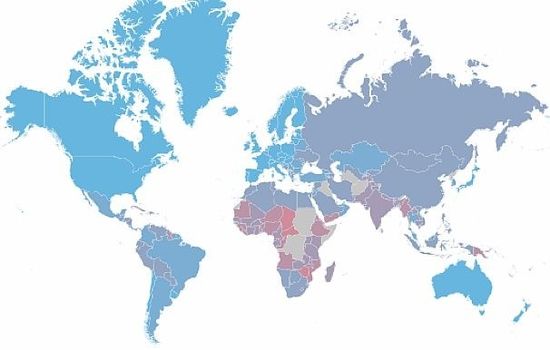
Global_Warming_Map

An interactive map by The Global Adaptation Institute shows global warming vulnerability and readiness by nation. Bradford Plumer captions:

[T]he map underscores one big hurdle for any coordinated world effort on climate change. The countries likely to get smacked the hardest aren’t, by and large, the countries currently pumping out the most greenhouse gases. One big exception is China, which scores dismally on GAI’s “readiness” index. That may explain why leaders in Beijing are taking increasingly ambitious steps to rein in carbon pollution. (Whether they’ll actually succeed is a different question, but a sense of urgency does seem to have taken hold there.)