Would Romney Be A Better President?

The jury is out:

Mitt Romney has very little trust inside his party. If he wins the Republican nomination, it will be because he persuaded the conservative base that Rick Perry would lose to President Obama. A relationship of convenience, however, won’t give Romney a lot of running room once in office. If he wants to hold his party’s members of Congress, and avoid a primary challenge in 2016, he’s going to have to show an uncommon level of fealty to the Republican agenda. His impulses as a competent technocrat might be quite blunted by his instincts as a politician interested in his own survival.

The Geography Of A Service Economy

Tallahassee's StarMetro re-envisioned their bus system this summer:

All of the city’s previous routes went one place: downtown. But by 2005, just 14 percent of the region’s jobs were located there. And the results of a 2009 on-board survey showed that only 6.8 percent of StarMetro’s riders were trying to get there.

Tim De Chant connects this to structural changes in the economy:

It's not that a central business district is a bad idea; it's just that the modern service economy demands that people work all over town. And it's the suburbs that have seen the most dramatic job growth in recent years. Couple these factors with the fluidity of the labor market and you have a workforce that demands mobility. For many people, that means driving a car, but rerouting transit systems to more closely mirror passengers' actual travel patterns is a sensible way to reduce car dependence.

The Daily Wrap

Today on the Dish, we launched a new Ask Andrew Anything feature. Obama took the gloves off, and when the truth conflicts with the propaganda on Fox, the propaganda always wins. Romney may appeal to the crazy GOP base, but without Andrew's blessing, since Romney's "apology tour" riff is as ugly as it is untrue. We assessed Perry's damage from the debates and had flashbacks to Palin's weak preparations. The web waited for the GOP to settle on Romney, or for any of the GOP candidates to address foreign policy substantively. The press glossed over Obama's Biblical faith, Norm Geras complicated Andrew's thoughts on religion, and Andrew assessed Obama's attack method: only after asking nicely.

Iranian prisons compared themselves to Guantanamo and we covered the dust-up over John Mearsheimer's endorsement of Gilad Atzmon's new book. We hailed Margaret Thatcher's punk roots, Ireland surprised everyone with its growth, and Saudi women got the right to vote but not the right to drive. In other national affairs, unemployment hurts Democrats more than Republicans, and if it stays at current levels, could raise the deficit by $2 trillion to $4 trillion. Readers contemplated the death penalty for those whose evil is fairly certain, and whether it can ever serve a practical purpose. The industrial food complex could die a similar death to big tobacco's thanks to Obamacare, and we pondered what jobs of the future will look like. 

The cul-de-sac doesn't make as much urban sense as the grid system, teenagers take on risk because their brains are different from adults, and we learned why humans associate certain smells with childhood. Kevin Smith sabotaged his own film, Facebook's timeline feature could track babies across their entire lives, and we accidentally ruined someone's fake career. Diego Stocco made music at the drycleaner's, Apple's new HQ designs could ruin Steve Jobs' legacy, and our ability to remember the past influences our ability to imagine the future. Transcripts turned dada, bears got smeared by the Church, and Bloggingheads could use a dose of face substitutions.

Hathos alert here, map of the day here, VFYW here, MHB here, FOTD here, and the battle of butter vs margarine uncovered here.

–Z.P.

“The Largest Index Of People That Has Ever Existed”

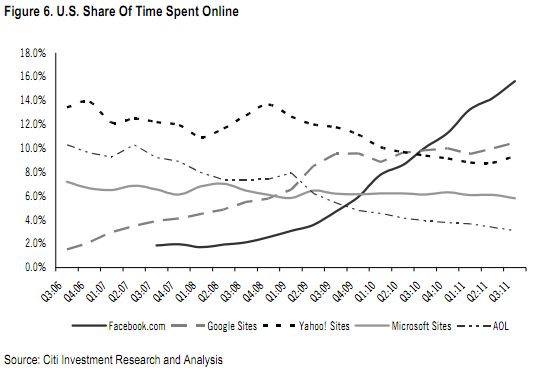
Facebook_Time

Harrison Weber worries about Facebook's new timeline feature:

[F]or the parents who created a profile for their newborn baby (yes, that really happens), the Timeline reflects a paradigm shift in the way our lives are being shared with the rest of the world. Now babies, born with a Facebook account, have a life-long timeline of every major event that happened throughout their lives. Our children will eventually take hold of their accounts when they’re old enough, and continue the Facebook cycle. This major change could safeguard Facebook from ever going the way of Myspace, all while creating a Skynet-like catalog of user information that makes Google look like it really does follow its “don’t be evil” motto.

(Chart from Peter Kafka)

How We Ruined Someone’s Fake Career

A reader writes:

In regards to your follow-up a few weeks' back regarding the exposure of Courtney Messerschmidt as a hoax, I thought you'd find this article from UGA's student newspaper worthy of your time.  Especially since, unbeknownst to you, you actually inadvertently started the chain of events to expose her/them.

Some back story:  I live in Athens, GA, home of the University of Georgia.  Upon seeing your initial post on GsGf back in July, I forwarded the link along to a person I know at the Red & Black and basically said, "Y'all need to talk to this girl."  The article pretty much picks up from there.

A little more back story:  The Red & Black bills itself as "an independent paper serving the UGA community".  It is self-supported and not funded by or affiliated in any way with the University.  It is a rock star in the world of college newspapers, having won every major peer award to be had.  This article is ostensibly a few college kids out-reporting Carl Prine, who attempts to dismissively fall back on his once-made but never again referenced notion that he suspected this was a hoax all along.

For all your pertinent arguments regarding the laziness of the media, I thought it might hearten you to see some real journalism being conducted by the next generation.

Does The Death Penalty Have A Practical Purpose? Ctd

A reader quotes another:

"OK, so some 6'5'' dude that looks like a pro wrestler rapes and kills 10 men with his bare hands. Because capital punishment is now abolished, he is sentenced to life in prison and put in a cell with YOU." OK, so with the death penalty this dude is in a cell with someone like Cameron Todd Willingham for twenty-five years while their appeals are working their way through the system. Better? How?

Another writes:

To your reader who expressed concern regarding what to do with lifers who act out in prison; two words: Solitary Confinement. For the rest of their lives.

Another:

The scenario described is one of the reasons for different security levels in the prison system.  Non-violent offenders are separated from violent ones, and the most violent end up in maximum security prisons in solitary confinement.   Death row inmates spend years in prison and are placed in solitary confinement for the same reason the violent inmate sentenced to life in prison ends up in solitary. But however unjust solitary confinement would be for someone wrongly convicted, it will always have the chance for a meaningful exoneration, unlike the death penalty.

Another:

What's more humane about imprisoning a human being for their lifetime instead of killing them? This has always baffled me.  

If a savage dog got off the leash and killed a human being, would it be more humane to lock the dog in a tiny cage, feed it an adequate amount of food and water to survive, just so it could die of natural causes in ten or twenty years?  I say no; killing the dog prevents much more misery than allowing it to live.  Yet we act more humanely towards human beings when we lock them away for decades (often with periods of solitary confinement) and allow their lives to waste to nothing?  It has always struck me as more humane to execute a criminal who is guilty of a monstrous crime than imprison them for life.  

Balko insists the opposite is true. Another reader:

Your reader holds the old, long-disproved fallacy that the death penalty somehow has a particular deterrent effect on crime. The death penalty simply does not give pause to someone who is already sociopathic enough to commit the heinous crimes the reader cites. If it did, we should have seen a decrease in death sentences in states like Texas and Louisiana since the penalty was reinstated, which we demonstrably have not.

Rather, the channeled blood lust of society as a whole, meted out on the (not always) most heinous offenders feeds on its own self-righteous pleasure in taking back the imagined power over life and death, of which these offenders have made us suspect and fearful. The lex talonis  serves to restore the psychological vulnerability of society in the face of murderers, but it certainly does not prevent murder. Wilkinson correctly identifies the real issues that drive the debate, which are the desire for vengeance for victim's families and society as a whole.

We can have a conversation over whether such a desire is appropriate, but let's drop the deterrence bullshit. Besides, such a gruesome scenario does not remove the moral hazard of the death penalty, under which an innocent person could so easily be sentenced to a wrongful death. Troy Davis's execution is an excellent example because, even if he may have been "probably guilty," "probably" just isn't good enough to justify such a punishment. No one should be allowed to make the deterrent argument for the death penalty without offering some studies to back it up.

Update from a reader along those lines:

Is there even a modicum of evidence that a dozen states that haven't had the death penalty since 1976 or earlier have higher rates of prison murder? Not according to numerous studies (pdf) that find no increase in murder among lifers in states that have no penalty.

The Other Execution From Wednesday Night, Ctd

A reader writes:

I totally agree with your reader.  It feels like almost a taboo issue to discuss and I held my tongue, but it seems like this discussion really needs to be centered around the execution of Lawrence Russell Brewer.  It's hard to deny that Troy Davis is an easier fight, but we as a country that executes people really should be asking ourselves, "If we really want to abolish Death Row, shouldn't this monster Brewer be the one we should be convincing ourselves we need to protect?"  It's much grayer waters to tread in than Troy Davis…

Another sees black and white:

I don't really consider myself a supporter of the death penalty, but to answer your reader's question about Brewer – yeah, he deserved it.  

Or at least that explains why there's no outrage over his execution.  People believe him to be guilty and believe Davis to be innocent.  And none of the reasons cited by the reader give us any reason to believe Brewer didn't deserve it. Focusing on the cost, the time between conviction and execution, the appeals process necessary to carry out an execution, and the deterrent factor doesn't provide a single reason why Brewer doesn't deserve the death penalty.  All the reader provides are reasons it's inefficient to use the death penalty, but that wouldn't change the fact that he deserves to die (if you believe that's the case).

Another:

The difference between the executions of Davis and Brewer are the guilt and innocence claims.  Davis had maintained that he was innocent throughout the entire process while Brewer admitted he was part of the group that chained Byrd to the truck and dragged him to his death, although he said he was only a bystander that kicked Byrd and sprayed black paint on his face, for whatever reason.  At the very least, Brewer was an accessory to a "hate" crime involving murder.

Another:

One of your readers speculated as to why Brewer's execution didn't receive the same attention as Davis's, wondering if it was a public assumption that he deserved it.  I do think that was largely the case, unfortunately. But another reason, in my view, is that capital punishment in general was not the point of the Troy Davis case.  The tragedy was that, where an inability to prove guilt beyond a reasonable doubt isn't supposed to allow a conviction, let alone an execution, the legal system refused to change its mind. 

It's a given that without capital punishment it wouldn't have happened.  But even with capital punishment in place, if those involved had acted sensibly – and as we would expect them to – in the face of dubious evidence, Davis would not have been executed.  The wrongdoing in the Davis case is glaring, regardless of how one feels about the death penalty.

One more:

From reading the various reports on the vigils and such during Troy Davis' execution, none of them have affected me the way a blog post from a guy named Jason Bugg did. I should add that I know this blogger, he's a pompous arse and his prickly demeanor is something I usually avoid at all costs, since he's a troll on some various forums in Western North Carolina. He may still be an arse, but he's staunchly against the death penalty and so he decided that he should go to the protest down in Georgia.  His blog left me in tears because here's this burly prickly arse of a man who surprised me first by going, but even more by his reaction. Here's one of my favorite sections:

There I was, a borderline atheist, praying with someone who had strayed from her faith and a Muslim. The cliché goes that there are no atheists in foxholes; well I’m here to tell you that there are no atheists, denominations or differences of religion when a human’s life is on the line. I’m sure there’s a story or a joke there, but I don’t know what it is. I do know what happened next.

I guess the part of this post that I find the most enchanting is that here is a white guy going to a protest that is predominately black and finding fellowship amongst the other folks at the protest. It strikes such a different chord than most of the other reports I've read from the protest outside the prison. Just an amazing piece of first-person journalism, and I think you might like it. Here's the link.
A Guide To Sabotaging Your Own Film

Jason Bailey looks at the curious case of Kevin Smith, who managed to get his new, supposedly great film Red State sent straight to DVD through sheer force of ego:

The Red State affair has been sunk by Smith’s attitude, whether conscious or not, that the production is less about the film than it is about him — so at every turn, he has done what is best not for the picture, but for his ego and his wallet. And that is why he made enemies of the critical community mere months before releasing a small film with no ad budget that could have benefited from positive reviews, and that is why he deliberately faked out independent distributors who could have given the film proper marketing and circulation and instead chose to embrace his inner huckster.