
St. Louis, Missouri, 9.29 am
St. Louis, Missouri, 9.29 am
Ebert's lodestar:
I believe that if, at the end, according to our abilities, we have done something to make others a little happier, and something to make ourselves a little happier, that is about the best we can do. To make others less happy is a crime. To make ourselves unhappy is where all crime starts. We must try to contribute joy to the world. That is true no matter what our problems, our health, our circumstances. We must try. I didn't always know this and am happy I lived long enough to find it out.
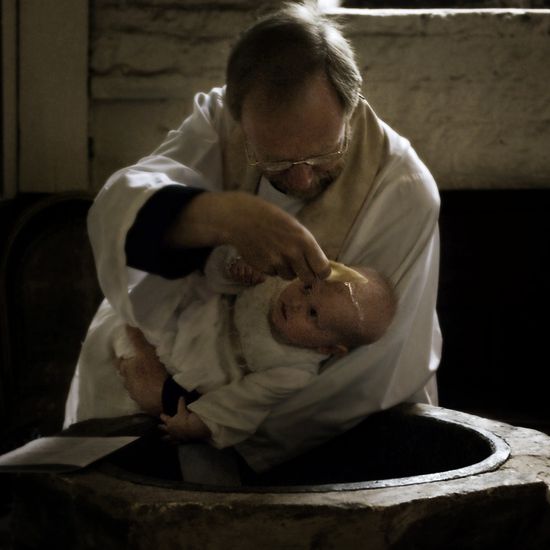
"Passage" by Alex Dimitrov:
At the St. Mark’s baths Hart Crane washes my hair
and I tilt around the cold porcelain of the basin
with strain and delight, trying to look at him.But before I meet his sea-tempered eyes
I feel his hands easing my head
into the dark water,as if he were a sailor calming a storm
on a ship with insatiable men. …Who am I? I think. And I try to remember
the beginning of beauty—before Orpheus,
before winter—before this man who sings
for the drowning, touches my lips,
and I ignite.
Read the entire poem here.
(Photo by Flickr user Tim Snell)
Roger Crisp provides a thought experiment:
Imagine some group of beings like us, except that these beings cared much more about people born on Tuesdays than those born on other days. (Their so caring is a brute fact, and does not rest on, say, any religious or superstitious assumptions about Tuesdays.) Even sentimentalists about ethics will probably wish to claim that there is something dubious about this differential attitude. But that raises the question whether we should say the same about a preference for identifiable fellow-citizens.
The property of being an identifiable fellow-citizen is not clearly morally irrelevant in the way that being born on Tuesday is. Indeed, it seems similar in important ways to the property of being one’s child, and most of us think that this is a property of great moral relevance when we are deciding how to spend our scarce resources. But there is of course one big dissimilarity: in most cases, a parent has deep personal relations with a child, and these could be taken to ground a parent’s giving greater weight to the interests of her child over those of others. The fact that such a relationship is lacking in the case of identifiable fellow-citizens suggests that the property of being an identifiable fellow-citizen may well be morally as irrelevant as that of being born on a Tuesday.

Paul Ford ruminates:
Recapitulation theory ("ontogeny recapitulates phylogeny") puts forth that incubating humans act out evolution as they grow from zygote to baby. This was a popular idea a century ago, but it's turned out the science isn't that simple. Yet the principle holds that the dividing fetal cells are engaged in a kind of performance of all of evolution—from simple to complex, from general form to specific form. The developing human loses its tail early, gains a cerebrum later.
Thus newborns are time boiled down, and every ounce gained is another 20 or 30 million years of life; they compress the three billion years since abiogenesis into a nine- or ten-month performance that runs from conception to birth. By the time they arrive they have gone for rides on comets, teased dinosaurs with sticks, come down from the trees, and run across the savannah.
(Photo: Human Embryo, 7th week of pregnancy.)
Professor William Egginton argues as much in his book, In Defense of Religious Moderation:
Whether Christian or of other faiths, the movements we call religious fundamentalism are always the result of a perceived attack on a given community of faith. This is one reason why the attempt to regulate or restrict religious practice, what the new atheists are in essence calling for, has always resulted in and can only result in more fervently held beliefs, often in the form of fundamentalist backlash.
He offers the Scopes “Monkey Trial" as an example:
[B]efore the Scopes trial few fundamentalists actually believed in creation science or thought it particularly important to do so. Creation science became a hot-button item for the fundamentalist movement only after William Jennings Bryan’s defeat in court by Clarence Darrow was ridiculed by the journalist and essayist H. L Mencken, who wrote in an obituary for Bryan that he “lived too long, and descended too deeply into the mud, to be taken seriously hereafter by fully literate men, even of the kind who write school-books.” In the face of such humiliating condescension, groups tend to close ranks around tenets and practices that define them as different from the outside world.
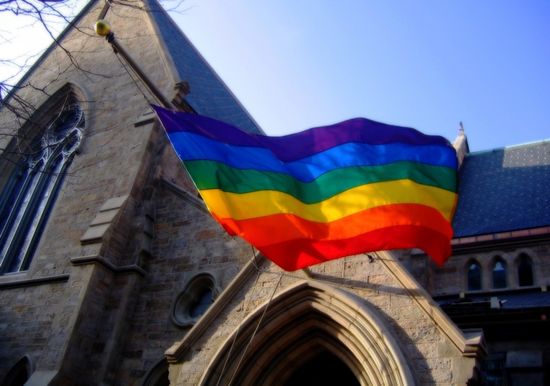
Justin Lee shares his experiences with ex-gay ministries:
Even the national leaders and "success stories" of these change ministries privately admitted to me that they hadn't become straight. Yes, some of them had married a member of the opposite sex, but the "happily heterosexual" face they showed to the world was not the reality. I heard more tragic stories behind closed doors than I can possibly convey. As I turned to my church and the Christians I respected most to get their support, things only got worse. Christian groups kicked me out or turned their backs on me when they learned that I was gay, even though I told them that I didn't want to be and that I hadn't even acted on my feelings! I learned that that one magic word, "gay," had the power to make Christians turn unkind and uncompassionate without even realizing they were doing it.
His experience led him to start the The Gay Christian Network (GCN). Lee blogs here.
(Photo by Flickr user Brian Talbot)
Reihan digs up a 2010 article by William Baude on Troy Davis, presumed innocence, and the courts:
Legislatures create the procedures used to challenge criminal convictions. If our current ones are inadequate, lawmakers can create more generous rules for presenting new evidence of innocence. Indeed, in many states they have done exactly that in creating new procedures to accommodate DNA testing. Similar procedures could be created for other forms of new evidence.
The mistake is in thinking that judges are the only ones who can or should fix this injustice. If we care so much that actual innocence claims get into court, we should be lobbying the democratically elected branches, which have the power to create new procedures. If we are unwilling to demand better systems for assessing innocence from them, we should not be surprised that the courts are reluctant to invent one.
Fifty people in Chicago share their favorites:
Researchers set out to test it (pdf):
Some say we believe in God because our intuitions about how and why things happen lead us to see a divine purpose behind ordinary events that don't have obvious human causes. This led us to ask whether the strength of an individual's beliefs is influenced by how much they trust their natural intuitions versus stopping to reflect on those first instincts.
Alasdair Wilkins summarizes how the study was run and its conclusions:
The researchers enlisted 373 participants and had them write a paragraph about something good that had happened to them. For one half of the group, they were asked to write about a time when intuitive thinking led to a good result, while the other was asked to remember a time that reflection had helped them make the right decision. When surveyed afterward, the first group was significantly more likely to say they were convinced of God's existence than their peers. … The researchers do argue that this is evidence for a causal link between intuition and belief in a higher power, although they concede that the opposite is possible — that it's actually an abiding belief in the divine that leads people to more intuitive thought processes.
Tyler Cowen has more.
 The Dish