The Good Neighbor, Ctd

A reader writes:

Thank you for the ongoing posts highlighting Mr. Rogers. To me it is especially important that he was a ordained pastor in the Presbyterian Church. His message, quiet and presented for a secular audience, is rooted in his theology – a vision of God and how God loves all of us with extravagant, overflowing, endless grace. It is this theology that led me to follow him into the ministry in the Presbyterian Church (USA). His humility and love is something I try to emulate day after day. In this age where too many quarters of the church are known for the evils some have wrought on children, there are so many more unassuming, humble, gracious ministers and lay leaders trying to communicate what Mr. Rogers did so well: that all children (and indeed, grown ups) are unique, loved, prized, important.

I so wish that Mr. Rogers was the more visible icon of what the Christian church stands for today. Because in my heart, it does.

Another writes:

Your Fred Rogers thread gets me every time.  For the past few days I've been brought to tears over my morning coffee. It makes me think of something my dad once said.  He was a powerful CEO who met with people like the Queen of England and Walt Disney.  One summer he was even invited to the White House for dinner. He came home and we all asked "How was the President?!"  He dismissed it and said, "The president was fine, but I sat next to Mr. Rogers, and he was the most impressive person I've ever met." 

Another:

A small thing about Mr. Rogers, though it was actually enormous to my child.  My daughter, aged two, was simply terrified of band aids – not just the ouch, pull-it-off part, but the open the box, put-it-ON part, too.  I couldn't figure it out.  I had never heard of such a thing.  It seemed inexplicable … and weird.  And then, lo and behold, Mr. Rogers did an entire SHOW about band aids – how they're made, what they're for, how you put them on and take them off, how you might FEEL when they go on and come off – in his kind, endlessly patient, direct to the child, inimitable way.

My daughter watched this show, riveted.  I watched her watching; I don't think she moved a muscle.  When it was over, she asked if she could put on a band aid.  We put one on; we took it off.  She looked up at me with a beaming, blue-sky face and announced: "I'm not scared of them anymore!"   

I thought a lot about that.  How I just didn't have the patience to try and see her point of view on this trifling matter and how so much comes down to that – patience and perspective.   I vowed to try and be just a bit more like Mr. Rogers, a vow I fail at every day.  But at least I try.

I have the good fortune to work in children's television and my department met with Mr. Rogers one lucky day.  I can tell you that he seemed, up close, just as kind and courtly as he appeared on TV and all of us grown-ups clustered around him at the end, joyfully, like children, just soaking up the vibe. 

One more:

I grew up and still live in the Pittsburgh region, where "Mr. Rogers Neighborhood" was filmed.  In the late '80s I was a student at the University of Pittsburgh and had an apartment in the Shadyside neighborhood where the studios of WQED are located.  Fred Rogers lived nearby and was a familiar sight in the area walking to the studios every day.  I suffered no end of good natured teasing from friends and family that I lived in Mr. Rogers Neighborhood.

The Roots Of Classy Porn

Tracy Clark-Flory interviews sex pioneer Susie Bright:

There were about a dozen women in the '80s who started making their own movies, magazines, images, and we fought against all the naysayers. Then, to everyone's shock, the women's erotica movement made significant sales. Into the middle of that mix, came along a filmmaker named Andrew Blake, who did a series of very high-tone, music-video-style X-rated videos. There was no narrative; they were all similar to a very long commercial for luxury goods — with sex in them.

It was just Blake's thing; he had no particular interest in women viewers. But these movies were wildly popular with women. For all the ranting and raving everyone had made about wanting "a good story," that turned out to be untrue.

What novice female viewers wanted, without being able to say it, was class-conscious reassurance that one could be a nice, well-dressed, well-kept woman, and indulge in "erotica" while maintaining your dignity and marriageability. Everyone looked like a millionaire in Blake's movies, and that turned out to be the ticket. Not story, not orgasm, but reassurance that you weren't a terrible worthless slut to be looking at such things.

I found that discovery enlightening but depressing. I wish women wanted to look at sex stories and movies because of their unapologetic sexual self-interest. Luckily, once many women got through the Andrew Blake gateway, they loosened up and started enjoying other things that were more personal to them.

Confessions Of A Gay Jock

The story of Thomas Rogers ties in nicely with our thread on out pro-athletes:

Not only did becoming a jock boost my self-confidence, it was an antidote to my anxieties about my burgeoning homosexuality, about the girlish lilt that could emerge in my voice or my occasional extravagant hand motions. I had always been pretty comfortable with the idea that I was gay, but I was still struggling with the implication that it meant being less manly than the other boys. But jocks were manly. They were self-confident, and cool, and, somehow, better than people who weren’t jocks. And if I became one, especially at college, I would be like that too.

Then the hazing happened: oil wrestling in unitards.

The Most Intimate Act?

Anthony Lane reacts at a gruesome scene in Drive, where Ryan Gosling's character stomps a villian's skull to a bloody pulp:

The people around me reacted with the eewrrgh sound that has become de rigueur in the viewing of violence, followed by the traditional hasty giggle to pop the tension; even those moviegoers who revel in such a sight, however, might usefully pause to inspect the kick of pleasure that it provokes. No doubt they will have seen much worse, and they will also know that a bursting brain is no more real than a game of Quidditch, yet what perturbs me about a film as careful and as intelligent as "Drive" is its manifest delusion that, in refusing to look away from the minutiae of nastiness, it is actually drawing us closer to the truth about pain.

Richard Brody sees a different lesson from the Danish director, Nicolas Winding Refn:

Refn doesn’t seem interested in pain but in its infliction—specifically, how blank-faced, soft-spoken people manage to commit mayhem and, at the moment of violent outburst, stay fixed on their plan and maintain a fearsome calm in the face of disgusting gore. … [I]t’s the notion of duplicity: the poker face as the key to success, and the suggestion that anyone who makes it in any walk of life, legit or not, does so as a real cool killer.

How the director describes his intent:

With Drive, the structure I wanted to do was basically based on Grimm’s Fairy Tales. So the first half of the movie is about two people who meet and fall in love, but it’s spiritual, it’s never physical, it’s maybe not even, in a sense, real. It’s the idea of higher love. And in Grimm’s Fairy Tales, when the tables turn and it’s time for the villains to be punished it’s always very visceral, very extreme.

Matthew Baldwin muses:

Drive instinctively understands something that’s been forgotten by the products of the Thrillaminute Factory: killing someone is an extraordinarily intimate act, possibly even more so than sex. After all, a person can fuck you repeatedly, but they can only kill you the once. 

What We’re Missing Online

LindsayBubbled

Andrew Sempere considers the invisible trail of censorship that can occur on the Web:

Like the bubbling on celebrity photographs [above], technology can be manipulated to imply something is there when it isn’t, but unlike the censorship of the 1950s, there is no drawer of discarded YouTube videos whose content has been deemed inadmissible by copyright violation. … There is no recourse for accessing the Flickr Pro accounts of individuals who have died. There is no system in place for archiving the Facebook walls of the missing. This type of removal is ruthlessly efficient and effectively invisible, garbage-collected by automatic censors, not available in any form. The non-presence is invisible, and the story of our cultural transitions are potentially lost if we’re not careful.

The Art Of Rolling A Joint

A meditation:

You never considered that there might be an origami aspect to rolling a joint, a frustrating and covertly dehumanizing feeling that creeps in when you’re un-sticking a Zig-Zag for the 70 billionth time: Is this supposed to be so hard? Putting some weed in some paper? You had not accounted for the gluey mess that splits open like a wet paper grocery bag, the hard stare of the greedy would-be smokers, the passage of time marked by the slow, dialogue-heavy movie droning in the background. …

Some people knit sweaters for their loved ones. Joint-rolling is my contribution. And not all rolls are created equal. As with any task that can be converted into a bragging right, there is more than one approach to skinning this particular cat. Even for those of us who perform this waltz with two left hands, rolling joints should be a joy—you’re smoking drugs! The most important thing is that you feel—stupidly, perhaps, but stupid is still valid—proud of what you’ve created.

Why Are So Many Superheroes Trust Fund Babies?

Batman

Julian Sanchez detects a pattern. His explanation:

The hero must wield enormous power in order to effectively perform the superheroic function, but cannot seem to seek it too eagerly, even for admirable ends—perhaps particularly when we consider that they typically make use of their great economic power by translating it into a superhuman capacity for physical violence. Spider-Man is always reminding us that “with great power comes great responsibility”—but the responsibility is the noblesse oblige of one who has (often reluctantly) found that power thrust upon him.

Alyssa Rosenberg goes all materialist:

When a hero moves from having his wealth be the most important fact around him to his capacity for good being the most important fact around him, it invites the audience to reassess how important they think wealth actually is. These reassessments only go so far, of course. It’s not like Batman is liquidating Wayne Enterprises and giving his fortune away. We wouldn’t want to make people think that wealth itself is bad, now would we? Wealthy people who become superheroes are a great way of reconciling us to concentrations of wealth, to convince us of the idea that it’s actually a good thing for some people to have accumulate vast sums of money because they’ll channel it for public benefit.

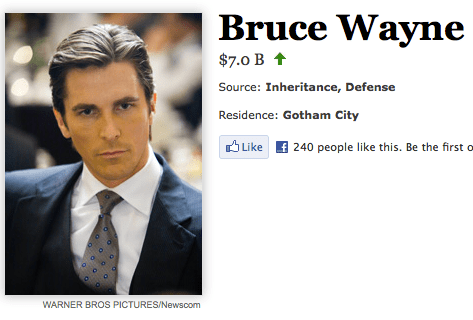
Screenshot from Forbes fictional character rich list.

The IKEA Effect

When instant cake mixes were introduced in the 1950s, housewives were hesitant because they thought it devalued their labor. Manufacturers changed the recipe to require adding an egg. Richard Landers summarizes a new study that tested the tendency of people to value things they have created or built themselves:

Participants either inspected an IKEA pre-built box or assembled it themselves.  Afterward, they were asked to bid on the box they had either seen or built.  … [O]n average, participants bid 62% more when they built the box versus when they simply inspected it.  On average, participants also self-reported liking the self-built box more than the inspected boxes.

The Unoriginal Genius

Kenneth Goldsmith teaches a class at the University of Pennsylvania called "Uncreative Writing":

In it, students are penalized for showing any shred of originality and creativity. Instead they are rewarded for plagiarism, identity theft, repurposing papers, patchwriting, sampling, plundering, and stealing. Not surprisingly, they thrive. Suddenly what they've surreptitiously become expert at is brought out into the open and explored in a safe environment, reframed in terms of responsibility instead of recklessness. …

After a semester of my forcibly suppressing a student's "creativity" by making her plagiarize and transcribe, she will tell me how disappointed she was because, in fact, what we had accomplished was not uncreative at all; by not being "creative," she had produced the most creative body of work in her life. By taking an opposite approach to creativity—the most trite, overused, and ill-defined concept in a writer's training—she had emerged renewed and rejuvenated, on fire and in love again with writing.

Goldsmith is the founder of Ubuweb.com, a collection of sounds, texts and videos that has been called the WikiLeaks of the avant-garde. As he told Tank Magazine:

Everyone is frightened of copyright. Ubuweb simply acts like copyright doesn’t exist: we just ignore it. Everything on Ubu is free. We don’t touch money. The site is run by students and volunteers, and our server space and bandwidth is donated by universities. Ubu has discovered an economic gray zone by hosting out-of-print and hard-to-find items that aren’t valuable, economically speaking. It’s mostly artists’ ephemera and although it might not be worth a lot of money, intellectually and historically it’s priceless.