Why Online Poker Should Be Legal

Poker_Screenshot

Full Tilt Poker, a gambling website, is in major trouble for allegedly stealing hundreds of millions of dollars from its players. Felix Salmon blames anti-online gambling laws:

If poker sites were legal and regulated, we could trust the regulator — an arm of the US government — to protect gamblers’ funds. Casinos are strictly regulated; online poker sites should be as well. Instead, they became international fugitives, going to great lengths to make it possible for US gamblers to skirt regulations and use their sites.

Balko nods:

What is abundantly clear is that the federal government’s paternalistic efforts to “protect” online poker players from losing money to offshore gaming sites . . . was a colossal failure.

Screenshot from Full Tilt Poker's website.

America’s First Trillionaire

Annie Lowrey wonders when he or she will arrive:

[L]et's assume that our hypothetical trillionaire is actually only as rich as today's richest American, Bill Gates, whose estimated net worth is $56 billion. Since inflation slowly erodes the value of the dollar, it will be easier and easier to hit the trillion-dollar mark as time goes on. (We were all once Zimbabwean trillionaires, after all.) If the United States averages 3 percent annual inflation, and the richest American's fortunes keep up with Gates', America would have a trillionaire in 98 years. But now let's assume that the richest American's fortune not only matches the rate of inflation, but outpaces it by, say, an additional 3 percent a year. At that rate, we should have a trillionaire in 50 years.

The Daily Wrap

Screen shot 2011-09-21 at 6.32.43 PM
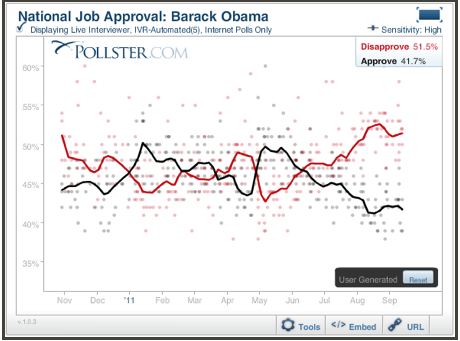
Today on the Dish, Andrew disparaged the GOP's sabotage of economic growth for short term political advantage, but Krugman defended the Buffett tax. Eric Kleefeld reminded us how liberal the GOP platforms were in 1860 and 1864, readers pilloried Rep. Fleming's shoddy math, and the GOP still largely owns the debt. Andrew bashed Perry's "Christian" willingness to support Israel over his own president, and recalled how he has been burned by Bush's fundamentalist psyche and the Christianism that now dominates conservative politics. We remembered the first gay soldier to fight for the right to serve, and honored the ones still coming out today. John Guardiano warned Republicans they need to put homosexuality on a legal and social par with heterosexuality, and It Gets Better lost a 14-year old to suicide.

On the campaign trail, we analyzed Perry's overblown cinematic ad about "President Zero," Jonathan Cohn parodied David Brooks' disappointment, and Nader and Cornel West's call for a liberal primary challenge fell flat with most of the left. Palin delayed her decision about whether she'll run, Bernstein prepared for a short GOP nomination battle, and Christie hasn't been in office long enough to make 2012 viable. Internationally, Exum explained how all parties have lost faith in the peace process, an assassination in Afghanistan challenged any sort of rapprochement with the Taliban, Iraqi wishes about our presence in the country barely registered with politicians here, and Egyptians conflate democracy with lowered economic inequality. James Hamilton urged America to take advantage of its vast natural resources and terminator-style robot warfare looked more and more feasible and secretive every day.

A ton of police resources went to busting victimless possessors of pot, social media is holding police more accountable for brutality, and even if it's legal, cops can still arrest you for recording them. Readers defended organic and local produce, scientists were prosecuted for not predicting an earthquake in Italy, and gamers helped solve a puzzle in AIDS research that has stumped scientists for decades. Netflix can't stream everything because it'll ruin the studio system; meanwhile they can't even claim their own Qwikster Twitter handle. Humans loved spoiled endings, and we admired Fred Rogers' lifetime achievement acceptance speech.

VFYW here, MHB here, and FOTD here.

–Z.P.

“The Party Of Lincoln”

Eric Kleefeld dusts off the 1860 and 1864 GOP platforms: 

[These] platforms inherited the Whig tradition of what were known at the time as "internal improvements" — government investment in infrastructure. For example, the platforms called for government to aid in the large project of constructing a transcontinental railroad, to improve rivers and harbors, and to have "a vigorous and just system of taxation" in order to ensure the payment of the national debt. The 1864 platform also declared: "Resolved, That foreign immigration, which in the past has added so much to the wealth, development of resources and increase of power to the nation, the asylum of the oppressed of all nations, should be fostered and encouraged by a liberal and just policy."

Our Secret Drone Rules

David Cole wants the Obama administration to make its drone policies explicit: 

Presumably the administration has developed criteria for who can be killed and why, and a process for assessing who fits those criteria and when their targeting is justified. But if so, it hasn’t told us. Instead, it exercises the authority to kill, not only in Afghanistan and the border regions of Pakistan, but in Yemen, Somalia, and presumably elsewhere, based on a secret policy. …

If we are engaging the enemy within the rule of law, as [John] Brennan insisted we must, we should have the courage to make our policies transparent, so that the people, both in the United States and beyond, can judge for themselves. And if, by contrast, we continue to justify such practices in only the vaguest of terms, we should expect other countries to take them up—and almost certainly in ways we will not find to our liking.

More on the legal implications of drones here

Face Of The Day

125722611

U.S. Rep. Rosa DeLauro (D-CT) speaks during a news conference September 21, 2011 on Capitol Hill. A petition with 250,000 signatures, gathered by USAction, Change.org, ColorofChange.org and CREDO Action, were delivered to the Capitol today to thank the co-sponsors of the Fair Employment Opportunity Act for banning hiring discrimination against unemployed workers. By Alex Wong/Getty Images.

Netflix’s Gamble, Ctd

A reader continues the thread:

Hi!  I'm a consumer with a wife, a child, two dogs, a small house, two vehicles, and a 10-year-old home theater system.  From my vantage point, my entertainment future is, quite frankly, fucked.

A couple of days ago, I forked over $17.35 to Netflix, for one month of the mail/streaming combo package.  In a couple of days, I'll also pay $135 to Cox Communications for digital cable (Starz/Encore and one other small premium upgrade), and cable Internet service to the house. This is a quote from an email I received from Cox on September 13th:

Dear Cox High Speed Internet Customer,

We'd like to take this opportunity to announce the availability of the Data Usage Meter. This new feature provides an easy way to check monthly household high-speed Internet data usage at any time. Monthly data usage is the amount of data that users send, receive, download or upload each month for movies and videos, photos, web surfing, email, gaming, and other files.

Each of our packages has a specific data usage amount. The amount depends on your Cox High Speed Internet package and corresponds to the speeds provided with the package. Our speediest package provides the highest usage amount. You are currently subscribed to the Essentials Package which has a monthly data usage amount of 50 Gigabytes (GB). This is equivalent to streaming about 27 standard definition movies, or 16 high definition movies in a month*.

The vast majority of our customers do not exceed their usage amount in a month and Cox does not charge you an additional fee if you exceed it. However, if you find that you are exceeding the usage amount for your package, you should check for the following potential causes…

The message goes on with suggestions about checking your computer(s) for spam bots, things like that.  Clearly, the writing is on the wall:  "If you try to replace our cable programming with a streaming service, we will nail you.  Hard."

I chuckled more than once over Tim Camrody's post over on "Wired."  Tim seems to have forgotten that he writes for a magazine that regularly tells me which ginormous "wired" (as opposed to "tired") $3,000 TV I should hitch up to my $4,000 Dolby 7.1 home theater system and $300 Blu-Ray player.  (No, I don't have those things – our Kenwood home theater cost $525 on Black Friday 2001, and a free Hitachi DVD player was part of the deal.)  Oh, but wait, the "FUTURE" for this high-end technological wonder is a streaming service that serves up 1970s-era broadcast-quality movies with two-channel audio and – very occasionally – subtitles.

At least until my wife fires up her laptop for another round of "Mafia Wars"; then, either her game crashes or Netflix gets a bad case of bandwidth hiccups. It's a coin toss.

You know who does *not* screw me over?

1) Digital Shelf, this little independent shop that rents movies and games.  Everything is a seven-day rental, most things are either $1 or $2.  The carpet is old, the shelving is old, the college kids behind the counter are sometimes indifferent, but the prices and selection are great.  And if a disc is scratched, they will fix it, or trade it out, and I'll get an extra day or two to keep it.

2) CD Tradepost, the retailer of pre-owned music, movies, games, game systems, and game peripherals.  You're always welcome to try before you buy, all purchases are guaranteed for at least seven days, and the prices are reasonable.  If they don't have what you want, you can leave your name and number along with the title of what you want, and if they get a copy, they'll call you.

No major rental chain (Blockbuster, RedBox) or streaming service can compete with that kind of tag team.  Yeah, it may be a little more time, and a little more gas money, but at least with a DVD, I can hear all 5.1 channels.  And if my wife gets bored, she can fire up Facebook without interfering with my movie, or vice versa.

I think, to get the bandwidth needed to really make streaming content a high-quality reality, we're going to have rip up the old copper coaxial cables and replace it with fiber-optic – nationwide.  I think Google is going to lead the way once they've fixed up Kansas City, Kansas to their liking, but it will be our children, maybe even our grandchildren, who will really get to enjoy truly nice streaming media.

I appreciate Netflix making the effort – thinking out of the box with both the postal and streaming delivery of video entertainment – but I don't think we're quite ready for any of this.

Another writes:

The movie and TV industry are the lucky beneficiaries of the fact that video requires roughly 10x more bandwidth than audio, so they've had years to learn from the music industry's demise before we all had enough bandwidth to start easily watching video over the internet.  Yes, Spotify is awesome for users and it's awesome for Spotify but it's not awesome for Sony Music.  The movie and tv studios are not going to go gentle into that good night.  They'll only be forced to negotiate licensing on equal footing with internet distributors once there's sufficient content they don't control going through new channels like Netflix, Vudu and YouTube.  

Thus the attempt by Netflix to do an end run around the studios with House of Cards.  I imagine that their first goal with this series is to deliver a big hit that will draw subscribers the way The Sopranos did for HBO.  But that their even larger goal (dream?) is that it will be the pebble that begins an avalanche of content from independent producers.

It sounds far-fetched given the costs of production, but keep in mind that 1. the cost of all the equipment to film, edit, mix and distribute high-quality video is plummeting, 2. there are armies of film-school students out there that want to make a name for themselves (most of whom don't have jobs with an unemplyment rate at 9%) and 3. most importantly, disruptive technologies don't initially have to be as good as the thing they replace.  They just have to be cheaper, more convenient or more effective in some way.  Lots of cheap, niche content with loyal followings like Dr. Horrible's Sing-Along Blog, The Guild or Seth MacFarlane's Cavalcade of Cartoon Comedy can start to displace studio content if they're easily available on Netflix or YouTube the same way that digital photography displaced chemical photography.  It didn't matter that at first digital cameras had terrible photo quality. You could take as many pictures as you wanted to!  Cheaply.  Whenever and wherever you wanted.

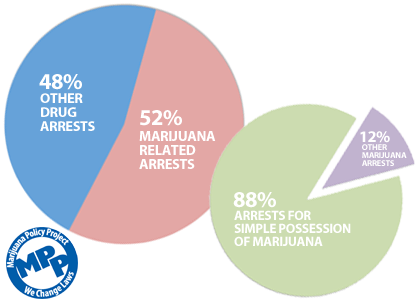
How Many People Get Busted For Pot?

Marijuana_Arrests

Morgan Fox breaks down the FBI's latest numbers:

Arrests for simple marijuana possession accounted for 5.7% of all arrests in 2010! That is a significant percentage of our law enforcement efforts devoted to punishing people for a victimless crime. It seems that there are better ways to use those resources, especially considering that there were more arrests for marijuana possession than for all violent crimes. How many violent acts occurred last year that did not result in an arrest? How many rapes and murders went unsolved due to lack of funds or personnel?