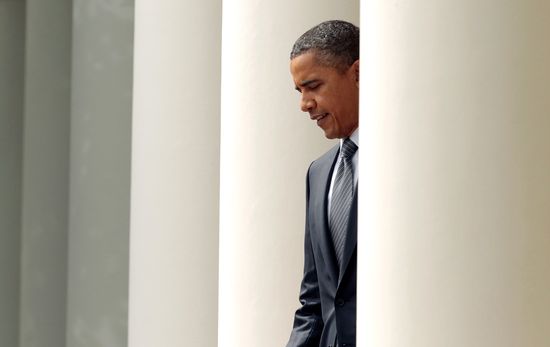
The Un-Bush, Ctd

Steve Benen guesses at why Obama isn't running on his foreign policy record:

Why does the administration choose not to invest more energy in patting its own back? If I had to guess, I’d say it comes down to two things. One, Obama doesn’t bring a dance-in-the-end-zone style to his responsibilities. Bush tried to milk national security for political gain, and maybe the president found it distasteful and prefers a classier approach. And two, it probably wouldn’t matter much anyway — Americans’ interests are focused so heavily on the economy, nothing else sways public attitudes. But that leads to another question: should Obama and his team do more chest-thumping and take more victory laps? Should they try to get the credit they deserve, and reinforce the image of Obama as a skillful and effective leader? I don’t think it’s a stretch to say a Republican president with a record as impressive as Obama’s would be talking about little else.

Lose The Pragmatism?

That's Frank Rich's advice for Obama on winning over independents:

[Pew] has found that nearly half of independents are in fact either faithful Democrats (21 percent) or Republicans (26 percent) who simply don’t want to call themselves Democrats and Republicans. (Can you blame them?) Another 20 percent are “doubting Democrats” and another 16 percent are “disaffected” voters, respectively anti-business and anti-government, angry and populist rather than mildly centrist. The remaining 17 percent are what Pew calls “disengaged”—young and uneducated Americans, four fifths of whom don’t vote anyway. There’s nothing about the makeup of any segment of these “all-important independent voters” that suggests bipartisan civility has anything whatsoever to do with winning their support.

Michael Tomasky echoes a similar sentiment:

Obama and his people seemed to think that over the summer, independents wanted them to cut a deal with the GOP on the debt ceiling. He'd look moderate, reasonable. So they cut it. Result: they lost about 8 points among independents, who hated the deal because it symbolized dysfunction and because the president looked weak. …

There is, then, a way for Obama to inspire both the base and swing voters, and it's absurdly simple: he needs to accentuate the items on which the two groups more or less agree and fight hard for them. I'd call it a radical stylistic posture on behalf of an ideologically modest agenda.

Andrew Sprung parses:

[Obama] is being punished in the court of public opinion not for trying to compromise but for failing to get a compromise. The difference is important.

Stanley B. Greenberg muddies the water:

We know from the way Obama carried independent voters in 2008 and the way Republicans carried them in 2010 that sometimes very strong positions taken by one of the parties sweep across the independents. Finding the position halfway is not necessarily the way to appeal to them. … There are affluent suburban voters who are fiscally conservative and culturally liberal; there are seniors, who are more populist than the population as a whole; and there are a high number of white, blue-collar voters who are deeply angry and have been explosive in election after election. In 2006 and 2008, all these groups voted overwhelmingly for Democrats. In 2010, they voted overwhelmingly for Republicans. Right now, I don’t think we have a clue where they’re going.

My two cents: tax reform. The biggest disappointment for me in the Obama years has been his timidity on reforming taxes and spending. A serious Bowles-Simpson style tax reform, which broadens the base, ends corporate welfare, and simplifies the system dramatically squares every circle. It can be used to defend raising revenues while lowering rates; it can be invoked as the ultimate weapon against the lobbyist culture in Washington; it is both populist and debt-reducing. Right now, the GOP candidates are more daring on this than the president. That's a problem.

The Double Dip Is Inevitable

That's the forecast from the ECRI, an outfit that has called the last three recessions correctly. And the underlying analysis is even gloomier:

More than three years ago, before the Lehman debacle, we were already warning of a longstanding pattern of slowing growth: at least since the 1970s, the pace of U.S. growth – especially in GDP and jobs – has been stair-stepping down in successive economic expansions. We expected this pattern to persist in the new economic expansion after the recession ended, and it certainly did. We also pointed out – months before the recession ended – that because the “Great Moderation” of business cycles (from about 1985 to 2007) was now history, the resulting combination of higher cyclical volatility and lower trend growth would virtually dictate an era of more frequent recessions.

How To Remove The GOP’s Tumor

Andrew Sprung's bright idea:

I want a third party in U.S. politics. Not a Washington-consensus, Barack-Obama-with-a-touch-more-deficit-reducing-zeal third party, but a hard-right, real-America, manifest-destiny-for-Israel, bomb-bomb-Iran, roll-back-the-New-Deal party.  Instead of primary challenges that push conservative incumbent GOP Senators and MCs to the right, let's have third-party challenges that push them to the center. Let those who dream of reducing a deficit by trillions with no new taxes or of a foreign policy driven entirely by a right wing Israeli government's perceived self-interest spin free on their own exuberance and in a fit of absent-mindedness cut the GOP loose from their tight embrace.

Romney’s New Attack Ad Draws Blood

Rick Perry has walked back his immigration remarks. But Romney isn't letting up:

TPM provides some background:

Yes, that’s former Mexican President Vincente Fox (a George W. Bush BFF and later Bush critic) giving Perry a shout-out for signing a bill all but four members of his state legislature sent to his desk. The bill was at the time fairly uncontroversial. Although the GOP right now portrays it as some kind of “magnet” for illegal immigrants, it was seen at the time as a practical solution to a common border state issue. Texas had plenty of young Latino children who had been brought into the country by their parents illegally when they were young. Many were in effect naturalized and passed through the various institutions of the state, but then reached college and found they would have to pay out-of-state tuition fees. This was a barrier to higher learning for a mobile and burgeoning group, and so passed the Texas legislature fairly smoothly.

“Scientology High”

Ben Carlson takes a look at Delphian, Scientology's elite boarding school. Among other idiosyncratic teaching methods: 

The students … do drills called “TRs” — “training routines.” One such drill conducted at Delphian requires students to sit still for two hours staring into another student’s face. If you flinch or slump, you fail, and have to start over.

The Un-Bush

125624415

Last fall, the Dish hosted an impassioned debate about the morality and ethics and prudence of targeting US civilians who have joined the Jihadist enemy in seeking to attack the US. My own position is that we are at war, and that avowed enemies and traitors in active warfare against the US cannot suddenly invoke legal protections from a society they have decided to help destroy.

And so my response to the death of Anwar al Awlaki is obviously not going to be Glenn Greenwald's, although I respect his consistency and integrity on this question, even though I think his position minimizes the stakes of the conflict, and misreads the nature of war.

My response is to note what the Obama administration seems leery of saying out loud – in line with its general response to al Qaeda which is to speak very softly while ruthlessly killing scores of mid-level and high-level operatives. This administration actually is what the Bush administration claimed to be: a relentless executor of the war in terror, armed with real intelligence and lethally accurate execution. Sure, Yemen's al Qaeda is not the core al Qaeda of Pakistan/Afghanistan – it's less global in scope and capacities. But to remove one important propaganda source of that movement has made all of us safer. And those Americans who have lived under one of Awlaki's murderous fatwas can breathe more easily today.

The same goes for al Qaeda more generally. Obama has done in two years what Bush failed to do in eight. He has skillfully done all he can to reset relations with the broader Muslim world (despite the machinations of the Israeli government) while ruthlessly wiping out swathes of Jihadist planners, operatives and foot-soldiers in Afghanistan and Pakistan. He has thereby strengthened us immeasurably both in terms of soft and hard power.

Compare the two presidents. One unleashed a war in Afghanistan he then left to languish, and sparked an unjustified war in Iraq, that became a catastrophe of mass death and chaos. He both maximally antagonized the Arab and Muslim world and didn't even score a major victory against the enemy. In many ways, Bush gave al Qaeda an opening in Iraq where it never had one before, and allowed its key leadership to escape at Tora Bora. The torture program, meanwhile, fouled up our intelligence while destroying our moral standing in the world.

Obama has ended torture and pursued a real war, not an ideological spectacle. He has destroyed almost all of al Qaeda of 9/11 (if Zawahiri is taken out, no one is left), obliterated its ranks in Afghanistan and Pakistan, found and killed bin Laden, in a daring raid pushed relentlessly by the president alone, capturing alongside a trove of intelligence, procured as a consequence of courage and tenacity rather than cowardice and torture.

I know the next election will be about the economy. But what it should also be about is the revelation of the Republicans as fundamentally weak on national security. Caught up in their own ideology, they proved for eight years they'd rather posture and preen than do the intelligent, relentless, ethical intelligence work that is only now leading to victory.

Obama, in other words, is winning the war Bush kept losing. And since Cairo, we have witnessed the real flowering of democratic forces in the Middle East – unseen during the Bush-Cheney years. For all the tireless efforts of the Israelis to cripple US foreign policy against Jihadism, Obama has done the job. If he fails to make this case in the next election, he will, in my judgment, be blowing an important opportunity to reinforce a structural advantage against the GOP on national security.

Back in 2001, I wondered if Bush would be the president to win this war, while hoping he would. I wondered if his errors might lead to a successor who learned from them. That hope has now been fulfilled – more swiftly and decisively than I once dared to dream about.