Is Georgia About To Execute An Innocent Man?

Troy Davis was just denied clemency by the Georgia state parole board. Scott Lemieux explains why this is such a travesty:

There is no physical evidence against Davis. The case relies entirely on eyewitness testimony, a highly unreliable form of evidence that is far more likely than any other source of evidence to lead to wrongful convictions. Moreover, 7 of the 9 eyewitnesses against him have recanted their testimony and claimed that their identifications were produced under the kind of high-pressure conditions that are especially likely to lead to erroneous identifications. We cannot be completely certain that Troy Davis is innocent, but we can be certain that if states can execute people based solely on inherently unreliable evidence innocent people will be executed. The state of Georgia is about to be responsible for an outrageous violation of human rights.

(Video via Alyssa Rosenberg)
The “Buffett Tax”

Greg Ip is disappointed with it:

[Obama's tax] would require that people who make more than $1m pay at least the same rate that middle-income taxpayers do. … The millionaire’s tax, depending on how it was implemented, would almost certainly make the tax code less efficient while raising little additional revenue. The same aim could be achieved simply by taxing capital gains and dividends at ordinary income rates, as they were before Bill Clinton and George Bush lowered the rates.

Coupled with a corporate-tax reform that lowered the top corporate rate, such a proposal would both make the system more progressive and more efficient. That Mr Obama has yet to publicly propose such a thing is a telling sign that he is at present more interested in the optics than the substance of his proposals.

The AP suggests that few high-income taxpayers would get hit with the tax. Chuck Marr differs.

Face Of The Day

125614249

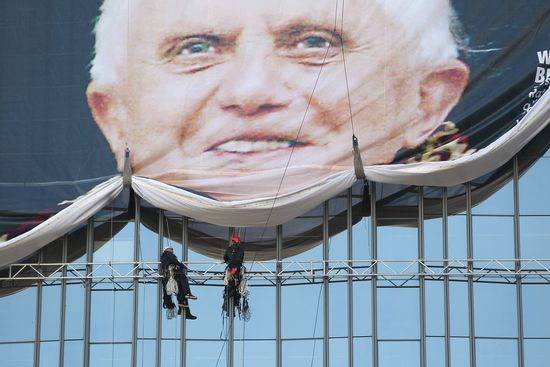
Workers unfurl a giant reproduction picturing the front page of tabloid Bild Zeitung the day after Joseph Ratzinger was appointed Pope Benedict XVI in 2005 on the facade of the Axel Springer Verlag headquarters on September 19, 2011 in Berlin, Germany. Pope Benedict XVI is scheduled to visit Germany, his homeland, from September 22-25. By Sean Gallup/Getty Images.

Modern Marriage

E.D. Kain eagerly anticipates Mitch and Cam's wedding on "Modern Family," which won five Emmys on Sunday:

I disagree that it’s unfortunate that Mitch and Cam aren’t married…yet. You see, I’m almost positive that during the show we’ll see the couple get officially, legally hitched. I’m not sure if this will follow the return of gay marriage to California, or whether they’ll tie the knot-tying into the show in some other way, but I do think we’ll get the wedding. The act of getting married on the show would be far more powerful and emotionally moving than having Mitch and Cam married from the outset.

Alyssa Rosenberg has lower expecations.

Perry On The Boy Scouts

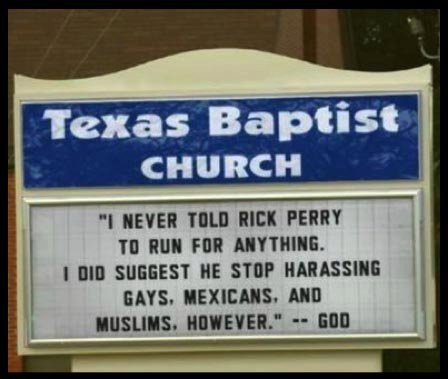
Texas-Baptist-Church-Rick-Perry

Justin Elliott finds the governor's book on the topic quite revealing:

Perry paints with a startlingly wide brush. “Student campus unrest, rejection of authority, the ‘self-esteem’ movement, moral relativism, and the demands of secularists all gradually fused into a series of attacks on American institutions,” he writes in the book. We learn that he disdains “secular humanism,” the “self-esteem movement,” and youth sports leagues that don't keep score. For good measure, he compares homosexuality to alcoholism, and supports corporal punishment of children. Ultimately, for Perry, the Boy Scouts are the litmus test in adjudicating sides in this culture war. (Perry, it bears mentioning, is a proud Eagle Scout; he’s known to still wear his Eagle pin on the lapel of his suits.) As Perry tells it, the Scouts are at the center of two of the main fronts in the culture war: religion and homosexuality. The group has long barred participation by atheists or “avowed homosexuals.”

(Image source here.)

The Unofficial Campaign

Super PACs have changed elections:

Despite the conclusion of the Supreme Court, there is no clear reason contributions to the Super PACs will not have the same effect of buying access to candidates and their staffs that more limited contributions have historically had. The court decision also clears the way for corporations to give money to efforts, potentially concealing the identity of the donors. Campaign finance experts fear that established non-profits, which do not disclose their donors, may be used as pass-throughs to conceal the identity of donors to a Super PAC. The U.S. Chamber of Commerce, for instance, could legally give money to a Super PAC without disclosing the source of the money, even if it had been earmarked from a specific corporation or wealthy individuals.

Interrogating Ahmadi

Abbas Milani has 10 questions for him on the occasion of his visit to the UN, including:

In recent Zogby polls, Iran has only 14 percent support among Muslims of the region, while Turkey's model of secular, democratic governance in an Islamic society is gaining more and more power and popularity. With Turkey's star on the rise and your ally Ayatollah Sistani, Shiism's highest-ranking cleric in the world, refusing to create a clerical regime in Iraq, and with Syrian despot Assad on the ropes, what do you think is the future of Iran's style of clerical absolute rule?

Netflix’s Gamble, Ctd

A reader writes:

I feel like Netflix has a great opportunity with this split. More people are streaming every day, and it's a burgeoning market. And, now that there's Qwickster, they wouldn't have to worry as much about alienating their analog customers. But I'm ready for Netflix to integrate their entire library to the streaming system. It's inevitable, and people will pay more for the larger library. If Netflix doesn't do it, someone else will.

The company should look to the music world for a business model. Spodify and Rdio are great examples of how it can be done.

Both sites offer streaming of just about every single album ever released by major labels and distributors. Rdio charges customers $4.99/month for unlimited web streaming, $9.99/month for unlimited web and mobile streaming. Spotify is a similar payment model, but it offers a much more personal experience for the consumer.  

If Netflix wants to win their customers' respect and trust back, they should make the experience similar to this. Access to the largest library of movies and TV shows for $20/month? People would be hooked. Hell, even $50/month for unlimited access would take millions away from cable. It would literally change the way people watched television. Maybe that's too steep, but I think something along those lines would be a game-changer.

It all comes down to the shifting of the ownership society to the access society. Instead of having a large collection of CDs and LPs that weigh a ton and literally take up rooms and warehouses, you can access the same amount of information and entertainment on a device that fits in your pocket and backpack. If Netflix doesn't do something quick, it's all over for them.

“Women In Niqab Are Effectively Under House Arrest”

Angelique Chrisafis checks in on the French burqa ban: 

There have been instances of people in the street taking the law into their hands and trying to rip off full-face veils, of bus drivers refusing to carry women in niqab or of shop-owners trying to bar entry. A few women have taken to wearing bird-flu-style medical masks to keep their face covered.