The 5th century BC Greek play gets a revival in the Philippines:
(Hat tip: Nerdcore)
The 5th century BC Greek play gets a revival in the Philippines:
(Hat tip: Nerdcore)
Various governments and religions throughout history have tried it:
Perhaps the strangest attempt to ban coffee came in Berlin in 1777. Fredrick the Great had no taste for the drink of merchants and worried what its effect might be on the army. "The King does not believe that coffee-drinking soldiers can be depended on to endure hardship or beat his enemies." He’d rather the troops drank the more manly, Germanic alternative: beer, which had clearly won more wars than any espresso had.
A reader writes:
Jesus said, "The poor you will always have with you." The US Census Bureau has effectively made this public policy by defining poverty as a function of the average income level. People have argued for a long time about whether this approach is the right one (linen shirts, and all that). But in any case, it renders discussions about whether the numbers of poor are rising or falling a bit meaningless.
Another writes:
I was a bit surprised by what you chose to include in your post on the Census Bureau's release of increased poverty indicators. By summarizing Wilkinson's point but not Drum's, the portrayal of the indicators' inadequacy is quite one-sided.
The flaw the Wilkinson article, compared to the Drum article, is that the official poverty rate indicators already underestimate the high costs of living that contribute to poverty. Wilkinson notes that "the poverty line is set [rather arbitrarily] at three times the food bill of a typical family in the early 1960s, adjusted for inflation. It is possible to complain about the adequacy of this way of fixing the poverty line, but let's leave it alone." Leave it alone? When as Drum notes, "official poverty thresholds developed more than 40 years ago do not take into account rising standards of living or such issues as child care expenses, other work related expenses, variations in medical costs across population groups, or geographic differences in the cost of living"?
While I do agree that poverty indicators should account for the impact of programs like Section 8, food stamps, Medicaid, and the Earned Income Tax Credit (perhaps with side-by-side figures for the poverty level "before and after" these sources of assistance, which would provide some outcome indicators for these programs' effectiveness), they should also account for the actual costs of maintaining a minimum standard of living in different localities. The last point is key, since after all $20,000 a year might well be able to minimally feed and house a family of four in rural Nebraska, but not in urban Washington, DC or New York City, where the cost of living is exponentially higher.
A more accurate measurement is needed, and I'll look forward to seeing the soon-to-be-released proposal Drum mentions. Whether intentionally or not, by citing Wilkinson's point and not Drum's you came off as echoing the Heritage Foundation's continued insistence that the increasing affordability of (used) home appliances somehow means that people aren't "really" poor.
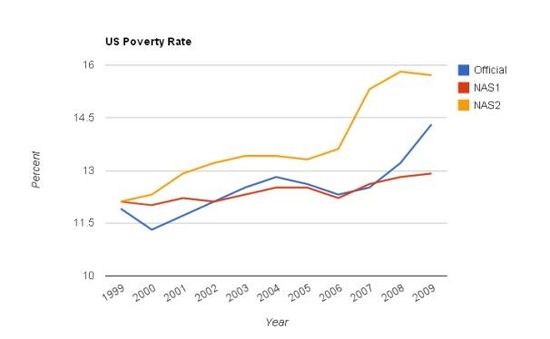
Suzy Khimm chimes in by showing how the Obama administration has developed a model that is likely to show even higher rates of poverty (even when you factor in things such as food stamps and EITC, as Wilkinson recommends). She captions the above chart:
The yellow line (NAS2) shows that poverty is significantly higher than the official rate. But the red line (NAS1) is mostly lower. What’s responsible for the difference? Both experimental rates factor in the benefits of public assistance, as well the cost of out-of-pocket medical expenses, work transportation, etc. But the lower rate is adjusted to the Consumer Price Index, while the higher rate is based on the Consumer Expenditure Survey–an average for actual consumer spending on food, clothing, utilities, and shelter by those at the 33rd percentile of income.
Another reader:
Regarding the photo you used: I think it subtly contributes to the errant stereotype that poor people sit around doing nothing all day. In truth, most poor people are busy the whole day working to try to keep themselves and their families from becoming more poor. I would suggest you find a photo instead that illustrates one of the working poor racing out the door at the end of the shift from his first job to make it to his second job on time, or of a working mother rushing to drop her kids off at daycare so she doesn't miss the bus that will take her to work, or that same mom, with tired hungry kids on her lap, on the bus on the way home at the end of the day. How about farmworkers stooped over in the setting sun, or nursing home aides standing on swollen feet at the end of a double shift? There are plenty of poor people in America, and most of us don't sleep on the street.
Today on the Dish, Andrew supported Obama's call for the rich to contribute their share, with which most Americans overwhelmingly agree. The full web reax is here, Bruce Bartlett questioned Obama's attention to the economy, and we pursued more analysis on whether green jobs are endangering the cause. Andrew cheered news of the Conservative party in Britain's support of full marriage equality, and assessed how this recession differs from those in the past, while a Louisiana Congressman argued he can't afford a tax increase because $400,000 isn't enough to live on.
Andrew parsed the evolution of the Israel lobby and being pro-Israel or pro-Greater Israel, while a majority of the world's public, including America, supports a Palestinian state. NRO earned its keep for a Palestine-inspired Malkin Award, Republican infighting broke out over defense spending, and Andrew Breitbart jumped off the paranoid deep end but promised to be packing heat. Terror alerts should tell us what to do in the event of a terror attack, the "responsibility to protect" imagery projected pure imperialism, and the world turned its back on Yemen's massacre over the last couple of days.
We awaited DADT's end tomorrow and reconsidered how much of our own tax dollars goes towards policies we disagree with. Perry's approval ratings plummeted, his Afghanistan policy defied logic, but his campaign methods have proved very successful in the past. Romney appeared the strongest contender for Obama, attack ads work, and the GOP needs to get over its anti-intellectualism. Mike Tyson bragged about Dennis Rodman's endowments, Gaultier survived childhood by doodling, and Netflix gambled on our willingness to compartmentalize our desires. A father pondered circumcision, we tracked Medicare Advantage improvements that may be a result of Obamacare, and Obama's war on drugs was basically indistinguishable from Bush's.
Chinese restaurants wooed Halal diners after they'd successfully nabbed the Jews, and a new report busted the myth that minorities get more scholarship money. Charles Kenny argued organic food markets hurt the world's poor, we chastised but never changed the financial and oil drilling systems that went so horribly wrong, and an end to smoking could save us $211 billion. One reader attested to high levels of meth use in some gay communities, another connected meth to lethal prescribed drugs, and another reminded us there's already been a great gay superstar: Martina Navratilova. Good schooling isn't tied to price, and Mr. Rogers is reason enough to support PBS.
MHB here, FOTD here, VFYW here, and the views from your airplane window here.
–Z.P.
Jacob Sullum takes stock of how little has changed under this president, despite promises to the contrary. On medical marijuana raids:
[S]ince the Justice Department now says anyone but patients and caregivers is fair game for prosecution, Obama’s policy is indistinguishable from Bush’s. … The problem is that most of the "individuals with cancer or other serious illnesses" whom the Obama administration claims to be sparing are not up to the task of growing their own marijuana. When DEA raids or Justice Department threats to landlords shut down dispensaries, [Americans for Safe Access spokesman Kris Hermes] notes, "patients wake up the next morning wondering where they’re going to find their medication." The administration’s position, essentially, is that patients can have marijuana; they just can’t get it anywhere.
Palestine and beyond.
Before outlining education reforms that work, The Economist points to a disconnect:
The idea that good schooling is about spending money is the one that has been beaten back hardest. Many of the 20 leading economic performers in the OECD doubled or tripled their education spending in real terms between 1970 and 1994, yet outcomes in many countries stagnated—or went backwards. Educational performance varies widely even among countries that spend similar amounts per pupil. Such spending is highest in the United States—yet America lags behind other developed countries on overall outcomes in secondary education. Andreas Schleicher, head of analysis at PISA, thinks that only about 10% of the variation in pupil performance has anything to do with money.
A reader supplements our post:
I bet you've had a lot of people send you this video of Mr. Rogers defending public broadcasting during a 1969 Senate hearing. His sincerity overwhelms.
A new book imagines it. Sarah Kliff recaps:
The authors estimate that if all smoking ceased in 2006, 2.8 million premature deaths would be avoided between then and 2025. Health spending would decrease by $211 billion, or 1.52 percent, in that same time period. The economic effect on public programs, however, would be more of a mixed bag.
States’ Medicaid costs would noticeably decrease: lower-income populations have higher rates of smoking and the negative health outcomes that follow. But states would also lose revenue from cigarette excise taxes, which amounted to $13.75 billion in 2006. …With Americans living longer, Social Security would bear the increased cost of supporting people for a longer time. But those costs are slightly offset from an increase in healthy workers, who “tend to earn more and retire later,” leading to higher contributions.
Kris Alexander deepens his colleague Ackerman's reporting by discussing his own experience with Islamophobia in our national security institutions:
When I read Spencer’s piece, it underwhelmed me with the old news. I sent some tweet snark his way, and had an IM spat with Noah Shachtman about it. Then a funny thing happened; I realized that this was a big deal. How much of my tax dollars had been spent spreading the crap? When you’re in the institutions, sometimes it’s hard to see how they look from the outside. The story seems to be growing legs, and I hope it fuels some changes. Our first responders — hell, all of us — deserve better.
 The Dish