Face Of The Day

125622095

Mary Ann Sheridan holds her 1-year-old baby Katlin outside the barricaded entrance of the traveller settlement at Dale Farm near Basildon, Essex, south east England, on September 19, 2011. Bailiffs surrounded Britain's biggest traveller settlement on Monday to carry out a mass eviction, but residents chained themselves to barricades and vowed to resist the clearance. Around 200 remaining travellers and supporters locked themselves in, blocking the main gate with a van and setting up barricades using tires and barrels filled with concrete. The sign reads, "Danger of death. Behind this gate a woman is attached by her neck. If you attempt to open this gate you will kill her." By Adrian Dennis/AFP/Getty Images.

The Folly Of Anti-Intellectualism, Ctd

Matt Lewis warns that the Republican "everyman" shtick is becoming irresponsible:

As much as we decry the state of America’s modern educational system, Americans are becoming more urbane and more highly educated (they are also more skeptical and less likely to fall for trite bromides)…At some point, being anti-intellectual becomes a liability. At some point, this becomes a mathematical and demographic issue…Republicans should take Rubin’s advice seriously — not because it would make make Rubin more comfortable admitting to be a Republican on the cocktail circuit (though it might) — but because it’s the only way Republicans can enact the kinds of fundamental changes that are necessary in order for America to win the 21st century.

Is Obamacare Working? Ctd

It has likely increased insurance coverage for young adults. Are the Medicare Advantage cuts also paying off?

Medicare Advantage plans are becoming cheaper, slightly more people are enrolling in them, and everybody on Medicare — even seniors  in the traditional government-run program — has better coverage than they did before.

Sarah Kliff thinks these trends have little to do with the new healthcare law.

Malkin Award Nominee II

"Abu Mazen’s goal is not independence — which was available in 1948 and at many points thereafter — but rather to stay in office and not concede any/all of his mentor Arafat’s three touchstones of the Palestinian revolution: ● an independent Palestine without conceding the legitimacy of Israel’s sovereignty; ● its capital in Jerusalem; and ● the entry of Palestinians who left the area in 1948–49 and their descendants into pre-1967 Israel with the rights of citizenship. The Palestinians have for decades been masters at producing new, inventive, and bloody ways to hang on to those demands, drain money from Western coffers, subvert Israel and avoid penalty for the multi-generational ruin of their own people: hijacking airplanes; wrecking Lebanon; two bloody uprisings; subverting treaties; destroying Jewish antiquity under the Temple Mount; bigger and more accurate rockets from Gaza; and the BDS movement… [Abbas] wrote his Ph.D. thesis in Moscow on “secret relations” between Nazis and Jews and was the bag man for the Munich Massacre," – Shoshana Bryen, NRO.

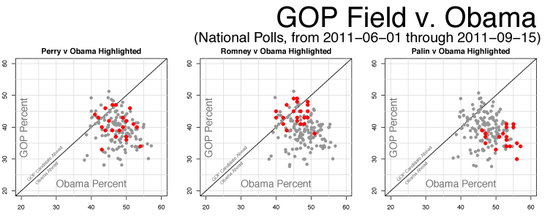
Who Can Beat Obama?

GOP_Obama

Romney looks like the strongest general election candidate:

While no GOP candidate has established a consistent lead, Romney and Perry show the greatest number of leads. Romney’s results are in a more compact region, showing some consistency as a serious challenger to Obama. Perry’s data is much more spread out, though this could reflect both his recent entry and relative unfamiliarity with voters as well as his recent downturn seen in the first chart above. We need more time to get a good fix on the dynamics of the Perry candidacy.

The Power Of Presidential Focus

Repeating an oft-heard complaint, Bruce Bartlett wishes Obama had paid more attention to the economy:

Imagine that instead of wasting months on health reform and other non-economic and non-time-sensitive measures in 2009 and 2010, Obama had single-mindedly kept his attention on the economy. If the time he spent being briefed on health reform had instead been spent with his economic advisers, then perhaps he would have been more aware than he appears to have been that the stimulus was insufficient. Perhaps there might have been opportunities during the appropriations process to raise and redirect funds into more economically stimulative channels. Perhaps the Federal Reserve could have been pressured to be more aggressive in terms of monetary policy.

Kevin Drum dissents:

I really think we often overestimate just how much difference presidential "attention" makes. It's just not possible to stay focused laser-like on the economy for years at a time when (a) things really do seem to be improving, and (b) your own party is eager to get moving on other stuff. That was the situation in early 2010. I'm not convinced that there was really all that much Obama could have done about it.

Jonathan Bernstein counters Drum, but Seth Masket backs Drum:

One virtue of having a large administrative branch is that the "president," broadly speaking, can focus on many things at once. Just because the president is making a speech on health care doesn't mean that his economic advisors aren't focused full time on monitoring the economy and reporting to him regularly about its health and recommending policies. Furthermore, the president giving speeches constantly on the economy doesn't make the economy any healthier.

Are “Green Jobs” A Scam? Ctd

Yglesias bemoans a political double standard:

When Newt Gingrich says we can “create jobs” by drilling for oil everywhere, he’s saying that he thinks the optimal long-term growth strategy for the United States is to try become more of a natural resource extraction economy. It is true that when Barack Obama touts “green jobs” as the future of the American economy, he’s saying something that doesn’t literally stand up to scrutiny. What he means is that he wants a higher productivity economy that also has less pollution. But the only analytic error he’s making here is the exact same analytic error that all politicians are making when they talk about “job creation.”

Karl Smith follows up. Massimo Calabresi believes that the green jobs movement is off the tracks:

I’m all for innovation and believe in government investments to fuel it. But just as Jimmy Carter’s solar subsidies in the ‘70s did lasting damage to renewable energy’s credibility, the green jobs movement is in danger of undermining itself for years to come by projecting utopian scenarios through the lens of bad numbers. In the wake of Solyndra, supporters of renewables need to find credible solid ground to stand on if they want to avoid a complete rout. Politically, it may already be too late.

Earlier thoughts on green jobs here and here.


“This Is Not Class Warfare. It’s Math.” Reax

Ezra Klein:

The White House's strategy here isn't to appear so reasonable that Republicans can't help but cut a deal. They feel they tried that during the debt-ceiling debate, and it failed. The White House's strategy here is to produce a popular plan that strikes directly at Republican vulnerabilities on taxes and Medicare. If that scares the GOP and makes them more interested in coming to an agreement in the supercommittee process, then great. If not, it gives the White House a message to base its reelection campaign off of.

Zackary Karabell:

Compared … with the proposals of Obama’s own deficit-reduction committee at the end of 2010 or with the audacity of the Tea Party, these initiatives are modest. And that may be the most significant weakness. The jobs bill proposed, at less than $500 billion, is modest for a $15 trillion economy. The budget reductions of $3 trillion over the course of a decade—modest. The rhetoric is bolder, but the underlying actions aren’t.

Matt Yglesias:

[T]here’s no real chance of implementing this idea. Yet as a statement of vision it sets up the contrast with the opposition quite clearly. House Republicans want to repeal Medicare in order to make tax cuts for the rich affordable, President Obama wants to tax the rich in order to make Medicare affordable. Some critics will focus on the relatively small changes to federal health care programs here, but the President is essentially doing what progressives have been urging him to do for months — abandoning the strategy of pre-compromising, and planting his flag in a way that draws strong contrasts.

David Frum:

[Obama's] offering the sharpest left turn since Teddy Kennedy’s challenge to Jimmy Carter in 1980. The President’s new brainwave is a stunt that threatens the country’s long-term prosperity and growth. The lapse of the Bush tax cuts plus a new millionaire tax bracket thrusts us back to the high rates of the 1970s.

Steve Kornacki:

[W]hat we have here is the makings of a reelection strategy, one rooted in redirecting swing voters’ intense anxiety, frustration and anger away from Obama and onto the GOP. Obviously, there’s not much inspiring about this, but it’s probably Obama’s best bet for winning a second term — and maybe then having more leverage to actually enact some of his preferred economic policies.

James Joyner:

[T]he idea is to get a promise to raise taxes in exchange for spending “cuts” achieved by ending two wars when they’re planned to end and some Medicare savings that will begin toward the end of the next presidential term and phase in over the next two terms after that? Sweet. I get that this isn’t so much a plan as a campaign strategy. But even by that standard, this is pretty silly.

Greg Sargent:

[T]here’s a ton of commentary out there today to the effect that this new posture is about nothing more than appealing to the Dem base. But that’s thoroughly bogus: Whether they’re right or wrong, Obama and his advisers have also decided that this is a good way to appeal to independents, too. Polling shows that while indys marginally disapprove of Obama’s jobs plan, and are deeply skeptical of his performance on the economy, solid majorities of them support his actual jobs-creation prescriptions.

Peter Suderman:

Obama is actually right that the current tax code is a mess. The American economy would be better off with a simpler system that isn’t riddled with complications and special exceptions. A simpler system would also allow for lower across-the-board rates. But the president's proposal, which merely selects a handful of politically convenient carve-outs for elimination, wouldn’t simplify the system in any way that really matters in the broader scheme of things. If anything, the administration is using the tax code’s complexity to its own advantage, framing targeted tax hikes as a form of tax-code simplification.

Austin Frakt:

It’s as much a political statement as a policy one. It is a statement about how the president views Medicare and how he intends to defend it. The message of his proposal is this: Medicare requires change, but that change should be within, not to, its current structure. The big news is that changing Medicare’s fundamental form is itself grounds for debate.

Jamelle Bouie:

[T]he question for this proposal isn’t whether it will pass Congress (it won’t), but whether it will bolster Obama’s standing with Democratic voters, and move public opinion in his direction

Earlier thoughts here.