Perry’s Social Media Strengths

Ezra Klein sets his sights on the unconventional campaign employed by Perry's campaign manager Dave Carney, in the 2006 gubernatorial election:

Carney invited four political scientists — “our four eggheads,” he would call them — into the campaign, and let them run wild testing ad buys, candidate visits, yard signs and the like. … A visit from the candidate had an enduring impact, both in the minds of voters and in the favorability of the local news coverage. Direct mail, robocalls, newspaper ads and visits to local editorial boards didn’t much matter, so Carney banished them from the next race. Most of the voters Perry was targeting were using social media heavily, so his campaign focused on creating virtual networks rather than opening regional campaign offices, a traditional mainstay of statewide races.

Perry easily won his subsequent elections.

Ezra insists he should apply the same logic to global warming:

A powerful hurricane is a problem if you’ve prepared for it. It’s a catastrophe if you haven’t. … If Perry needs convincing of that, he can just ask Carney and the eggheads whose data-driven labors helped put Perry in position to run for president.

Abby Rapoport pores over Perry's playbook:

Rather than making phone calls and wearing Perry t-shirts, would-be supporters were asked to do something very, very specific: turn out 12 Perry votes from their friends and family. … Almost 1.5 million voted in the Republican primary, more than had voted in 2008 when GOP presidential nominees were still battling it out. The unprecedented turnout carried Perry to a decisive victory over Hutchison.

A Majority For A Palestinian State

_55444763_palestinian_bbc_poll_464_gr

Global polling shows 2-1 support across the world, including the American public:

The United States and the Philippines both polled 36% against the resolution. But 45% of Americans and 56% of Filipinos backed recognition. The lowest level of support was in India, with 32% in favour and 25% opposed, with many undecided.

Support was strongest in Egypt, where 90% were in favour and only 9% opposed.

In other Muslim countries, Turkey recorded 60% support, 19% opposition; Pakistan 52% for, 12 against; and Indonesia 51% for, 16% against. Chinese were among the most enthusiastic supporters, with 56% in favour and just 9% opposed.

Note the data from Egypt. Sooner or later, the US will have to choose between its core interests – supporting and allying with the newly democratic nations of the Middle East, from Turkey to Egypt, and getting on the right side of history – or being for ever marginalized in this amazing development by the pro-Greater Israel lobby. If only the US vetoes the Palestinian bid, Israel will have inflicted a devastating blow against its alleged ally (and non one will be more pleased at Obama's humiliation than Netanyahu who has built his government around the destruction of the Obama presidency, and all the opportunities it holds for the US.

The Tories Back Full Marriage Equality

102147284

What a contrast. In the US GOP, gays are the spawn of Satan, and a leading candidate runs a business designed to "cure" them. In Britain, the Conservative-Liberal Coalition government has just announced it is moving ahead with legislation for full marriage equality:

Lib Dem Equalities Minister Lynne Featherstone today declared … "I am delighted to announce today that in March this Government will bring in a formal consultation on how to implement equal civil marriage for same-sex couples.

"And this would allow us to make any legislative changes necessary by the end of this Parliament."

She added: "Civil partnerships were a very welcome first step, but as our constitution states, this party rejects prejudice and discrimination in all its forms. And I believe that to deny one group of people the same opportunities offered to another, is not only discrimination, it is simply not fair."

When Virtually Normal came out in 1995, I didn't dare hope that this day would come – or that it would come from the Conservative party in Britain, which now has more openly gay members of parliament than the more liberal opposition. And it is, of course, a conservative position: promoting family, responsibility, and civil equality in response to an emerging social reality – large numbers of openly gay citizens. In this sense, the GOP is not in any way "conservative". It is better understood as a religious movement with radically reactionary political objectives, like undoing much of the New Deal.

One day, it may recover, and candidacies like Jon Huntsman's show the way forward. But not yet. And perhaps not for a very long time. When a party becomes a religion, and when policies become doctrines, change is very hard.

(Photo: Britain's Deputy Prime Minister Nick Clegg (R) smiles after Britain's Prime Minister David Cameron made a joke during a speach to guests at the Gay Pride reception in the garden at 10 Downing Street, in central London on June 16, 2010. By Andrew Winning/Getty.)

Dumping Tea On The Military-Industrial Complex

Eli Lake reports on intensified Republican infighting. Spencer Ackerman comments:

The defense hawks are making a budgetary argument, not a strategy argument, and hoping no one sees the difference. The defense doves are also making a budgetary argument, not a strategy argument, because they're not typically interested in defense strategy, just currently interested in the first-question argument that everything should be cut.

The Pro-Greater-Israel Lobby

A few years ago, it was not permitted to use the term "the Israel lobby" in establishment media. It was, as Jeffrey Goldberg once thundered, inherently anti-Semitic. This is piffle, of course – even though such piffle was reinforced by relentless smears and diatribes and accusations of anti-Semitism against anyone prepared to report the truth. In that context, you don't get more Washington Establishment than Tom Friedman. A sentence from his excellent column today:

This has also left the U.S. government fed up with Israel’s leadership but a hostage to its ineptitude, because the powerful pro-Israel lobby in an election season can force the administration to defend Israel at the U.N., even when it knows Israel is pursuing policies not in its own interest or America’s.

If you live long enough … My only suggestion is that the terms Israel Lobby or pro-Israel Lobby be retired, because they are somewhat dated. The question now is not whether you are pro-Israel or not. It is whether you are pro-Greater Israel or not. Of course, AIPAC will deny any such thing, as will swathes of TNR-style Israel supporters. But since these groups expend every ounce of energy ensuring that settlements continue to be built on the West Bank, while claiming they oppose them, I think it's more accurate. Any Israel supporter who opposes any serious pressure on Netanyahu to stop the settlements is objectively pro-Greater Israel.

“This Is Not Class Warfare. It’s Math.”

125624415

The president's policy is simple, really. More stimulus now, more fiscal retrenchment later. And there is no way that we can – or should – balance the budget entirely on the backs of the poor and the middle class. There has to be some contribution from those most successful in an economy that continues to reward them more and more generously, even as the country's debt escalates.

The deal is basically this:

$1.5 trillion in tax increases, primarily on the wealthy, through a combination of letting the Bush-era tax cuts expire, closing loopholes and limiting the amount that high earners can deduct. The proposal also includes $580 billion in adjustments to health and entitlement programs, including $248 billion to Medicare and $72 billion to Medicaid. Administration officials said that the Medicare cuts would not come from an increase in the Medicare eligibility age.

Senior administration officials who briefed reporters on some of the details of Mr. Obama’s proposal said that the plan also counts a savings of $1.1 trillion from the ending of the American combat mission in Iraq and the withdrawal of American troops from Afghanistan.

So a Democratic president is prepared to cut Medicare even further than he already has, while taking us back to Clinton era tax rates for the wealthy and ending the Bush-Cheney wars. Isn't this what he was elected to do? And if the alternative is gutting Medicare, or social security, while maintaining historically low tax rates for the super-rich, I just don't see how this isn't a winning argument.

Some believe that's now irrelevant. By allowing the GOP to define his presidency in grotesquely misleading ways and by presiding over continued mass unemployment, Obama is, we are told, toast. But this is political gaming, not policy decision-making. I remain of the view that, in the end, arguments matter and proposals count. A  2-1 spending cuts to tax hikes ratio is substantively what many Americans support. Greg Sargent notes of a recent poll:

* A solid majority, 56-30, favors significantly cutting payroll taxes for working Americans.

* A majority, 52-40, favors Federal aid to state governments to avert public employee layoffs.

* A huge majority, 80-16, favors spending money on the nation’s infrastructure in order to try to create jobs.

* A big majority, 71, favors reducing the deficit through a combination of tax increases and spending cuts; a meager 21 percent favors only spending cuts.

* A solid majority, 56-37, favors reducing the deficit with tax hikes on households earning $250,000 a year or more.

* A solid majority, 56-29, thinks creating jobs should be prioritized over cutting spending.

If these are the terms of the fiscal and economic debate, it seems to me that Obama has positioned himself on the majority side, and the GOP, especially if led by Perry, are on a dangerously long limb. I'd prefer major tax reform on the Bowles-Simpson lines. I'd prefer more Medicare savings. But this is a sensible set of proposals, hard to oppose without resort to hard ideology, and worth trying.

(Photo: Chip Somodevilla/Getty.)

Rick Perry’s Afghanistan Policy

Decoded:

A presence of 100,000 troops seems too high to Perry, but he opposes Obama’s plan for a modest withdrawal of about 30,000 troops because it’s apparently driven by “politics.” He’s against a precipitous withdrawal, yet he’s interested in a 60 percent reduction in forces–to a level that would make David Petraeus bang his forehead on his desk.

Perry’s Slide

This poll is from Rasmussen, the GOP-tilted pollster, which makes it all the more striking:

A new Rasmussen Reports national telephone survey of Likely U.S. Voters shows Obama picking up 46% of the vote, while Perry earns support from 39%. Fifteen percent (15%) are either undecided or prefer another candidate. Two weeks ago,  Perry was up by three. Three weeks ago,  the president held a three-point edge over the governor. (To see question wording, click here.)

Now, Perry’s chief rival for the nomination, former Massachusetts Governor Mitt Romney, holds a three-point lead on the president.  Another GOP hopeful, Congresswoman Michele Bachmann, trails Obama by double digits.  The fluctuation in Perry's, Romney's and Bachmann’s numbers comes as a Generic Republican  maintains a steady lead over the president. 

The debates may be both cementing Perry as a front-runner while dooming him as a general election candidate. When a president has a 40 percent approval rating and he still beats a specific competitor by 7 points, the opposition is in serious trouble.

The Collapse Of American Jobs

Screen shot 2011-09-16 at 8.46.58 AM

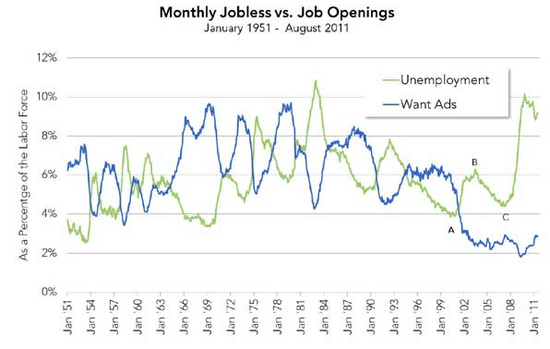
Kenworthy's conclusion from Scott Winship's chart:

In the 2001 recession, posted job openings as a share of the labor force (the blue line in the graph) fell to their lowest level in more than half a century. Then, as the economy picked up steam, posted openings didn’t budge. The lack of increase was a sharp departure from previous upturns. Many hope that when the economy finally gets moving again, we’ll return to the glory days of rapid employment growth. But developments in the 2000s, prior to the crisis, paint a discouraging picture.

I think people are slowly realizing that this recession is different, and this recovery is different. It is occurring as billions of people join the global economy in India and China, as technology wipes out whole industries at an accelerating pace, and as the rewards for innovating in the global economy enrich the few and the successful in ways utterly beyond the means of their compatriots.

Part of me wonders if it will be decades before the US returns to full employment, as we have known it, let alone wages that can sustain a vibrant middle class.