What exactly does he know about Dennis Rodman that we don't?
Month: September 2011
Why Attack Ads Are Inevitable
They work:
Perry leads in the polls, while Bachmann and Paul trail substantially. As the model predicts, trailing candidates are attacking the front-runner. Why? Because these candidates improve their relative position in the polls more by undermining Perry’s support than by trying to attract undecided voters. … Perry is not somehow nobler for “taking the high road.” Rather, candidates are simply responding to the electoral incentives they face. In this particular case, trailing candidates need to attack.
Censure But No Change
A new report (pdf) officially blames BP for choosing cost-cutting measures over safety at the Deepwater Horizon rig. Peter Maass spots a pattern:
After disasters like the BP spill and the financial meltdown, two outcomes seem possible: real reform and a better system, or superficial change and danger-as-usual. The financial meltdown occurred in 2008, two years before the BP disaster, and it’s pretty clear which way that story is going. Modest financial reforms have been instituted but nobody of substance has been punished, and the big banks are bigger than ever and as powerful as ever, perhaps more so, in view of the Supreme Court’s Citizens United decision giving corporations greater leeway to make political donations. The banks remain too big to fail and could well fail again. The BP spill is following the same unfortunate path.
Kiley Kroh notes that Congress has failed to pass a single piece of legislation aimed at strengthening offshore drilling safety or oversight.
The View From Your Airplane Window

Coastal Maine

Cité Solei, Port-au-Prince, Haiti, “one of the worst slums in the Western Hemisphere”
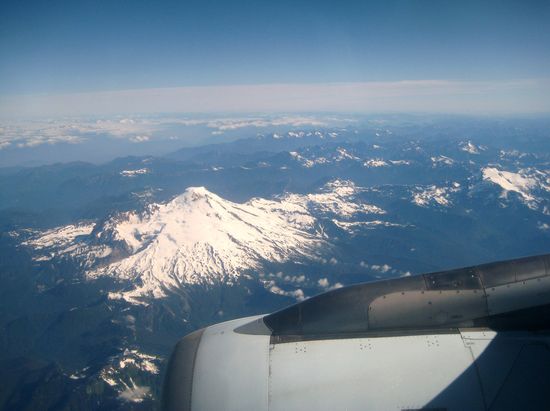
“Flight to Vancouver over Montana”
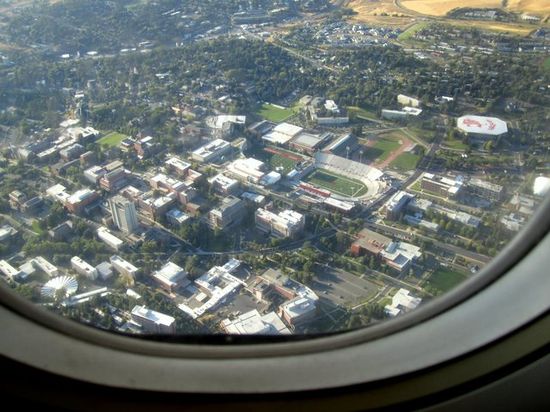
Washington State University, Pullman, Washington

Mendenhall Glacier, Juneau, Alaska
Should We Ditch Organic?
For the sake of the world's poor, Charles Kenny argues yes:
The best way to help poor people eat well is to make healthy food cost less. But the more agricultural land we divert into lower-efficiency organic production, the higher the price of all food will climb. On test farms, organic production has been shown to be at least as efficient as conventional farming — and considerably more productive than the average efficiency seen on farms in the developing world. But until that's widely replicated outside agricultural research stations, organic is no friend to the world's poorest consumers.
Why Do Jews Love Chinese Food? Ctd
A reader writes:
This article from the Jewish e-zine Tablet gives an excellent and very plausible explanation for the connection between Jews and Chinese food (you can ignore the stuff about the "hip Brooklyn deli").
Another writes:
Philip Roth also addressed this in Portnoy's Complaint. There, Portnoy says his father loves going to the Chinese restaurant because the waitstaff treat him better than he thinks he would be treated at a tony, cloth-napkin joint. "They think we're white," he imagines his father thinking.
Another writes along the same lines:
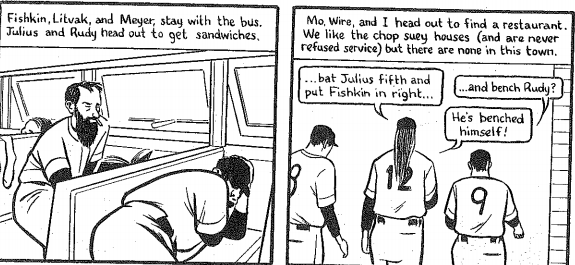
James Sturm’s great graphic novel “The Golem’s Mighty Swing” depicts a barnstorming Jewish baseball team in the Midwest in the early 1920s. There’s a throwaway line in one panel, literally a parenthetical aside, where the narrator says “Mo, Wire and I head out to find a restaurant. We like the chop suey houses (and are never refused service) but there are none in this town.”
Jews were subject to racial prejudice parallel to that suffered by African-Americans, and even beyond the boundaries of melting pot New York, Jews and the Chinese would have been the most marginalized of non-black groups. The outcasts will stick together one way or another.
Cartoon excerpted above. Another reader:
Some years ago, one of the much-acclaimed Lyrics and Lyricists concerts at the 92nd St Y happened to fall on the Jewish New Year. The great founder of that series, Maurice Levine, told the following joke (since I don't remember what year it was, I have used the current year):
Welcome to the year 5771. Did you know that this is the Chinese year 4709? Do you know why that's important? It means the Jews wandered in the desert for more than 1000 years before they could get Chinese food.
The elderly Jewish audience ROFLed.
Another looks ahead:
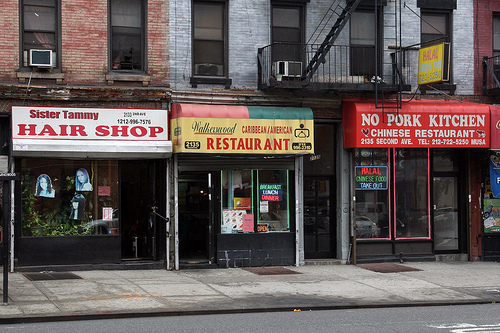
There is the "No Pork Kitchen" Chinese restaurant in New York. (There was a similarly-named Chinese restaurant in an Arab neighborhood in Brooklyn.) The neon sign in the window says, "Halal Chinese Food":
So we're moving from Kosher to the very similar Halal, as Chinese restaurants target new immigrants.
Update from a reader:
The photo of a restaurant displaying a "Halal Chinese Food" sign is probably not an example of a Chinese restauranteur adapting to new (Muslim) immigrants to the US. China has had a significant Muslim minority for centuries, and consequently, has a traditional Chinese-Islamic cuisine. In one of these restaurants in California, the Chinese sign in the window reads, "Islamic food", while the Arabic sign reads, "Chinese food".
The Absurdity Of Terror Alerts
Ackerman recalls the paranoid genius of the old Homeland Security Advisory System. Napolitano has revised the system, but Ackerman and Bruce Schneier aren't impressed:
Unlike warning systems for, say, extreme weather, the advisory—now as then—doesn’t tell you what to do in the face of a looming terrorist attack. “For it to be useful,” says Bruce Schneier, a security consultant and vigilant critic of terror hysteria, “the alert would have to say, ‘There’s a terrorist on this corner of this street, right now. Instead of making a left, make a right.’ It’s not going to do that. It’ll be, ‘There’s a terror alert in New York on Tuesday.’ The same bullshit.”
Busting The Scholarship Myth
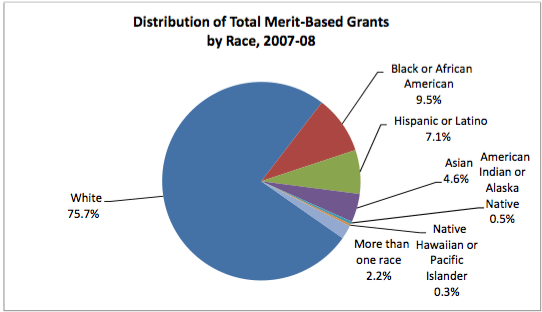
Money quote from a new report, "The Distribution of Grants and Scholarships by Race" (pdf):
White students receive more than three-quarters (76 percent) of all institutional merit-based scholarship and grant funding, even though they represent less than two-thirds (62 percent) of the student population…
Kay Steiger echoes the report's author, Mark Kantrowitz, that "this might be because scholarship committees are overcorrecting for the idea that there are a plethora of scholarships for various minorities." Yglesias considers other factors:
Schools want to produce two things. One is rich alumni who give them money, and the other is high ratings from US News and World Report. … And since high school seniors from high socioeconomic status families tend to already be better-prepared for college than kids from low-socioeconomic status families, that means that financial aid resources naturally flow to the high-socioeconomic status students.
Freakonomics points to another possible explanation:
In attempting to understand why the numbers stand as they do, Kantrowitz postulates that the creators of scholarships look for recipients like themselves. As an example, minorities are less likely to compete in sports like swimming, and downhill skiing, while many scholarships are geared towards these pursuits.
The Collapse Of Meth; The Rise Of Pot, Ctd
A reader writes:
I find myself entirely unsurprised by the drop in usage of crystal meth. Pretty much the exact same thing happened with crack. Usage increased, addiction became widespread, the media turned it into a circus, lives were destroyed, younger people saw those lives destroyed and decided it wasn’t worthwhile, and use collapsed. You should also note that this collapse is happening at a time when law enforcement is complaining that cutbacks would result in higher meth use.
Another writes:
Not sure I agree with the concept that people are "moving off drugs that kill you toward soft drugs." I believe the survey’s result have more to do with the fact that people who have always been marijuana users are now feeling freer and less demonized, thus permitting said users to comfortably admit the truth on a survey.
Another:
I have several questions and observations about the statistic showing a 50% collapse in meth use from 2006-2010. First: as a former meth user, how would the government possibly know to have included me in such a statistic?
I never answered a questionnaire about it, and didn’t even tell my close friends and family. The range and amount of any individual’s use could vary so widely that I don’t see how any accurate data could be gathered even indirectly by, for example, measuring the trace amounts of the drug in the city’s waste water. How are those numbers derived, I wonder?
Second: I still see observably huge numbers of PnP’ers in the gay community in some cities (Dallas, for example). If you go on any of the gay hookup sites and just talk with people, you can very quickly get tired of being asked to PnP. If you’re a sober bottom in those cities, you’re almost out of luck. I’m not so sure the use of meth is that low. Again, the fact that government policy drives drug use underground makes their estimates very suspect, in my book. There’s no real way to measure how many actual drug users are out there because there’s no way to measure the transaction of buying drugs.
Third: if the statistic is at all accurate, it flies in the face of the public service messaging and the "recovery" industry’s assertion that meth is so addictive it is nearly impossible to overcome. I did it (though it took some time!) People can quit, and although I think a good number of the ½ of the users died before they quit, there are lots of former users too. Maybe our stories should be publicized to give hope to those who want to quit but haven’t … yet. But just like the actual data on the difficulty of transmitting HIV if you’re undetectable, they can’t suffer facts if there is any chance it undermines the "not tolerance" message. Not unlike the radical sex abstinence position that also doesn’t work.
Pakistan And The US: It’s Complicated
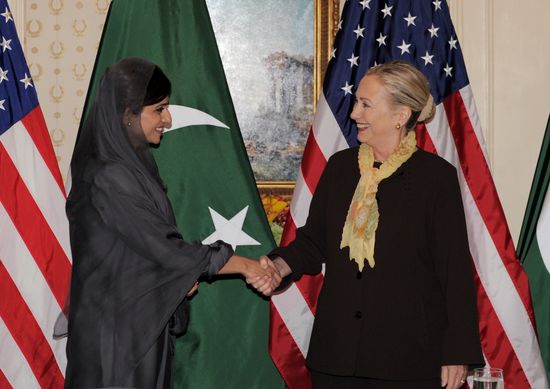
Mohsin Hamid examines our relationship:
For a decade … successive civilian Pakistani finance ministers have gone to Washington reciting a mantra of “trade not aid.” They have been rebuffed, despite a WikiLeaked 2010 cable from the US embassy in Islamabad strongly supporting a free trade agreement with Pakistan and citing research showing that such an arrangement would likely create 1.4 million new jobs in Pakistan, increase Pakistani GDP growth by 1.5 percent per year, double inflows of foreign direct investment to Pakistan, and (because Pakistani exports would come largely from textile industries that US-based manufacturers are already exiting) have “no discernible impact” on future US employment.
(Photo: US Secretary of State Hillary Clinton shakes hands with Pakistan's Foreign Minister Hina Rabbani Khar before their meeting on September 18, 2011 at a hotel in New York. Both are in New York for the upcoming United Nations General Assembly. By Stan Honda/AFP/Getty Images)
 The Dish