"Fish fuck in it," – W. C. Fields, on why he refused to drink water.
Month: September 2011
The View From Your Window
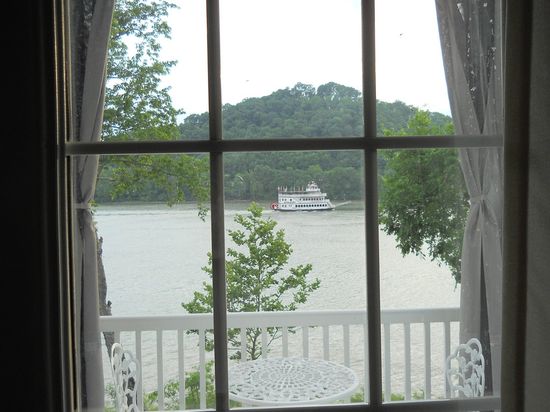
Ripley, Ohio, 3 pm
Waiting For A Gay Superstar
Will Leitch taps his fingers:
An openly gay athlete is an inevitability, and his coming out may not be so difficult after all. “I can’t imagine a player being treated the way Jackie Robinson or Bill Russell was,” says Jared Max, the ESPN Radio New York morning sports personality, who came out on the air in the wake of Barkley’s comments. “I don’t think that that’s going to go on now.” So who will it be? Max thinks it’ll have to be a superstar. “It’ll have to be an All-Star,” he says. “Someone with status. Someone whose teammates will be like, ‘As long as he wins.’”
We’ve All Been Charlie Brown
An excerpt from a never-released documentary about Charles Schultz:
Money quote:
For example, when I've been beaten in a golf tournament or a bridge game, or maybe I've bowled badly on a particular night, when I feel low, this is when I come home and really pour it on poor old Charlie Brown.
The Key To Groupthink
The wisdom of crowds works best anonymously:
Andrew King asked 82 people to guess the number of sweets in a jar. If they made their guesses without any extra information, the wisdom of the crowd prevailed. The crowd’s median guess was 751.* The actual number of sweets was… 752. This collective accuracy collapsed if King told different groups of volunteers about what their peers had guessed.
But when the researcher told volunteers the best guess of their peers, they again guessed well. Ed Jong concludes:
If anything, this result simply reiterates how important it is to choose who we emulate. If we pick poorly (like the crowds who learned about a random earlier guess), our decisions are worse. If we pick well (like the ones who learned about the best previous guess), we fare better. … Maybe the real trick to exploiting the wisdom of the crowd is to recognise the most knowledgeable individuals within it.
The View From Your Window Contest
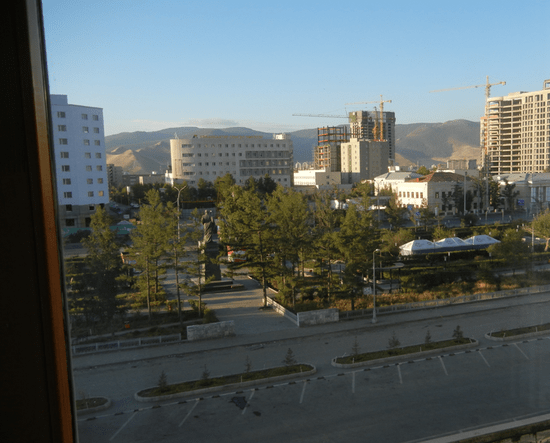
You have until noon on Tuesday to guess it. City and/or state first, then country. Please put the location in the subject heading, along with any description within the email. If no one guesses the exact location, proximity counts. Be sure to email entries to VFYWcontest@gmail.com. Winner gets a free The View From Your Window book. Have at it.
The Afghan Jester
Jon Lee Anderson meets a traditional maskhara, or jester. Pashean is employed by a wealthy warlord, Atta, north of Kabul:
Over our food, which we dug into with our hands, Atta boasted proudly of Pashean’s many talents, telling me that in addition to his prowess as an entertainer, he was also a professional blackmailer, a master thief, and a prolific murderer, with an estimated fifty victims killed by his own hand. As Atta related this last statistic in delighted exclamation, the other men and boys in the room laughed and stared reverentially at Pashean, who grinned and nodded his head in acknowledgment.
Alley Living
Kamala Rao explores a new housing experiment in Vancouver:
Laneway homes are basically miniature versions of single-family homes – in the range of 500 to 1,000 square feet – that are built in what has traditionally been the garage location of a single-family lot: in the backyard facing the lane. … The goal was to densify single-family neighborhoods without affecting their character; so the density needed to be relatively invisible with no impact on the curb appeal of these long-established and highly-sought after neighborhoods. They had already legalized basement rental suites—the most invisible form of increased density—but were bold and committed enough to ask themselves if they had actually done all they could do to increase housing options in the least dense parts of the city.
Gregory Kloehn, seen above, takes the laneway concept one step further. In The Gated City, Ryan Avent emphasizes the economic benefits of cities that can house more people. Josh Rothman summarizes:
As more and more talented people are driven out of our ever-more-expensive cities, Avent notes, the cities themselves lose out on the potential to become more innovative and vibrant — and it's all because of a "not in my backyard," or NIMBY, attitude which prizes pristine streets and quaint urban 'character' over economic growth. … Cities are work zones, not theme parks, and it's good for them to be crowded, bustling, and overrun by newcomers. It's time to start letting our big cities grow again, Avent argues, because when they grow, America will grow, too.
Splitting Pennsylvania?
A new Republican plan could change the state's electoral system so that each congressional district gets its own electoral vote, rather than the winner-takes-all system that's in place now. Since the GOP controls both houses of the state legislature plus the governor's mansion, "the so-called 'redistricting trifecta'" in Pennsylvania, Nick Baumann smells trouble:
Under the Republican plan, if the GOP presidential nominee carries the GOP-leaning districts but Obama carries the state, the GOP nominee would get 12 electoral votes out of Pennsylvania, but Obama would only get eight—six for winning the blue districts, and two (representing the state's two senators) for carrying the state. This would have an effect equivalent to flipping a small winner-take-all state—say, Nevada, which has six electoral votes—from blue to red. And Republicans wouldn't even have to do any extra campaigning or spend any extra advertising dollars to do it.
Jonathan Bernstein scopes the big picture:
It would be entirely possible for a Republican to win the 2012 presidential election despite losing the popular vote by a solid margin and losing states containing a solid majority of electoral votes. Democrats would likely retaliate the next time they had a chance. Close presidential elections would wind up being decided by all sorts of odd chance events, rather than, you know, who wins the most votes.
Weigel thinks the plan is doomed. Drum sighs:
As recently as a couple of decades ago this would have been a bridge too far for most of the party's mandarins: conservative pundits and senior GOP officials would have sounded off against it because it was just too raw a deal even for flinty political pros. But now we live in the era of Lee Atwater and Karl Rove and Tom DeLay and Fox News. There's really no one left who might object to this merely out of a decent respect for institutional integrity and fairmindedness.
Joyner defends PA's right to do it as smart political gamesmanship:
It’s by no means certain that, whatever the intent, this will advantage Republicans. Pennsylvania has 7.8% unemployment. An August Quinnipiac poll shows a majority of Pennsylvanians believing Obama does not deserve a second term, Mitt Romney beating Obama, and Obama in a statistical tie with Rick Santorum! It’s at best even odds that Obama takes the state. So, this tactic could actually do Obama a favor in 2012.
Jamelle Bouie parses the racial politics:
African Americans are a large share of the population, and under a winner-take-all system, they play an important part in determining the election outcome, despite the fact that they’re concentrated in a few urban districts. Under the Republican plan, the state’s rural voters – who are mostly conservative and overwhelmingly white – would have the most say over the distribution of electoral votes, due to the larger number of rural districts.
Find The Conservative Capable Of Compromise
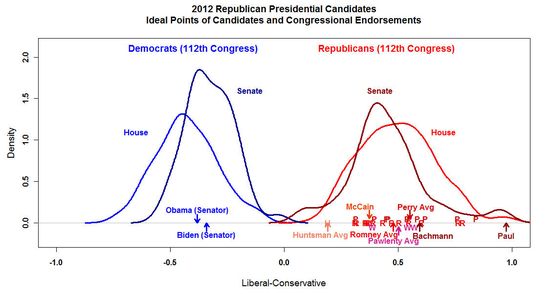
Keith Poole graphs the ideological locations of the candidates, using congressional records if they have them, or the congressional records of those who have endorsed the candidates if they don't. Adam Brown simplifies the findings:
Rick Perry is slightly to the right of Mitt Romney, but only slightly. The gap between Jon Huntsman and Mitt Romney is WAY bigger than the gap between Mitt Romney and Rick Perry.
 The Dish