Why Shouldn’t Women Serve In Combat? Ctd

111349039

The discussion thread has quickly become our most popular, now with inimitable insight from two female vets. One writes:

As a woman who spent 15 months in Afghanistan in 2007-2008, I have to wonder if the nature of the wars cause all these strong opinions about women not belonging in combat. It's no secret that the rights of women in the Middle East are virtually nonexistent.  I just have to wonder if that is the lens through which people see women who go to combat in those regions.  That we cannot be effective or taken seriously on missions because the locals cannot connect with us.

Certainly in rural Afghanistan, my point was proven. 

We would have locals contracted to work on FOBs [forward operating bases], and when I'd walk to the shower in my flip-flops and PT uniform (which included shorts that fell to my knees and a baggy shirt), I'd have "whore" and "slut" shouted at me by those very locals.  I brushed it off, sometimes I even thought it was funny, mostly because I knew they didn't know what it was they were suggesting.  War isn't for the thin skinned or the faint of heart.

When I was out on a humanitarian mission, I was one of two females on the whole mission, and when we'd arrived to the district center, the leaders asked the district leader if the females could use his bathroom (aka, a hole in the ground covered in wood, with mud brick walls and a potato sack as a door), and we had to wait while the council voted.  Just our luck, we were allowed to use the bathroom (given the conditions of the bathroom, I would have rather gone in the grass with the rest of the guys). 

But it's things like that, extra, that have to be done, which make me wonder if people view females as a hindrance to missions (I have to admit, at times I felt like I hindered a mission, just by being a female, despite the fact that no man I was in combat with ever made me feel that way).

The other:

This is my first time writing to you, but as a female Army veteran, this topic caught my interest. Since before I joined the service, I found the standard of women not allowed in combat arms to be absurd. Much as the reader who commented on a base physical standard for those jobs that does not take into account gender, I feel that if a woman can do the physical and mental work, she should be allowed the options. Many of the standard objections over the years, such as the concern over our menstrual cycles causing problems with hygiene and security, have been overcome by science or other progressive social norms. And since we no longer have a front line, we can't say that women aren't deployed into combat - just not into combat arms.

Recently I had this conversation with another veteran, an Army sniper who served two tours in Iraq. He believes, adamantly and without reserve, that women should never be allowed in combat arms. When I asked him why, he explained that it was because of the men deployed in those units and on those missions. He said, from the perspective of one who had been there and who had led others there, that the mindset needed to see and do the things they did all day, every day, was primal and brutal. Eat, sleep, patrol, kill. It was absolutely necessary, in those circumstances, for Soldiers to adopt a mentality and a demeanor that allowed them to process what they were doing in a manner that made sense … and that would be dangerous to women in those circumstances.

His concern was not for the delicate flower of femininity, for the reproductive future of the gender or even for the risk of rape in a POW situation. His concern was that the people who all Soldiers in that situation must trust the most – their team – would be unable to turn off their "caveman brain" (his words) in regards to the women next to them. Because along with eat, sleep and kill, sex is one of our most primal instincts. And in that circumstance, he was concerned, terrified, that the men would take it the way they take everything else in that situation – by force, if needed.

This is not to say that the men in our combat arms are rapists and have no control of themselves. I've known many an Infantryman and they do. But if my friend's words are true, and I feel he says them with conviction, the mindset needed to kill someone on a daily basis is not one that would effectively allow women and men to serve side by side without strong risk to the bonds of fraternity that are vital to the military functioning as a unit. I know first hand what happens when you are betrayed by the people you trust the most – not because you know them, but because they wear the same uniform. It is a breech of trust from which you never fully recover.

So while I still believe that women should be allowed in combat arms and would be truly effective (especially as snipers), I also believe that to do so without first looking at the way we deploy them would be a mistake. I'm not calling for a kinder, more sensitive military. Gag. I am suggesting that we take a page out of my intelligence instructors handbooks and approach this situation from the "Work Smarter" approach – for the sake of the ties that bind those in uniform to each other.

Another reader:

I’m writing in response to your reader who thinks women shouldn’t be in combat because of depleted uranium in ammunition.  As a former female Army EOD technician, I can say this reader clearly needs to educate himself about military ammunition.  DU is not used in small arms; in fact, DU is predominately used in tank rounds (they were used pretty extensively in 120mm SABO rounds in the Gulf War) and due to the so-called combat restrictions on women, women aren’t ever allowed to serve in tanks.  This effectively eliminates the majority of exposure of women to DU.  And if someone like myself, who could have been called in to clean up a DU site wears basic protection, there isn’t any cause for concern. 

The other element of this readers comment is his obvious concern for women’s wombs.  If he’s so concerned about unborn children and the effect that DU might have on them, then I’m sure he’s also against women drinking, smoking, cleaning their house (those chemicals can be TOXIC!) or doing anything that could potentially harm a fetus that hasn’t even been conceived.  Please spare me the condescending tone. 

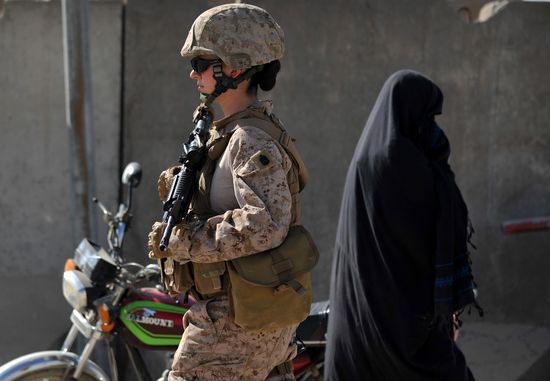
(Photo: US Female Marine, Gunnery Sargeant Michelle Mollen of the 2nd Battalion, 1st Marines Regiment, patrols in Garmser, Helmand Province, Afghanistan on March 12, 2011. There are around 140,000 international troops, two-thirds of them from the United States, in Afghanistan fighting the militant Islamist Taliban. By Adek Berry/AFP/Getty Images)

Media Coverage Isn’t Created Equal

Nor should it be, according to Jonathan Bernstein:

[T]here is no actual good reason for either parties or the press to be fair to candidates. They should be fair to voters, either individually or as they exist in organized groups and constituencies. But candidates? Nope. There is simply no reason for the press to automatically believe that vanity candidates Newt Gingrich and Herman Cain are entitled to the same level of coverage as plausible nominees Rick Perry and Mitt Romney.

Steinglass echoes.

Ironies Of Urbanization

Omro

Robert Bruegmann notices that "at the very moment when urban population has been reported to surpass the rural, the distinction has lost most of its significance":

Two hundred years ago, before automobiles, telephones, the internet and express package services, cities were much more compact and rural life was indeed very different from urban life. Most inhabitants of rural areas were tied to agriculture or industries devoted to the extraction of natural resources. Their lives were fundamentally different from those of urban dwellers. 

Today the situation has changed radically. Most people living in areas classified as rural don’t farm or have any direct connection with agriculture. They hold jobs similar to those in urban areas. And although they might not have opera houses, upscale boutiques or specialized hospitals nearby, the activities that take place in these venues are available to them in ways that they never were before.

(Photo: "Town of Omro," which is legally a city according to Bruegmann, by Flickr user bigcityal)

The Costs Of Contractors

The Project On Government Oversight has an astounding new report:

POGO’s study analyzed the total compensation paid to federal and private sector employees, and annual billing rates for contractor employees across 35 occupational classifications covering over 550 service activities. Our findings were shocking—POGO estimates the government pays billions more annually in taxpayer dollars to hire contractors than it would to hire federal employees to perform comparable services. Specifically, POGO’s study shows that the federal government approves service contract billing rates—deemed fair and reasonable—that pay contractors 1.83 times more than the government pays federal employees in total compensation, and more than 2 times the total compensation paid in the private sector for comparable services.

Robert Greenwald and Derrick Crowe zoom in on defense contractors.

Face Of The Day

124945852

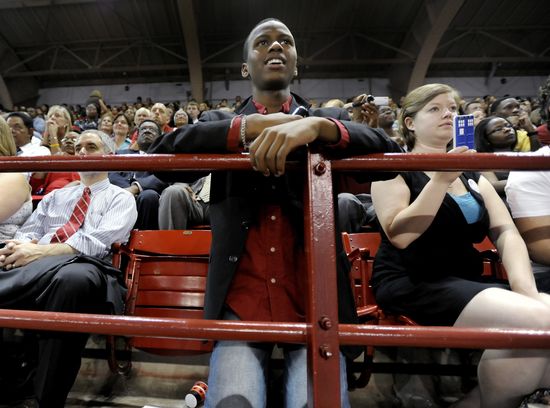
People listen to U.S. President Barack Obama speaking about the American Jobs Act at North Carolina State University September 14, 2011 in Raleigh, North Carolina. Obama is stumping for his $450 billion jobs proposal in the wake of the Democrats losing a congressional seat to Republicans in a special election in New York. By Sara D. Davis/Getty Images.

The Subtlety Of Testosterone, Ctd

William Saletan contends that this study on fathers having lower testosterone is being oversold:

Testosterone affects and is affected by many things. It probably does adjust to environmental cues as men become mates and then fathers. But we're just beginning to explore how and why this happens. The new evolutionary-psychology theory we're being fed has less to do with earth-shattering evidence than with changes in our economy and culture. Women are gaining more respect and consideration. Wages have shrunk, so both parents have to work for pay. Men have to help out more at home, and they can't get away with cheating the way they used to. For a bunch of reasons, we need a more domestic and egalitarian theory of masculinity. And we're using this study to sell it.

Christopher Ryan rebuts another piece of spin, "that this effect is about being a biological father."

Perry’s Base Weaknesses Are National Strengths

Steve Kornacki compares GOP primary voters to the general electorate:

Ironically, immigration and the HPV vaccine are probably two of Perry's best selling points as a prospective general election candidate. In the fall of 2012, he wouldn't need to apologize to swing voters (as he did to Republican primary voters Monday night) for trying to reduce the incidence of cervical cancer, or for believing that every child who graduates from high school ought to have a fair chance at going to college. These positions would help him combat Democratic efforts to paint him as an extremist ideologue. But within the Republican Party, he's vulnerable on them.

Rebuilding After Qaddafi

GT_LIBYA_110914

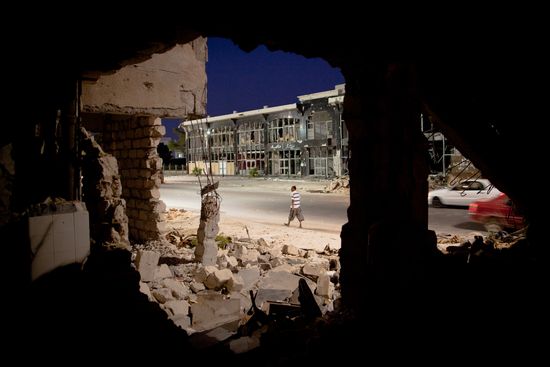
Daniel Serwer writes about some of the difficulties in reconstruction he observed while visiting Libya:

A debate at the human rights workshop ended with the young Libyans voting to send Qaddafi to the ICC, due to the difficult problems of meeting international standards and preventing the trial from becoming a political nightmare. The political nightmare could be deadly, as Libyans are still armed to the teeth.  This will only change if stability is maintained and a spiral of revenge killing prevented, as few will give up their guns if they really think they need them.  There has been some effort to collect the weapons, but there are still a lot more out there.  Re-restablishing the state’s monopoly on the legitimate use of force will not be easy or immediate.

He collects more optimistic thoughts here. A number of worrying stories have emerged about growing rifts between Islamists and secularists in the new government. Spencer Ackerman fears that the Libyan insurgency has begun. Rory Stewart urges us to remember that the consequences of intervention are unpredictable:

Already people are claiming that the euphoria and calm after the fall of Tripoli could have been predicted and can be easily explained. But such civility was not inevitable; it could not have been assumed from Libyan history or culture. Libya shares many features of countries where anarchy has prevailed. Like Afghanistan or Iraq, it has a distinguished history and has experienced periods of stability but lacks the essential trinity of the international state-building apostles: ‘a vibrant civil society’, ‘rule of law’ and ‘good governance’. It has a rapidly growing young population, which is only partially educated, and few jobs. The traditional forces of tribe and Islam co-exist with more cosmopolitan aspirations, as they do in the rest of the Islamic world.

Jamie Kirchick is already blaring the victory horn.

(Photo: A man walks past a war torn building on Tripoli Street, on September 03, 2011 in Misrata, Libya. By Daniel Berehulak/Getty Images.)