Past Performance Is No Guarantee Of Future Results

The case for buying and holding stocks is weaker than you might think:

Over the last 50 years, the real returns from equities have been lower than those from bonds in Germany, Japan and Italy. In the Italian case, the gap is almost three percentage points, and that is despite the recent bond sell-off (actually, as Deutsche points out, a 5-6% yield on Italian debt is quite low by historical standards.)

The buy and hold mantra was developed in the US where real equity returns have generally been positive over long periods. But the US was history's winner in the 20th century; enjoying 100 years of political stability while its European rivals destroyed themselves in two world wars and Russia followed the dead end path of communism. The US equity market, in other words, displays distinct survivorship bias. In turn, that bias leads to greater confidence and thus higher valuations; eventually the valuations become so high (as in 2000) that they doom future returns to be disappointing.

Who Is The Neocons’ Candidate?

The neocons are starting to fret over Perry's unreliability (or incoherence) on Afghanistan. Jennifer Rubin's eyes wander (she later called Monday's debate a "foreign policy horror show"): 

The biggest argument for another candidate is Perry’s failure to close the deal. He’s turned in two very spotty debate performances and refused to put nettlesome issues to bed by disclaiming imprudent comments and ill-thought-out positions. He hasn’t presented any proposals, relying purely on his record (albeit a very good one) in Texas. Right now he’s collecting the lion’s share of the not-Romney votes, but if there were another not-Romney who had a solid record, was a familiar face and could present a compelling agenda, wouldn’t a lot of Perry’s support melt away?

And who might that possibly be? Hmmmm. Wlady Pleszczynski, meanwhile, is sticking with Perry vs. Romney. 

Bachmann’s Anti-Vaccine Nonsense, Ctd

Michael Specter pounces:

Religious conservatives have sought for some time to create a special category of illnesses: those related to sexual activity. This is absurd; viruses don’t care whom they infect. (If we had an effective AIDS vaccine, would people try to prevent young men and women from receiving it on the grounds that it would encourage them to have sex? Stay tuned.)

So Perry is damaged by this, and Bachmann is as well. Advantage: Sarah.

Dissent Of The Day

Many readers are echoing this one: 

Using the term "indecent" to categorize the cheering at the most recent debate is dishonest.  Watch the video and then tell me when the cheering occured.   It was in response to Paul's statement about people being responsible for their own lives and consequences.   Is that not a statement that SHOULD be cheered by a true conservative?  Only when Blitzer said something about the hypothetical patient dying did some yahoo in the audience shouted "Yeah!",  but it was hardly a group response.

Daniel Foster makes related points:

What those people were cheering, either explicitly or implicitly, was the idea that we ought to be responsible for our own actions. That being held to account for our decisions, and not socializing the cost of making bad ones, is the only way to avoid moral hazard. EMTALA is held up as creating a moral hazard in its own right — and it does — but repealing it isn’t the only way to fix it. EMTALA, infamously, doesn’t contain a robust enforcement mechanism. Giving providers better legal recourse to to seek repayment would go a long way toward ensuring that those who have any capacity to pay, do. The true indigents would still be “free-riding”, but these are the people that even a modest social safety net is designed to catch anyway.

Rick Perry’s Immigration Problem, Ctd

76368074

Noting that the number of eligible Hispanic voters increased by 23 percent between 2006 and 2010, Chris Good explains why the Texas governor should hold his ground on immigration even as the Tea Party boos:

Perry could offer the Republican Party its best chance to steal Latino votes from President Obama in a general election — not just because he sits to the left of the other candidates on immigration policy, but because of his tone. Republicans have harped on "amnesty" and deployed some heated, anti-illegal-immigrant rhetoric in recent years; Perry, when confronted on his alleged coddling of illegals, has at his disposal a few practiced lines about Latino contributions to Texas and its economy. … In a close race against Obama, an improved showing among Latinos could deliver the White House to the Republican.

Matt Lewis makes similar points. Previous discussion of Perry's immigration record here. The trouble is: the party base just isn't with him, indeed are defined in part by their discomfort with a multicultural America and minority groups – let alone illegal minority groups. Remember the actual immigration question from the CNN debate. It was in many ways more revealing than any of the answers:

What would you do to remove the illegal immigrants from our country?

If that's where the base is, I don't think providing in-state tuition fees is the right political answer.

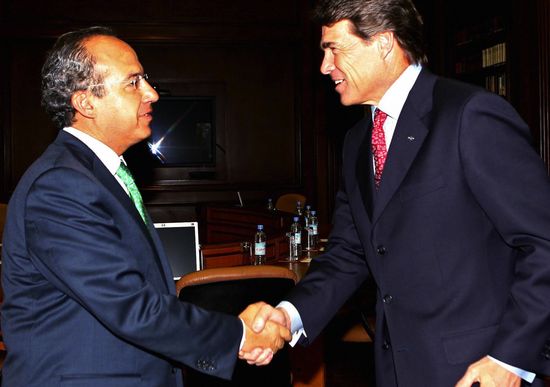
(Photo: Mexican president Felipe Calderon (L) shakes hands with Rick Perry, governor of the state of Texas, at Los Pinos Residence in Mexico City 28 August 2007. Perry criticized the U.S. Congress Tuesday for failing to make progress on the immigration reform, saying its members lack the 'maturity' to sit down and discuss the issue thoughtfully. By Alfredo Guerrero/AFP/Getty Images)

How Fragile Is China?

John Quiggin sees a collapse of the Communist government as a real possibility:

The spectacular economic growth of the past two decades has made the resolution of policy disagreements relatively easy. Simply put, there has been enough surplus to satisfy all important interests and still allow rapidly rising incomes for the mass of the population, or at least those in urban areas who might pose a threat to political stability. Again, the example of the Arab Spring suggests that a slowdown in economic growth can bring about a sudden break in what seemed like an established political order. In democracies, economic shocks typically result in electoral defeat for the incumbent government, which at least provides the public with someone to blame, and a test of the hypothesis that the crisis was the result of mismanagement. In a closed oligarchy like that of China, there is no such mechanism.