The Special Election Scorecard

The GOP picked up two congressional seats yesterday. Details of Anthony Weiner's lost seat here. Nate Silver looks towards 2012:

[T]he four special elections, taken as a whole, suggest that Democrats may still be locked in a 2010-type political environment. Democrats might not lose many more seats in the House if that were the case, since most of their vulnerable targets have already been picked off, but it would limit their potential for any gains. And it could produce dire results for the Democrats in the U.S. Senate, where they have twice as many seats up for re-election.

Bombing Alone

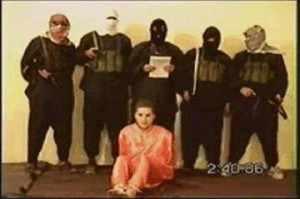
Nick-Berg-300x199

Dave Betz summarizes one explanation for terrorist motivation:

Bonding capital is inwardly focussed, it is ‘good for undergirding specific reciprocity and mobilising solidarity’; it is about reinforcing exclusive identities and ‘by creating strong in-group loyalty, may also create strong out-group antagonism.’ Take the picture [above], for instance, which shows the young American Nick Berg moments before the men behind him, one of whom is thought to be Abu Musab Al Zarqawi, saw his head off–all captured on video and proudly distributed.

Now consider [the] question ‘what do terrorists really want?’ Indeed, what do they want? What is the purpose of killing in this particularly gross and degrading manner? As a normal human being it’s ‘incomprehensible’ and best leave it at that; except probably I’m not normal…because I think we ought not leave it at that and that the act is comprehensible. It’s an extreme example of the building of bonding capital. Can you imagine a more explicit drawing of the line between in-group loyalty and out-group antagonism? Me neither.

“The Barter Myth”

Anthropologist David Graeber has written a book, Debt: The First 5,000 Years, debunking the claim that money evolved from antecedent barter systems. Why he thinks this matters:

It seems to me because it goes back precisely to this notion of rationality that Adam Smith too embraced: that human beings are rational, calculating exchangers seeking material advantage, and that therefore it is possible to construct a scientific field that studies such behavior. The problem is that the real world seems to contradict this assumption at every turn. Thus we find that in actual villages, rather than thinking only about getting the best deal in swapping one material good for another with their neighbors, people are much more interested in who they love, who they hate, who they want to bail out of difficulties, who they want to embarrass and humiliate, etc.—not to mention the need to head off feuds.

Getting Our Money’s Worth

What Americans pay into Medicare and Social Security and what they get back (pdf):

Paying_In_Entitlements

Money quote from the report:

As the discussion of needed reforms proceeds, a common demand will be that future retirees get back what they have paid into the systems. But reducing these complex discussions to a debate over “money’s worth” ignores the grim reality of the programs’ finances today, as well as the fact that these programs have always transferred money between individuals – both within, and more importantly, across generations. Our work has shown that current and near-term retirees can expect to receive benefits well above their contributions, financed by current and future workers who have little hope of realizing the same level of return on their taxes due to the economic and demographic forces that are working against them.

Don Taylor focuses on "the profound subsidy of marriage that is inherent in how Social Security determines benefits for spouses who do not pay Social Security taxes in earlier life."

The Decline Of American Tennis

Reeves Wiedeman describes American tennis fandom in the twenty-first century as a "downward-trending proposition, much like the experience, from some perspectives, of being an American." Taking a technical approach, Steven Hahn and Declan Hahn blame the power-game ethos of the hard court (as opposed to clay courts):

In the United States…the emphasis is on power. Coaches tend to stress hitting hard on serves and ground strokes and pasting the lines. The idea is to get the point over quickly. Hit deep, hit a good angle, hit down the line, get a short ball, boom. … On clay the orientation is very different. Coaches stress technique and fundamentals, beginning with legs and footwork.

Along the same lines, Brian Phillips wishes American tennis players weren't so boring.