Pro Tip: Don’t Shine Laser Pointers At Airplanes, Ctd

A reader writes:

As an optical physicist, I can't let the unscientific comments by Alexis go unaddressed. A simple green laser pointer bought on Ebay for $20 won't blind someone pointing into their own eye directly unless they hold it there for some time. Even more importantly, while it is true that the surface area illuminated by the laser increases with distance from the source (not "cone" or whatever that means), the intensity decreases by the square of distance. So in fact, counter to what Alexis says, you are less likely to blind a pilot, not more. Sure, you'll hit their eye, but the intensity will be too small to do any damage. Unless you are willing to spend serious money on a very high-end laser, you couldn't blind a pilot.

That being said, however, you can dazzle the viewer to such an extent that they temporarily lose their dark-adapted sight, which is very bad for a pilot on approach. This is the reason for cracking down on these idiots. There is no need to throw around loose comments like "blinding" when the truth is bad enough.

Another goes into greater detail:

As someone who studies optical sciences, I wanted to point out a couple things. One is to make sure that we represent things correctly. It should be clear that while the radius of a laser increases with distance, it's intensity also drops off. If it's increased in diameter from a small point to enough to "fill a cockpit," it's no longer going to be that bright comparatively. If we assume conservatively that's a 10x increase in size, that means it's 100 times less bright than before. There's nothing mysterious about why this is; it's just the conservation of energy as the light spreads out. If it helps, think about it as the opposite of putting a magnifying glass between your hand and the sun. Not that much more light is actually hitting your hand; it's just all hitting it in one spot now. The energy is the same, but the intensity has changed.

The second thing I wanted to mention is more of a question of general safety. Shining laser pointers at an airplane probably wouldn't be such a problem if you couldn't buy a laser pointer online that is so powerful that it falls within the most dangerous category of laser safety classifications. Note, the "most dangerous category" caps out pretty low compared to say using a laser to cut things, but this does mean that if I was keeping it in a lab I'd have an obligation to make sure people didn't wander into the area or accidentally turn it on to make sure no one gets hurt or blinded by it. I'd have warning labels on my door, lights to let people know it's on, I'd carefully plan the layout of my lab and the laser itself would be equipped with a key switch and a safety interlock just to start with. Or you can buy one online and keep it in your pocket till you find something it'd amuse you to point it at, like a plane.

Going back to my earlier numbers, for example, with a 1W laser, which I found in 5 seconds online using Google, even after the beam expanded 10 times and it's intensity was 100 times less than before, it'd still be 2-10 times as bright as your typical 5 or 1mW laser pointer from across a room. And the one I found is green, which would mean even for the same wattage, it'd still look multiple times brighter to your eye than a typical red one because of the way our eyes responds to different wavelengths of light. Now that would be a distracting and dangerous beam of light.

I want to end with mentioning this is not a call to regulate laser pointers. It's great that people think lasers are awesome, but it'd be nice if that came with more awareness of what they were holding.

Update from a "visual engineer for flight simulation" using a federal email address:

The second expert you summoned has it correct, but the first expert, the optical physicist, should go back to school. The laser intensity does not decrease "with the square of distance". If that were true, we wouldn't have used lasers to reflect off of Image001 reflectors on the moon left by Apollo astronauts and other probes to the moon. Your first expert is also mistakenly lumping laser behavior with the attenuation of a light or radio frequency emitter that "radiates" equally in all directions such as a traditional light bulb or a non-directional radio transmitting antenna.

Your second "expert" does a better job of explaining that the increase of the point light to a broader area after a mile or so distance decreases the intensity per unit area – same as a video projector is brighter or dimmer as a function of distance. But neither one mentions that fine scratches on the plastic cockpit window can also cause the laser light to spread out and possibly make it impossible to see out the window – the same effect can sometimes happen to a car driver if direct sunlight hits a car windshield that is cracked – the sunlight will illuminate the inner plastic safety layer and the entire plastic layer lights up and you can't see through the windshield at all. I have seen this amazing dangerous effect.

It would be better to refer your readers to this site, where other dangerous effects they don't mention are discussed.
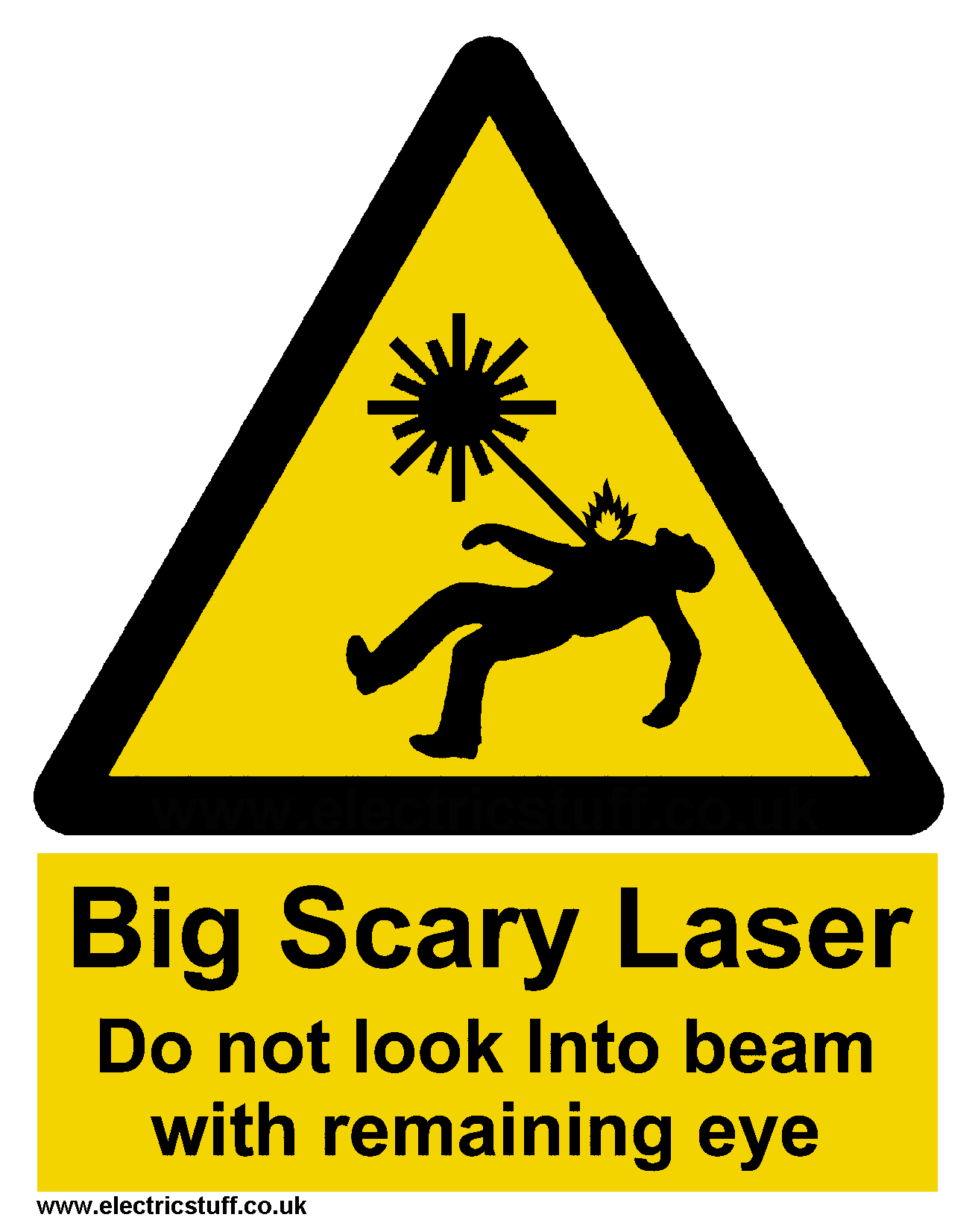
Another reader updates by sending the above image of "the laser safety placard we use at our plant."
Are Suspect Sketches Worthless?

Celeb_Composites

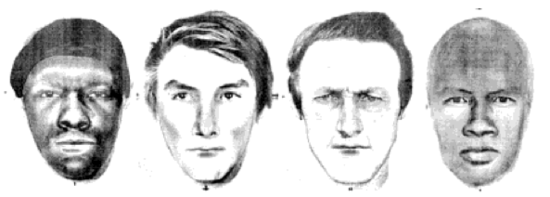
Mostly. According to Lillian Marx, "victims who assist in creating a composite sketch of their assailants are nearly 50 percent less likely to correctly identify a suspect later":

[T]he act of creating a composite sketch confuses the hell out of the victim. Your memory is actually very suggestible, thanks to a phenomenon called source amnesia, which basically means the brain remembers facts, but doesn't remember where we learned them. That means if the artist gets something wrong in the sketch (the suspect's nose is too big, or he has too many eyes), the victim literally starts to think that's what the suspect looks like. The brain doesn't remember if you first saw that feature in the real face or on the sketch. So the cops drag in a guy who looks like the inaccurate sketch and you say, "That's him!"

Operators were given photographs of various celebrities and attempted facial composites using a kit containing disparate facial features. The results are seen above. From left to right: Bill Cosby, Tom Cruise, Ronald Reagan, and Michael Jordan.

Fixing Pakistan

The only plan Ackerman can think of:

There is a strategy that might — might — result in a massive and positive payoff: defusing tensions between Pakistan and its arch-rival, India. (No, sporadic diplomatic engagement aimed at keeping the peace in Kashmir doesn’t count.) Pakistan maintains its ties to terrorist groups to supplement its relative weakness against arch-enemy India. So maybe Washington could try sponsoring peace talks between India and Pakistan. Not that it’s worked out well between, say, Israel and the Palestinians. But it’s a better strategy than constant feuding, mutual subterfuge and sub rosa military cooperation. And if it works, it’s a game-changer.

More likely, nothing will change.

The Case For Romney

Frum makes it. He sees Romneycare, a major political vulnerability for Romney in the primaries, as a governing strength:

Republicans need a realistic approach to what is feasible in the reform of ACA. There are deals to be done to fix its worst problems (the financing mechanism, the additional Medicaid burdens on states, the lack of cost control) — but outright repeal will convulse the American political system for years and very likely end in failure. The candidate who can make the necessary deals is the one who understands the health system best — and also the one candidate who cannot be accused of secretly wishing to destroy the principle of universal coverage.

Outsource Afghanistan?

GT_MULLEN_110928

Thomas P.M. Barnett wants to get out of Afghanistan and Pakistan by getting help from their neighbors:

By getting out of bed with Pakistan, we will immediately improve our relationships with virtually all of the key regional players. No joke: We'd be better off forging strong military cooperation with Russia's once-and-future-king Vladimir Putin, because his sort of blackmail will end up being far more tolerable than Islamabad's.

We'd also have more freedom of action with regard to Iran as it approaches weaponization of its nuclear capacity, and we could be far more open in our choosing of India — our true long-term future ally in South Asia — over Pakistan. And then there's China, who we need to step up and play responsible stakeholder; there's no better way to prove to them exactly how tough that row is to hoe than to give them Af-Pak for safekeeping. No, we won't love the immediate evolutions to follow, but those will be Beijing's problems — not ours. And if push comes to shove between Pakistan and India, we won't be caught in the crossfire and can balance, from offshore, what will be China's big-show-but-no-shots-fired response.

Fernando Luján believes we're doing good there, but his op-ed is driving Ackerman and Michael Cohen up the wall.

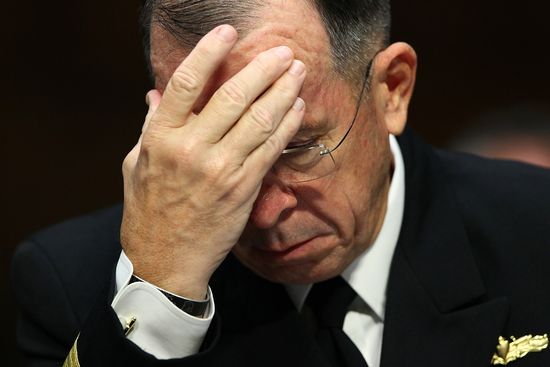
(Photo: U.S. Chairman of the Joint Chiefs of Staff Adm. Michael Mullen testifies before the Senate Armed Services Committee September 22, 2011 in Washington, DC. U.S. Defense Secretary Leon Panetta and Mullen were testifying before the committee on U.S. strategy in Afghanistan and Iraq. By Win McNamee/Getty Images.)

Getting More Mileage Out Of The Gas Tax

Reihan hypes James Whitty's proposal from the Oregon Department of Transportation. Whitty suggests a tax on mileage as an alternative to the gas tax, as cars and trucks become more fuel-efficient:

Whitty’s suggestion that the government allow drivers to choose to buy unlimited driving rights or pay a mileage tax allows drivers to make a bet about how much they’re actually going to drive. If I think I’m going to drive a lot, or if I really hate the idea of the government keeping track of my mileage, I’ll pay the presumably large lump sum. Perhaps I’d have to drive a tremendous amount to justify the expense.

I make a similar calculation every month when I purchase a MetroCard. Should I buy an Unlimited Ride card, and bet that I’ll use the subway at least X times a day on average? Or should I buy a fixed amount, on the assumption that since I’ll be in California for a spell, I will use the subway (X-n) times on average.

Tablet Wars

Tablets-comparison

Joshua Gans watches the web giants battle it out:

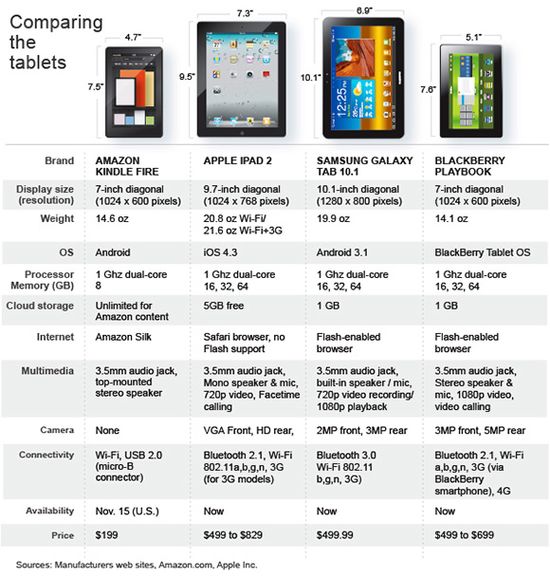
What is remarkable is that a decade ago, Amazon, Google and Apple could not have looked further apart in the digital competition space. Amazon was invested in the physical world. Apple dabbled in online music and Google was in search. Now, they are inter-locked and in head-to-head competition from the cloud to the customer.

Joe Coscarelli thinks Amazon has "seriously undercut the Android tablet business, as well as the pricey Nook reader from Barnes and Noble, which saw its stock price drop during the Amazon announcement." Dan Lyons says some "analysts expect Amazon to introduce a bigger tablet, one more comparable to the iPad, sometime in the next year." Why Amazon decided to make hardware:

Although the decision to design and build its own hardware is a high-stakes bet, it’s equally true that Bezos had no choice but to enter the tablet business. About 40?percent of Amazon’s revenues comes from media—books, music, and movies—and those formats are rapidly going digital. Amazon was late to understand the speed of that transition; Apple, which launched the iPod in 2001 and iTunes two years later, wasn’t. The iPad has only strengthened Apple’s hold over digital media. There’s a Kindle app for the iPad, but Apple takes a 30?percent slice of all content that app makers sell on the tablet and has restricted Amazon from directing iPad users to its website in order to avoid giving Apple its cut. Doing business on the iPad threatens Amazon’s already thin profit margins.

(Chart via LikeCool)

Quote For The Day II

"I felt like I was in a nightmare, you know this doesn't happen to us. All I could tell you is I couldn't move, I couldn't even hardly think, I was so afraid," – Nancy Parker, a US citizen who opened her door to multiple DEA agents with guns drawn in a drug raid that found the wrong address. At least she wasn't shot dead. Remember when the Fourth Amendment was reassuring?

Update from a reader:

This incident, while understandably alarming to the Parkers, doesn't seem like DEA overreach.  They had a tip; they went to the house; they knocked on the door; they said what they were after; they were denied entry without a warrant; they left.