Meanwhile, I think Michele Bachmann’s attacks on Perry are irresponsible and borderline demagogic. References to the “government needle” being “pushed into innocent girls,” sound paranoid and exploitative to me.
The good news is that a defense of moderation and compromise in conservatism is spreading from the apostates, like Frum, Bartlett or yours truly, to those closer to the hub. First, the always-thoughtful Peter Berkowitz’s effort to remind conservatives that compromise isn’t antithetical to “winning.” And now, staggeringly, Jennifer Rubin gets on board:
The RedState blog, which is hawking Texas Gov. Rick Perry’s candidacy, denounces every deal and budget agreement by Republican leaders as a sell-out and betrayal of conservative values. Perry himself has denounced Social Security. He in turn has been denounced for excessive moderation on immigration…[These positions] don’t reveal a conservative temperament, one that values steady progress, an understanding of existing arrangements and respect for other branches of government. They seem to invite conflict, if not chaos, as a desirable state of affairs.
Stephen Bainbridge focuses on the GOP’s shift towards populism:
Kirk emphasized that “conservatism is sustained by a body of sentiments, rather than by a system of ideological dogmata.” Yet, today, we see a GOP increasingly bound to certain rigid ideological positions on issues like guns, immigration, and so on, in which the goal seems to be crushing one’s opponents rather than pursuing what Kirk called “reasoned and temperate progress.”
My take on Republicanism’s evolution into a religion with doctrines, not a political temperament with policies, is here. My book spells all this out and did so in 2007, when the rest of the right was in aggressive denial. Its argument is simple enough:
All government, indeed every human benefit and enjoyment, every virtue, and every prudent act, is founded on compromise and barter.
The moment from last night that keeps haunting me:
Look: in some ways the honesty is refreshing. Yes, failing to get your own health insurance creates an obvious free-rider problem, and this is at the heart of the health insurance debate. We need to deal with that, and this was one of the more admirably candid moments in the entire years-long debate.
Look: I've long been a skeptic of government-provided healthcare, but I do have a core (maybe Catholic?) belief in helping the sick. Even the foolish sick. And certainly the poor and sick. In my personal life, I have found it morally impossible not to want to help someone stricken with illness, in whatever way I can. I'm sure my own health struggles have impacted this view, as my experience alongside a generation in a health crisis. Do I think we should have done nothing while hundreds of thousands died of AIDS? Of course not. Ditto cancer and all the ailments that flesh is heir to. America, moreover, has a law on the books that makes it a crime not to treat and try to save a human being who walks into an emergency room. So we have already made that collective decision and if the GOP wants to revisit it, they can.
Here's how: offer an honest proposal from the GOP to repeal the emergency room care law. Why not? If you are going to repeal universal health insurance, then make your libertarian principles coherent. And make the case that people unable or unwilling to buy health insurance deserve the consequences. That makes sense. And the question of why Perry or Ryan or Bachmann support this free-rider loophole in contradiction to their principles is one worth asking again and again.
Of course, even if such libertarian purity does make sense, that cannot excuse the emotional response to the issue in the crowd last night. Maybe a tragedy like the death of a feckless twentysomething is inevitable if we are to restrain healthcare costs. But it is still a tragedy. It is not something a decent person cheers. Similarly the execution of hundreds, while perhaps defensible politically and even morally (although I differ), is nonetheless a brutal, awful business. You don't delight in it. And the same is true of torture. Even if you want to defend its use in limited circumstances, it remains an absolute evil, no humane person would want to do it, and no civilized person would brag of it or dismiss any moral issue with it at all. And yet that is what Dick Cheney and Liz Cheney have repeatedly done. They are positively proud of their torture record.
The fish rotted from the head down. Last night, we got a whiff of the smell.
Hello from Cairo. Just wanted to note regarding your post earlier this morning how frustrating it is to watch what is going on here right now.
The SCAF is using the oldest trick in the book (we have always been at war with Eurasia) to distract the revolutionaries, and it is working. I am no conspiracy theorist, but the orchestration going on here is obvious and brilliant. You really think the security forces can clear Tahrir in 20 minutes but can't protect one building? Please. And how often is that footage going to be played over and over again on western media to justify the resurgence of emergency law, the ongoing media crackdown, and I am almost certain, a further delay in elections for "security concerns."
The saddest thing is that last Friday's rally was a peaceful, energetic and fairly focused demonstration, with great energy, until a very small fraction of the protesters went to the embassy to ruin it for everyone. My Egyptian friends were furious. "This is not the revolution."
Not only is al Qaeda philosophically out of step with the vast majority of Arabs, it is organizationally moribund. Today it comprises roving bands limited to the mountains and valleys of Pakistani tribal areas along the Afghan border, where bin Laden was assumed to be hiding; remote areas in Yemen along the Saudi border; and the wastes of the Sahara and Maghreb. Its actions show a consistent pattern of ineptitude. Its leadership increasingly relies on inexperienced freelancers or unskilled recruits. Al Qaeda peaked with the 9/11 attacks. As soon as they were over, the decline began.
Thomas Hegghammer and Andrew Exum complicate the narrative. But its core is true. And Obama made it happen. When you think of all the crass political mileage George W Bush squeezed out of the wars, while losing them, and compare it with the under-stated but lethal persistence of Obama, you see one core difference between Obama and the GOP: substance and style. Obama is earning the substance. And we know that, when necessary, he can weave it all together with some power. When necessary. And he feels like it.
Emerging from Fortress Facebook, the rogue unloads. She directly accuses Perry of crony capitalism, backing Michele Bachmann's assertion that the HPV vaccine was pushed through in Texas because of political connections:
"I knew there was something to it. Now we're finding that now, yea, something was up with that issue. It was an illustration or bit of evidence of some crony capitalism."
And she seems to be setting herself up as king-maker:
"I'm getting kind of a kick out of this," Palin said, claiming that the day after she brings up an issue, she notices the candidates adopt that issue in their stump speeches. "It's like come on candidates, it's about time you started talking about that."
Make of all this what you will. But she is adopting the purist populist posture against the GOP, including Perry, her onetime extremely close ally.
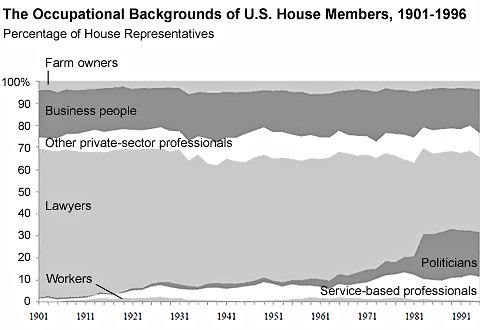
In Larry Bartels’ book Unequal Democracy, he finds that the voting behavior of senators is much more closely tied to the views of their upper-class constituents than the middle class or working class. One reason could be that upper-class people are more likely to vote, donate to politicians, and contact them to express opinions. But Mr. Bartels’s results persist even when controlling for the views of actual voters and those who have contacted their representatives. Mr. Carnes’s suggest another explanation: members of Congress vote as upper-class people would want them to because members of Congress tend to be upper class themselves.
Michael Totten has a dispiriting dispatch from Cairo:
Most Western analysts describe Mubarak’s government as an American ally that was at least moderately cooperative with Israel, which is accurate to an extent, but his state-controlled media cranked out vicious anti-American and anti-Israeli propaganda every day for three decades. No one should expect liberalism (and I’m using that word in its general sense, not in the parochial American sense) to emerge any time soon after all that. Egypt’s official propaganda after it signed the peace treaty and after it replaced the Soviet Union with the United States as its nominal ally has been no better than it was during the heyday of Nasser’s pan-Arabist days.
Marc Lynch worries that the recent attack on the Israeli Embassy might derail Egypt's democratic transition. Daniel Serwer thinks the attack is sympomatic of an underlying malaise in the push for genuine democracy.
 The Dish