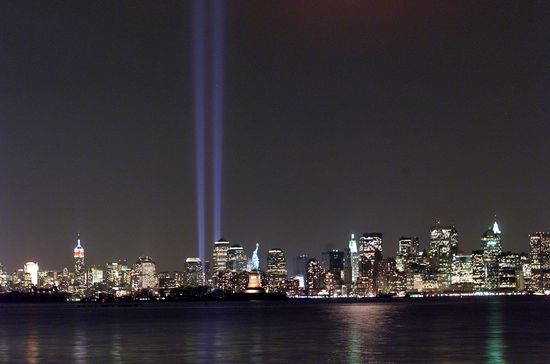
Submissions from the in-tray continue to overwhelm. A popular suggestion is the memorial seen above, arguably the greatest piece of 9/11 art. The photo's March 11, 2002 caption reads:
Memorial lights at World Trade Center Site shine skyward after being lit for first night. By Keith Torrie/NY Daily News Archive via Getty Images.
A reader writes:
No doubt this painting has crossed your radar. For some of us Gerhard Richter is the greatest artist of our time and, despite the palpable uncertainty and unheroic treatment of his version of the 9/11 event, titled "September", it is the definitive work of art on the theme for me. How weirdly antiquated – to "paint" the event, and to do so in a way that raises questions as much as pretends to answer them.
Another:
I've long felt that Blue Man Group's "Exhibit 13" was the single best work of art created about 9-11. It's a sweet, touching song and the visual aspect is based on found papers from the towers that blew into Brooklyn.
Another submits South Park's "Osama bin Laden Has Farty Pants" episode:
From Sharon unable to pull herself away from CNN to the absurdity of schoolchildren sending dollars to Afghanistan to Looney Tunes homage with Bin Laden as Elmer Fudd, Matt and Trey nailed the moment in the moment. What's more, they did it without being mawkish or sacrificing South Park's edge.
The Onion also didn't go soft. Another:
To answer the earlier reader who chimed in with Wilco's "Jesus, Etc.", the song does indeed pre-date 9/11. But the mythology stems from some odd coincidences that warrant its inclusion as a sort of "accidental" piece of 9/11 art. It helps that it is simply a beautiful song; through the years it has unofficially replaced my wife and I's wedding song.
Yankee Hotel Foxtrot, the album containing "Jesus, Etc." was officially released in 2002. But this was only after a famously textbook record company skerfuffle 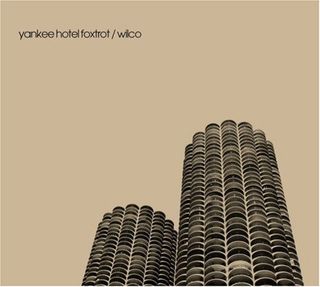 documented in Sam Jones' film "I Am Trying to Break Your Heart" in which Wilco was dropped by its label (Reprise) and bought back the record. Before the upheaval, the album was originally slated to be released on…September 11, 2001. Around this time, low-quality versions of the songs were beginning to appear on file-sharing networks, so the band went ahead and streamed the album for free the week after September 11 and released a proper physical copy the next spring.
Had Yankee Hotel Foxtrot seen its original release date, what would have hit shelves the morning of September 11th is an album bearing a stark photo of the twin Monarch towers in Chicago. Halfway through the record you'd hit "Jesus, Etc.", which contains the lyric "Tall buildings shake, voices escape, singing sad, sad songs." The song's overarching theme that ultimately all we have is each other, and that's God's love is the currency he spends through us, absolutely sounds like it could be an emotional overlay for the day and its aftermath. Even (and especially) knowing the song's similarites to 9/11 are only coincidental, it makes for a powerful emotional resonance. It's one of those songs you just want to sit people down and make them hear.
Several readers submitted examples of "accidental art", or simply songs that deeply resonated in the wake of 9/11 based on a similar theme or sentiment. One prominent example from cinema:
No discussion of 9/11-inspired art can be complete without James Marsh's beautiful, transporting documentary "Man on Wire", which I truly believe is the great 9/11 film. Though the attack itself is never mentioned, it hangs over every single frame of the film, which takes us back to a magical pre-9/11 lower Manhattan fantasy land to recap Philippe Petit's glorious wire-walk between (and triumph over) the Twin Towers. As Bryan Appleyard put it so eloquently back when the film was released, it's both a tribute to the pre-9/11 world and a repudiation of the attack itself. I honestly believe that the film should be broadcast on network TV every 9/11 to remind us of the incredible act of beauty that took place there decades before the terrorists brought it down.
Another example of accidental art that carries its meaning in context:
On Tuesday 9/11 the nation watched the towers fall. On Thursday 9/14 I attended a PJ Harvery concert in Chicago. The tour was for the album Stories from the City Stories from the Sea, an album about New York City released almost a year earlier. The album included songs with such titles as Big Exit, We Float, Kamikazi, and This Mess We're In.
PJ strode out on stage, alone, with a guitar. Lit by a single spotlight she addressed the audience. They had thought about canceling the show, especially given the material of the album, but had decided to go on with the show. She immediately launched into a solo accoustical version of This Mess We're In. The opening lyrics are:
Can you hear them?
The helicopters?
I'm in New York
No need for words now
We sit in silence
You look me
In the eye directly
You met me
I think it's Wednesday
The evening
The mess we're in and
The city sun sets over me
I remember the chills, I remember the tears, I remember jumping at loud sounds that filtered in from outside the auditorium, I remember cheering and screaming louder and longer than I think I have at any performance, and I remember being so grateful to gather in public and join in a collective grieving with my fellow citizens.
PJ didn't write the album in response to 9/11, but the events of that day gave the lyrics and meanings of each song new weight and pogiancy. For me, "Stories" will always be about 9/11, what we saw, how we responded, and how we healed. Here is a user-made 9/11 tribute to those died that day featuring the album version of "This Mess We're In" (which features Thom Yorke of Radiohead).
Several readers submitted the poem "110 stories" by the late John M. Ford. Another:
I've seen almost every field of art mentioned except for architecture, which is the one art actually involved in rebuilding the WTC. I'm not talking about the boxy glass office buildings currently going up but about the design for the original urban master plan. Arguably, when taken together, all the 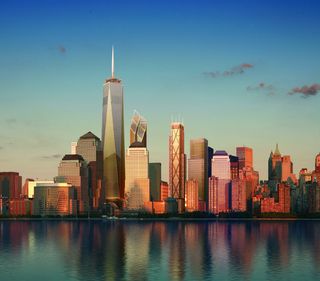 designs from the competition for a new development at Ground Zero constitute a memorable artistic response to 9/11. But the winning master plan design, "Memory Foundations" by Daniel Libeskind, which is now being implemented (albeit in a modified form) deserves special mention here. It is highly unusual for an architecture development to appeal to the emotions, but that was the point of Libeskind's proposal.
It was – and still is – explicitly about history, memory, tragedy and the sanctity of human life. In the architect's own words, "My idea in the master plan was that this was a place of the spirit. This is where people perished. It was not a piece of real estate any longer." The proposal also weaves American history into the new urban fabric in inspired ways: World Trade Center 1 (formerly the "Freedom Tower") will be 1,776 ft. tall to commemorate the country's founding, and the new memorial will celebrate the slurry wall underneath the WTC – a heroic piece of concrete that withstood the attacks thereby preventing Lower Manhattan from being flooded by the Hudson. These elements might be unusual and controversial, but I think they qualify "Memory Foundations" master plan as a worthy 9/11 work of architectural art.
Amy Davidson also marvels at the new WTC site:
It’s not because I have any disdain for the old World Trade Center. I miss the Twin Towers. It makes me angry when I hear them called soulless. They were part of my hometown’s landscape, the constant compass pointers on the city’s street grid—my true south. I thought they were beautiful. My senior prom was at Windows on the World. But for the last several years, my child and I have walked by the site on our way from our apartment to school, talked about the buildings’ progress, and watched them rise. I am ready to love them.
Her coworkers at The New Yorker recommend Netherland, among other works. Scott Galupo responds to the thread here. Previous installments here, here, here and here. The discussion continues on our Facebook page.
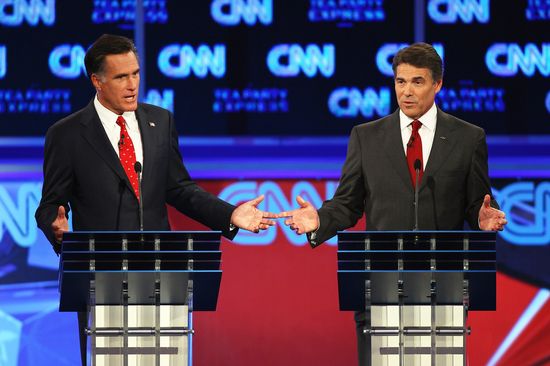
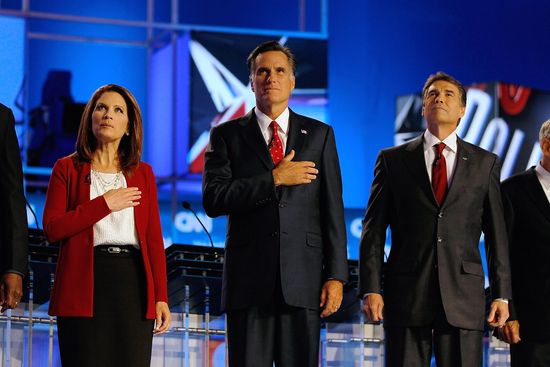 9.56 pm. The weirdest debate so far: feisty but surreal. If I had to game this one, I’d say Bachmann stayed alive, Perry began very strong but wobbled, Romney did fine, and Ron Paul shone the way only he can. But clearly the crowd loved Perry the most. God help us. 9.54 pm. Oh God. Wolf Blitzer is getting cutesy. I’m throwing up in my mouth right now. As to the White House, we’re getting more beds, fewer tsars, the collected works of Hayek, a babe-wife, a bust of Churchill, sacred constitutional documents, flava, and a Harley. 9.50 pm. Perry all but coopts the Paul-Huntsman view of Afghanistan, but then wants a remaining “presence”. He wants to adopt non-interventionism, while not scaring the horses. Santorum and Gingrich are the only ones with neoconservative knees jerking. It really is over: Iraq and Afghanistan have seen to that. The most we’ll ever do is Libya for the forseeable future. In the end, neoconservatism abolished itself. 9.46 pm. Santorum wants to banish any notion of blowback. And what does America stand for? American exceptionalism! Then Ron Paul insists that foreign occupations, not American freedom, were the contributing factor to 9/11. And Huntsman reiterates his commitment to getting out of Afghanistan. Another great conservative answer. 9.44 pm. Gingrich grabs a bowler hat and a cigar. Really: an enormous security crisis? He packed more fear and hyperbole into one sentence than even Cheney can. Meanwhile, altogether now: God Bless Ron Paul. 9.40 pm. Perry is revealing some kind of compassion – if it weren’t framed merely as a way to crack down on welfare recipients. Huntsman mentions H1-B visas, a vital topic. But, with this crowd, I suspect the point didn’t get across. 9.34 pm. A tiny piece of reality peeps in: Latinos exist and they can vote. Perry gets booed for providing in-state tuition for illegal immigrants. He stands firm. But it’s obviously a problem for him. He has had to live in the real world in a border state so that this issue is not an easy abstraction. But it is for Bachmann and she takes another whack. Perry has a black eye, and Bachmann has had a stronger second half. 9.32 pm. “What would you do to remove illegal immigrants from this country?” Not: how do we secure the border? But: how do we find these eleven million people and throw them out? Santorum seems genuinely offended by the brutalism of his party base. Perry, meanwhile, seems to want to militarize the entire border region. 9.27 pm. Just before she stalked off the stage to get her make-up freshened up, Bachmann rallied around her hatred of the Affordable Care Act. It played well to the crowd. But this debate is revealing how much of the far right oxygen Perry has now removed. 9.23 pm. I was surprised by the ineptness of Perry’s attack on Romneycare. But I am more surprised at the cheering of someone dying because he couldn’t afford intensive care. Yes, the GOP is now not only cheering executions; they are cheering people dying because thay cannot afford any health insurance. Cheering death by poverty. “Yeah!” came the cry at the thought of a twentysomething dying because he didn’t have insurance. I didn’t think I could be more shocked by the instincts of those in the Republican base, but I just was. 9.22 pm. Romney is now accusing Obama of cutting Medicare spending. Do they hear themselves? 9.20 pm. Wow. Romney is actually talking about how to cut healthcare costs. No, really. 9.18 pm. Cain wants to cut healthcare costs by repealing the first systematic attempt to restrain healthcare costs. Then … tort reform. By the way, I count two shots by now. 9.13 pm. Bachmann is accusing Perry of being a giant, walking syringe from big government. And now she’s accusing him of being corrupt, because of his close association with a drug company behind the HPV vaccine. And then Perry actually says that he cannot be bought for $5,000; you need to bribe him with much more money than that! Amazingly inept response. Then the Christianists take aim – a Bachmann-Santorum tag-team in defense of “innocent little girls”. And Perry is reeling. 9.09 pm. Now the recession of 2007 – 2009 is the “Obama depression”. Is there anything these people will not say? Then they’re going to promote tax reform and tax cuts – which is Obama’s position. At no point has anyone intimated that drastic austerity right now might actually hurt the economy in the short term. The sheer crudeness of this panderthon is gob-smacking. That must be why this debate has become so execrable. It’s not CNN’s debate. It’s a CNN/Tea Party debate. And so you almost force these people to be as craven and moronic as possible. 9.06 pm. Huntsman again pushes his tax reform, especially corporate welfare. 9.03 pm. Perry is alleging that Ben Bernanke is in collusion with Obama to attack the financial stability of the country in order to facilitate Obama’s re-election. And that is close to treason. Seriously. The mild-mannered, principled Republican appointee is now a tool of Obama. And the man making ths kind of charge – and refusing to take back his implicit threat of mob violence – is the front runner. Good God. 8.56 pm. If this were still a secular conservative party, Jon Huntsman would be an overwhelming front-runner, don’t you think? But they can’t handle him, can they? This debate is depressing me much more deeply than I’d expected. It’s that twinkle in Perry’s beady eyes that reminds me of W – but without even the smidgen of vulnerability Bush Jr had. 8.51 pm. Every time he has been asked, Ron Paul has brought up spending on wars and empire. It’s his trademark now. And he has the usual support in the crowd.
 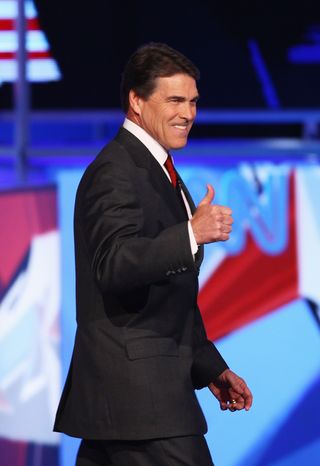 8.49 pm. Does Perry really think that the stimulus created no jobs? Truly, a wretched little twerp, dispatched on Tea Party theology by Ron Paul. 8.46 pm. So far, we have repealed universal health insurance, Dodd-Frank, much of the Pentagon, the Department of Education, and are so-so on Medicare and social security. What should government actually do to help the economy? Cut and reform taxes. Unless Obama proposes to cut taxes. Then that’s more spending. 8.43 pm. Perry seems to believe that tax cuts will be paid for by tax raises. Seriously, this guy is frightening. He gets asked how to pay for tax cuts, and he gives us a lecture about spending. Now, tax cuts are government spending – just because Obama is proposing it. That really is staggering. They will offer no response on Obama’s jobs bill and can only really offer platitudes and doctrines. God this is depressing. 8.41 pm. Huntsman offers a serious case for tax reform. Goes down like a lead balloon. 8.39 pm. Round One: Romney wins easily on points, but Perry reveals a kind of smug teflon smirk that this crowd is lapping up. There you see the choice – and Perry seems to me to be winning. As he strutted onto the stage he looked like a rooster in an Italian suit. He really is like W, but as a parody of the brash, slick and callous side of him. 8.38 pm. I think I’m going to have a shot every time I see a non-white person in the crowd. 8.37 pm. Bachmann is also on a roll of buzzwords. Is Palinism contagious? 8.35 pm. So they all want to repeal Obamacare, but no one wants to touch the Medicare Prescription Drug Entitlement. Blow me over with a feather. 8.33 pm. Santorum just gave us the doctrine – with all the boogey words “big government”, “one-size fits all”, Washington blah blah blah. Zzzzz. 8.30 pm. And the biggest applause of the night goes to Newt Gingrich for saying that Barack Obama is “scaring” the American people. Then he uses what I think is a reference to the effects of a national default as if it were a free-floating threat to senior citizens. Pretty much disgusting, when you think about it.
 The Dish