
Wester Ross, Scotland, 9 am
Wester Ross, Scotland, 9 am
Corey Robin, directly aiming a challenge in my direction, says yes – that conservatism is about ideology and power rather than restraint and freedom:
It’s not just Burke who makes … arguments in favor of ideological zeal and against prudential restraints. Nor is it in the face of an arguably lethal threat like Jacobinism that conservatives make them. In the 20th century, one finds a similar move in Hayek, arguing against not the totalitarianism of Stalin but the democratic socialism of Britain and France and the liberal welfare state of the New Deal. Again, this is not a widely noted theme in discussions of Hayek, but if you want a full-throated defense of ideology and utopianism against the prudential improvisations of the proverbial conservative, you could do worse than to start with Volume 1 of his Law, Legislation, and Liberty. There, Hayek says, among other things, that the "successful defense of freedom must therefore be dogmatic and make no concession to expediency."
You can see an earlier version of this argument, in a Raritan essay I read a while back. The trouble with running a blog of this pace and volume is that the time to read Robin's new book is short. So I apologize for not having read it yet, but hope to do so soon.
The obvious response to the essays' highlighting the radical or revolutionary aspects of the conservative mind – including Burke – is to agree that, faced with what looked like the end of all settled order in the late eighteenth century, many over-reacted, including Burke at times. The impulse to witness change and regard it as apocalyptic in its implications – and therefore to become more radical in attempting to arrest or mitigate it – is certainly a deep part of the conservative conversation. Burke, one should recall, was a Whig, not a Tory. And he was an Irishman. He contained multitudes. Equally, there's no question that Hayek's critique of the modern welfare state was radical in its prescriptions – just as Paul Ryan's plans for the future of elderly healthcare are.
I would simply argue that alongside this strain there is an equally countervailing one of respect for existing institutions, pragmatic prudence in governing, and an understanding of the value of moderation in political life. This is most fully achieved in Oakeshott, in my view, who rather downplayed the mercurial Burke, and famously criticized Hayek for excessive abstraction and too much faith in a too-perfect "system." Reihan conceded:
Robin’s ur-thesis is that the right has shrewdly employed a narrative of victimhood, victimhood for the predatory classes, as a means to win power and sympathy. I definitely think there is something to this, and I think it is an unattractive pose that the right ought to have outgrown. But again, I don’t see this as structural or ancient. Rather, I think it is contingent and particular, and that it parallels forms of victim politics that are deployed across the political spectrum.
I see that sense of angry alienation from modernity as more like a flickering flame through conservative history, one that burns sometimes with ferocity but also has long periods of quiet and calm. And context matters: Thatcher's pragmatic radicalism was in direct response to the unmissable collapse of the social-democratic model in Britain by the 1970s. The over-reach of post-war managerial liberalism demanded a conservative radicalism in response.
But having ratcheted back those hubristic moves (think lower tax rates, welfare reform), the proper conservative position decades later is to let be, to reform where one must, but to be a steady steward of a ship in high seas with currents and waves tossing us to and fro. That's why the increased ideology of the American right after their ideological and political triumphs since the 1980s is so, well, unconservative. Its radicalism is not contextual: tax revenues are at 50 year lows, and balancing the budget on spending cuts alone does not have a chance of winning broad consent in the time we have and would profoundly reset US society back a few decades, if not almost a century.
That's reactionaryism, not conservatism. It's religion, not politics. And the fact that these radical strains and extreme reactions have always been part of the right doesn't mean it is defined by them, or that the tradition that Tanenhaus and I champion is non-existent or incoherent.
Hanna Brooks Olsen, age 24, gets angry that people (including her doctors) keep insisting that she's too young to get her tubes tied:
Being a biological parent will, I believe, never be the right decision for me. And it’s not because I don’t like children, or because I am selfish, or because of what any study about the happiness of non-parents says. It is because I genuinely do not want to bring a child of my own into the world. And yet, every single person I tell reassures me: "You’ll change your mind eventually." I don’t believe that I will.
(Video via Whitney Jefferson)
A thought on the First Amendment.
A defense:
You could easily argue that it's the most important swing state in the 2012 general election. But it still has to wait in line behind states like South Carolina and New Hampshire? Why is it so important to find out which GOP candidate is strongest in those states? President Obama isn't going to compete in South Carolina or the rest of the Deep South. Unlike the rest of New England, New Hampshire is up for grabs in the general, but it only has four electoral votes.
The White House is asking the Supreme Court to rule on the constitutionality of the healthcare reform law. C.H. at DiA sees no upside:
If the court rejects the individual mandate, it will wipe out (or, at least, severely damage) the biggest achievement of Mr Obama’s first term. In the best case scenario for the president, the court will uphold the mandate. But that would just rally the Republican troops in the middle of the election campaign, making them even more eager to kick Mr Obama out of the White House. Regardless of the outcome, the case will focus attention on the most unpopular aspect of a law that many already view unfavourably.
Timothy Noah differs.
We're in it, says Steven Pinker. And the evidence is striking:
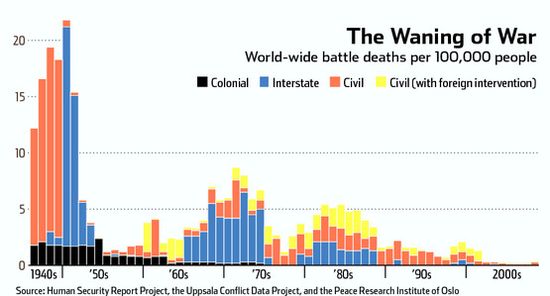
When you put this alongside the collapse of domestic crime – at historic lows and still not soaring again despite brutal economic times – the modern world really is less nasty, brutish and short-lived. And yet we would never think of the world this way – because, I suppose, the news always highlights provocative violence over the daily humdrum. (One reason for our View From Your Window project was to inject a moment of calm and normality in a blog so often covering crises and conflict.) Pinker thinks we have simply learned our lessons, and have not escaped our evolutionary genes:
A third peacemaker has been cosmopolitanism—the expansion of people's parochial little worlds through literacy, mobility, education, science, history, journalism and mass media. These forms of virtual reality can prompt people to take the perspective of people unlike themselves and to expand their circle of sympathy to embrace them.
These technologies have also powered an expansion of rationality and objectivity in human affairs. People are now less likely to privilege their own interests over those of others. They reflect more on the way they live and consider how they could be better off. Violence is often reframed as a problem to be solved rather than as a contest to be won.
That's an interesting take on why so many of the recent revolutions have been more self-consciously non-violent. Maybe the Internet played a role.
"The grind of a campaign may no longer appeal to her. Neither might the pay cut. I get all that. But justifying a decision not to run for president by insisting that she’s better than the process – that she’s too “rogue,” too “independent,” and too much of a “maverick” to be constrained by a campaign and the office of the presidency – is embarrassing. It also reveals, I think, a deep-seated insecurity. Ms. Palin knows full well she wouldn’t do well running for president (give her points for self-awareness), but she feels the need to try to place a cloak of virtue around herself to explain it," – Pete Wehner in a harmonic convergence with Jon Stewart.
“Perry’s close alliances with pro-Islamic Republican activists like Grover Norquist give additional cause for concern. Norquist supports open borders and amnesty for illegal aliens and is well known in Washington, D.C. circles for his tireless efforts to build Republican bridges to pro-amnesty groups and to slander advocates of immigration enforcement as “racists.” Norquist also has close ties to the Council of American Islamic Relations (CAIR), whose Houston chapter bragged in a recent newsletter that “Rick Perry’s relationship with Muslims may set him apart.” … Does Perry think he can talk tough in defending the Texas death penalty and then waffle on border security and taxpayer support for illegal alien children? Why does he think he can claim to be the “tea party candidate” while endorsing a whitewash of Islamic extremism in Texas schools?” – Former Congressman Tom Tancredo.
 The Dish