Hawaiian Shirt Environmentalism

This year Japan instituted "Super Cool Biz," a government campaign to encourage sandals, shorts and Hawaiian shirts at work to avoid nation-wide blackouts:

In 2005, the Japanese government launched a predecessor, Cool Biz, with a subtler sartorial assault (nix the jacket and tie) and a headier goal (fight global warming by using less air-conditioning). Most people dismissed the idea back then, but polls now show about 66% worker support. It has cut roughly 5 million metric tons of greenhouse gases–which goes to show that cultural changes can lower energy use as much as technological ones.

Iris Scans For 1.2 Billion People

GT_INDIACOAL_110907

It's part of India’s Unique Identification project, also known as Aadhaar, and it could be a major economic boon:

Today, there are as many as 400 million Indians who […] have no official ID of any kind. And if you can’t prove who you are, you can’t access government programs, can’t get a bank account, a loan, or insurance. You’re pretty much locked out of the formal economy.

Today, less than half of Indian households have a bank account. The rest are “unbanked,” stuck stashing whatever savings they have under the mattress. That means the money isn’t gaining interest, either for its owner or for a bank, which could be loaning it out. India’s impoverished don’t have much to save—but there are hundreds of millions of them. If they each put just $10 into a bank account, that would add billions in new capital to the financial system.

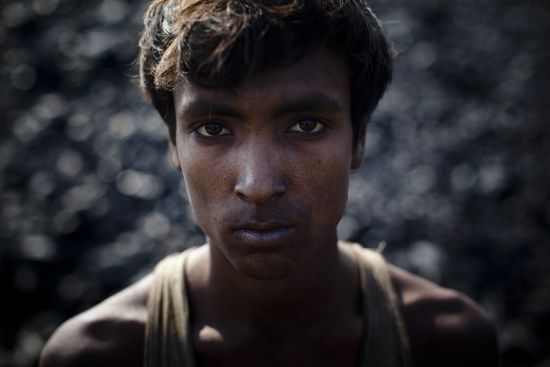
(Photo: 15 year old Abdul Haqim poses for a portrait, whilst working at a coal depot shovelling coal on April 15, 2011 near Lad Rymbai, in the district of Jaintia Hills, India. By Daniel Berehulak/Getty Images)

Bookends

Fein

Reza Aslan compares Mohamed Bouazizi, the man who immolated himself in Tunisia, to Mohamed Atta, the oldest of the 9/11 hijackers:

These two fires — the one lit by the hijackers on September 11, 2001, the other sparked by a single individual in a small Tunisian town ten years later — form the bookends to the 9/11 decade. Indeed, you can draw a straight line from one to the other. Their kindling was the same: humiliation, lack of dignity, a smoldering frustration with the ways of the world, and the overwhelming urge to set it all alight. Their fuel was the same: both fires spread through satellite television and social networking sites, something al-Qa‘ida had pioneered long before there was any talk of a “Facebook revolution.”

Yet, on this 10th anniversary of the attacks of 9/11, when Americans are embroiled in debates about what that day meant for us and how it changed the way we see ourselves in the world, perhaps we should pause for a moment and recognize the single most significant thing that the fires sparked by Mohamed Bouazizi and Mohamed Atta share in common, which is that neither of them had anything to do with us.

It was not the invasion of Iraq, or nation-building in Afghanistan, or Bush’s “freedom agenda” that deafened young Muslims to al-Qa‘ida’s call. It was al-Qa‘ida’s bloodlust in Iraq and Afghanistan. It was the fact that between 2004 and 2008, Muslims accounted for 85% of the casualties from al-Qa‘ida attacks (between 2006 and 2008, that number surged to 98%). Above all it was the youth themselves — the very kids that the 9/11 attacks were meant to mobilize. Though fed up with their dictatorial regimes and spurred by 9/11 to do something about it, by the end of the decade, these kids had discovered a far more effective model for action, a different symbol to rally around: that of young Mohamed Bouazizi, standing in the middle of traffic, holding a small, flickering flame in his hand.

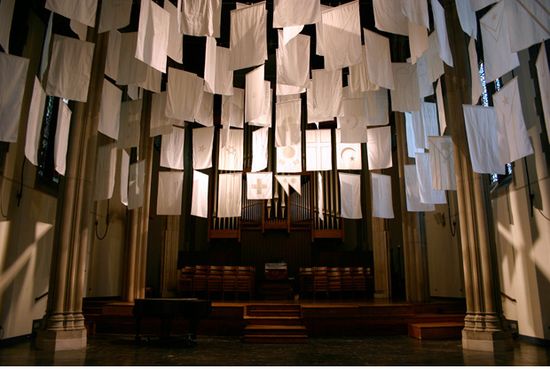
(Image: "White Flags,” a new installation at New York City’s Union Theological Seminary by Aaron Fein, of all 193 flags of the United Nations in white on white fabric)

The Prescience Of Mearsheimer

Take a moment to read the op-ed here, written in November 2001, about why we should not invade Afghanistan because it was a trap:

The principal target is Al Qaeda, and the United States should not rest until it has destroyed that terrorist organization. Removing the Taliban from power, and discouraging states like Somalia and Sudan from taking in Osama bin Laden and his fellow terrorists, are major steps in that direction. But probably the most important ingredient in the war against Al Qaeda is good intelligence, which will allow the United States to locate the terrorists and strike at them with deadly force when the time is right — and to locate, protect and reward those who come to the American side. The Bush administration should devote abundant resources to improving America's intelligence capabilities and to buying information on the terrorists from other governments.

Americans must face a hard reality: massive military force is not a winning weapon against these enemies. It makes the problem worse. In contrast, a strategy that emphasizes clever diplomacy, intelligence-gathering, and carefully selected military strikes might produce success eventually if we pursue it with patience and tenacity.

This is not terribly heartening. But it is the least bad alternative at the moment, and international politics is often about choosing among lousy alternatives.

It took Obama to get this right, after I and so many got it so terribly wrong. And this is another reminder of the strategic brilliance of Mearsheimer, a man subjected to a vicious smear campaign because of his resistance to the Greater Israel Lobby.

9/11 And The End-Times

There seems little question the Islamist terror attack prompted renewed apocalypticism from the evangelical right. Here's Billy Graham's daughter's take:

[T]he alarm did not fade away. Instead, I have heard it reverberating throughout the past 10 years: from Hurricane Katrina to the record-breaking floods, forest fires, tornadoes, droughts, and snow storms; to the collapse of our major financial institutions; to the economic recession; to the inability to win the war in Afghanistan.

The alarm keeps resounding because so many people have not heeded, or even heard, the warning … And what is the warning? Simply this: It is five minutes to midnight on the clock of human history. Judgment is at the door. Jesus is coming! It's time to wake up and get right with God! Are you listening?

Religious extremism begets religious extremism. In the Muslim world, the shift seems to have been somewhat against such extremism in the last decade. Not so much in the Republican party base.

The First To Perish

2366224

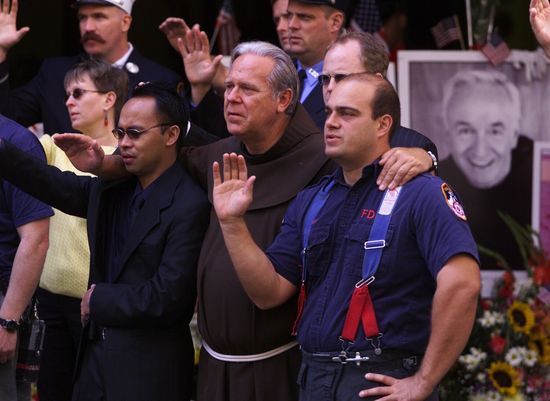
9/11's first recorded casualty was Father Mychal Judge, a gay Franciscan fire chaplain who ran to help with the firefighters he served:

As it happened, French documentary filmmakers were inside the North tower. Their camera captured some of the last moments of Mychal Judge's life. In the film, says his friend, Father Michael Duffy, you can see the priest standing by the plate glass window, watching the bodies fall on the patio outside. "And if you look closely at that film, you'll see his lips moving," Duffy says. "Now, for those of us who know him, he wasn't one that talked to himself. He was praying. And absolving people as they fell to their death."

Tony Adams concentrates on the Church's reaction:

Among the victims and heroes of 9/11 were many other gay people who have been claimed and memorialized and honored by their families, friends and communities. Although a documentary film has been made about the extraordinary priesthood of Father Judge, and a section of West 31st Street has been renamed for him, The Roman Catholic Church has turned its back on all requests to initiate the process of making him an official saint of the church. A gay priest who ministers to gay people and is not heavy handed about gay sex is an inconvenience and a source of anxiety for the Catholic hierarchy who have redesigned their scrutiny of candidates for the priesthood to discourage and weed out men like Mychal Judge.

More remembrances of Judge here, here, and here.

Von Hoffmann Award Nominee

“Once we have deposed Saddam, we can impose an American-led, international regency in Baghdad, to go along with the one in Kabul. With American seriousness and credibility thus restored, we will enjoy fruitful cooperation from the region’s many opportunists, who will show a newfound eagerness to be helpful in our larger task of rolling up the international terror network that threatens us,” – Max Boot, as early as October 15, 2001.

The Agency With Agency

The CIA of today barely resembles the one born under the National Security Act of 1947. Scott Horton sees danger in the expansion of its responsibilities:

The American military is trained to operate under the laws of armed conflict. It has professional officers sworn to ensure adherence to those laws, and a Uniform Code of Military Justice that provides a tool for enforcement. The CIA has no such checks. In fact, its culture has for decades been built on the notion that it operates outside of the laws of war.