What Is Islam?

GT_TAHRIRPRAYER_110909

Lawrence Wright thinks that was one of the question bin Laden set out to answer on 9/11:

In the name of al-Qaeda’s vision of Islam, children have been turned into suicide bombers, both Muslims and non-Muslims have been beheaded (sometimes on video), women have had their faces burned off, schools were destroyed, lovers stoned, aid workers murdered, and the whole world held hostage to terror. In the minds of many non-Muslims, Islam has become synonymous with barbarism. Nothing said by more moderate Muslim voices could compete with the appalling imagery put forward by al-Qaeda’s terror masters.

Then came the Arab Spring. …

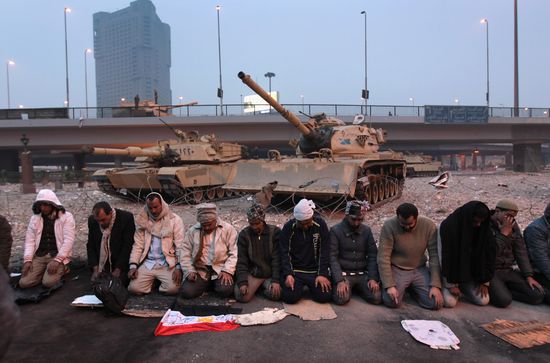
The protesters are not just bringing about badly needed social revolutions in their societies. By their moral example, they are redefining Islam and redeeming it from the savage caricature that bin Laden made of his religion.

(Photo: Anti-government demonstrators pray at sunset in front of Egyptian army tanks on February 5, 2011 in Cairo, Egypt. The army had planned to clear the demonstrators' barricades on the edge of Tahrir Square, and protesters vowed to lie down in front of the tanks. By John Moore/Getty Images)
The Ideas That Orbit Great Philosophers

Peter Millican explains why we still study Hume's 300-year-old work:

Without my interest in Hume, I might never have read Price’s views on perception and “sense data”. Through his book, the greatest philosopher of the 18th century has thus provided a connecting thread through which the insights of a different period – the early 20th century – can be conveyed forward even to those who have no special interest in that period. Thus one can learn greatly both about Hume and about philosophy through seeing his issues explored in a variety of ways, both over time and through the involvement of a variety of scholars with different emphases (and, of course, disagreements).

This also facilitates serendipity, the way in which interesting ideas can turn up unexpectedly, and chance observations or associations can prompt fruitful enquiries (perhaps quite distinct from the intentions of the relevant texts). One famous example is Einstein’s recollection of studying Hume’s Treatise “with eagerness and admiration shortly before finding relativity theory”. Einstein did not approach Hume’s text as a scholar, but his understanding of its “positivism … was of great influence” and even “suggested relativity theory”. Such serendipity can occur with all sorts of reading, but a particular virtue of going back to classical texts is that doing so forces us systematically to reinterpret our own ideas in their terms (or vice-versa), providing an especially fertile source of novel connections.

TM Goes Mainstream

Practitioners of transcendental meditation have tripled in the past three years:

It's a process perfectly matched to our self-interested times—"no pain, but a lot of gain," according to [Norman E. Rosenthal, Georgetown University professor]. … Practically speaking, sit in a chair, close your eyes, and silently repeat the mantra for 20 minutes. Once you get the hang of it, [David] Lynch says, you cut the elevator cables of your normal-thinking mind to descend to a place that feels different.

You may experience a connection with the universe or a mental light show, what Rosenthal calls "four-star graphic effects." At the very least, you should be blissfully relaxed, which is the foundation of the health benefits that have been measured in the medical research amassed, much of it funded by the government. The deep tranquillity TM promotes quiets the body's "fight or flight" stress response, lowering blood pressure and anxiety and combating depression.

An Unaging Society

Kyle Munkittrich reviews Drew Magary's The Postmortal, a dystopian take on a world without aging:

I suspect Magary’s indictment is not of those like Aubrey de Grey who seek the end of aging, but of those who resist maturation. Magary’s values are essentially conservative. It isn’t until the main character is about to die that he realizes what matters: namely, his son (out of wedlock), getting married, and protecting an unborn life. Life in the post-aging world is plagued by those who devalue marriage, childbearing, and religion. Yup, even the secular “Church of Man” is shown to be the “right” answer by the end of the novel. While I don’t deny that these are all valuable pursuits (substituting religion for the broader philosophy of the examined life) I do deny that they would be annihilated by agelessness.

Previous coverage of real-life efforts to fight aging here.

The Perils Of Religious Enthusiasm

A primer:

In German, there are two words—three even. Enthusiasmus, like the English enthusiasm, is rooted in the Greek “en theos,” to have the god within, to be inspired by god or the gods. But Enthusiasmus was inadequate to contain the sixteenth-century German reformer Martin Luther’s rage against those who purported to receive direct divine inspiration. For them, he coined the term Schwärmer, from the verb schwärmen, to swarm, as in the swarming of bees.

The Schwärmer were those, like the so-called Zwickau prophets, Nicholas Storch, Thomas Drechsel, and Marcus Thomas Stübner, who claimed to have direct revelations from the Holy Spirit, or Thomas Müntzer, who insisted that direct revelation and prophecy continued to occur in history. For Müntzer religious radicalism and political radicalism went hand in hand; the new prophecies and apocalyptic revelations he proclaimed called for the re-ordering of society, and not just of the church. In denouncing Müntzer, the Zwickau prophets, and others as Schwärmer, Luther rejected not only claims to continuing revelation, but also the forms of religious and political agitation to which he believed such claims gave rise. To be a Schwärmer, most often translated as enthusiast or fanatic, was to be ungovernable by either human or God.

(Hat tip: Morgan Meis)

A Poem For Sunday

Towers

"Try to Praise the Mutilated World" by Adam Zagajewsk:

You’ve seen the refugees heading nowhere,
you’ve heard the executioners sing joyfully.
You should praise the mutilated world.
Remember the moments when we were together
in a white room and the curtain fluttered.
Return in thought to the concert where music flared.
You gathered acorns in the park in autumn
and leaves eddied over the earth’s scars.
Praise the mutilated world
and the gray feather a thrush lost,
and the gentle light that strays and vanishes
and returns.

Matthew Kaminski spoke to Zagajewsk, a Polish poet, about his poem, which appeared on the last page of the New Yorker's special 9/11 issue after the towers fell:

Zagajewski, who often purrs his words and speaks slowly, rejects any suggestion that trauma ennobles Poland or any society. Yet thinking of 9/11 and further back, he notes a change in our response to trauma. In “the past in general and not only in Europe,” he says, “the rule was to forget, to move on. There’s a relatively new idea that you have to work on it—that you have to keep everything in our memory. Which I like. It’s changing us. I don’t think people in the mid–19th century were going back to the Napoleonic wars and thinking, ‘We have to work on it.’?”

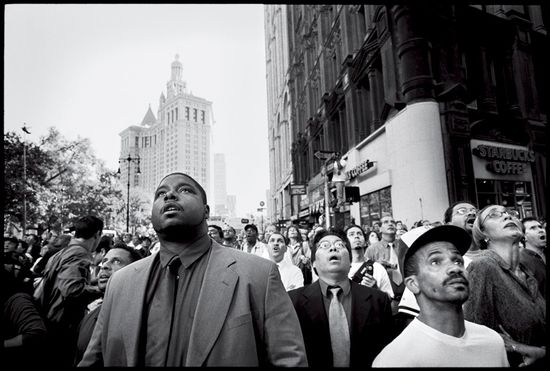
(Photo: "Bystanders watch in horror in downtown Manhattan as the World Trade Center towers burn," by Patrick Witty / Redux via Newsweek.)

The Anti-Racist White Movement

Jen Graves joins it in Seattle:

White people saving trees: check. Ending poverty: check. Improving racial equity: What's the catch? If you're white and talking about race, or working for the NAACP, people will ask you to explain yourself. Doing it isn't pretty. I've made a fool of myself. I've been accused of being a race traitor. … But how would the conversation be different if Seattle were as progressive on race as it is on the environment?

An Unheard Hero Of 9/11

A reader writes:

I didn't know if you had read this in the Washington Post, but I think it might be of interest in the discussion on whether woman should be allowed in combat. The story is about Lt. Heather "Lucky" Penney, a female combat pilot who was sent up into the air on 9/11 in a plane that wasn't armed with weapons, with the instructions to find and bring down Flight 93 before it could get to Washington – with her plane. She was to ram it, crash into it, and if she was lucky, she might have time to eject. Probably not. It was in truth a kamikaze mission. And she didn't hesitate.

I'm in awe.

Christianity And Immigration

Tony Woodlief inveighs against Alabama’s anti-immigration law, which "empowers police to arrest people on suspicion of being illegal immigrants, and deputizes public school teachers into border patrol bureaucrats":

[W]hat we have seen to be persistently true about any government armed with great intrusive authority is that no matter how good the intentions such power tends to be corrupted and the liberties of the virtuous destroyed. Therefore, an underlying principle of our Constitution is that often we allow the stupid and wicked, in order that virtue might be protected. In turn, this principle is rooted in a Christian understanding of man—that he is fallen and sinful, and that you dare not give him much unchecked power.

A federal judge in Alabama has delayed the enforcement of the law until she can figure out whether it's constitutional.

(Video: "Gospel Without Borders" Trailer from EthicsDaily on Vimeo. The full film "examines the biblical record about the treatment of the “stranger,” explores the experiences of documented and undocumented immigrants, and looks at how goodwill Christians address the overheated issue of immigration.")