What Presidential Speeches Can And Can’t Do

John Sides summarizes the political science research on the question. In short:

First, the president’s ideas have at least some support already.  If they didn’t, he probably wouldn’t have given the speech.  Second, as the political scientist Jonathan Bernstein notes, the speech thus serves not so much to persuade lots of recalcitrant voters or members of Congress, but more to signal the President’s intention to push for these policies and, equally if not more important, to bargain about these policies.  In other words, the speech, whatever its tone, was not laying proposals that are set in stone.  Expect the speech simply to spawn additional debate and negotiation. If the end result is a bill on the president’s desk, we’ll have an excellent example of how presidential leadership really works.  It’s not about magic words or eloquent moments.  As Edwards said, it’s about facilitating change.

Stop Fixating On Uncertainty

00 Most Important

Jay Livingston slams a GOP talking point lent legitimacy by Gary Becker:

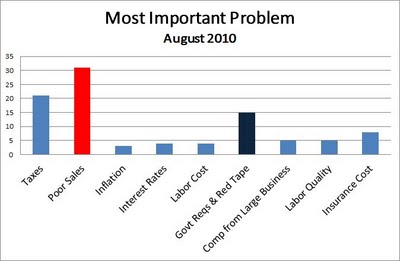
[Becker] pushes uncertainty to the front of the line-up and says not a word about the usual economic suspects – sales, costs, customers, demand.  It’s all about the psychology of those in small business, their perceptions and feelings of uncertainty,  Not only are these vague and hard to measure, but as far as I know, we do not have any real data about them.  Becker provides no references.  The closest thing I could find was a small business survey from last year [above], and it showed that people in small business were far more worried about too little demand than about too much regulation.

Greg Ip and Ezra Klein have more thoughts on the issue.

Google As Publisher

Alexis Madrigal evaluates the company's decision to buy Zagat:

All around, this is a fascinating move. Google has previously shied away from making its own content, preferring to aggregate a la Google News. In fact, not a single one of Googles 100-plus acquisitions was a content company. Zagat, though, is a pure content play and there's no getting around that. The convergence of every media, technology, and electronics company takes one more small step. 

John Battelle contemplates the purchase:

[I]t's easy to argue that this was a small, strategic buy to support Google's local offering. Then again…Blogger, YouTube, and GoogleTV are not small efforts at Google. And if I were an independent publisher who focused on the travel and entertainment category, I'd be more than a bit concerned about how my content might rank in Google compared to Zagat. Just ask Yelp.

Is The Death Penalty On Life Support?

Despite Perry's unthinking support of executions, Toobin claims that capital punishment is on the way out:

[T]he death penalty is withering, even in Texas. In the nineteen-nineties, juries in the United States handed down about three hundred death sentences per year; in 2010 there were only a hundred and fourteen. There were ninety-eight executions in 1999 and only forty-six last year. Earlier this year, Illinois became the sixteenth state to ban executions, and death sentences are down dramatically even in Perry’s own state.

Alyssa Rosenberg recommends the Cameron Todd Willingham documentary. Trailer above.

Why Shouldn’t Women Serve In Combat? Ctd

A reader makes an interesting case:

I served six years, from 2002 -2008, and made multiple tours overseas.  I served honorably alongside women, who were every bit as ferocious and competent as any drill sergeant could hope to train. There is no appreciable difference in performance that so many fear.  

Yet I must dissent against women serving in combat at this time.  

Our current ammunition is composed of depleted uranium.  Uranium is a pyrophoric teratogenic agent.  The former means that when a round is fired, microscopic amounts of the bullet are burned and ablated off as it passes through the air.  This is regarded as a feature, rather than a flaw.  But it also means that the soldier that fires the round will ingest tiny amounts of uranium compounds through inhaling the air the bullet passed through.  

This is where the second classification comes into play.  Teratogenic agents remain in the body and generate biological abnormalities.  For adults, this is essentially not an issue.  But it is for developing embryos.  As the compounds remain in the body, a female veteran could see immense complications if she chose to have a child, seeing immense spikes in the chances of birth defects. Fallujah saw birth defects and early-life cancers increase by a factor of 15 times following combat in that city.  

This is the breaking point for me.  It is one thing for a woman to freely choose to sacrifice for her country.  It is another for all her children to go through life with afflictions and deformities for decisions made before they were conceived.

I am aware that this is an argument against the use of depleted uranium rather than against the use of women in combat.  Hopefully that will be resolved, as these same risks for female soldiers exist for female civilians in a combat zone.  But the reality of it is that until this issue is resolved, through changes in policy or advances in science, I cannot stand behind asking the next generation to take on such a burden.

Face Of The Day

124230912

Zookeeper Ross Poulter holds a White's Tree Frog in Edinburgh Zoo's new tropical forest zone on September 9, 2011 in Edinburgh, Scotland. The Brilliant Birds Exhibit, which brings together beautiful and rare birds from all over the world, is now more colourful and unusual with the unveiling of the zoo's new tropical forest zone. It brings together a collection of vertebrates, invertebrates and amphibians for the very first time. By Jeff J Mitchell/Getty Images.

If You Can’t Beat Al-Qaeda, Copy ‘Em

Ackerman explores McChrystal's aping of al-Qaeda's organizational structure to use against them:

One of the greatest ironies of the 9/11 Era: while politicians, generals and journalists lined up to denounce al-Qaida as a brutal band of fanatics, one commander thought its organizational structure was kind of brilliant. He set to work rebuilding an obscure military entity into a lethal, agile, secretive and highly networked command — essentially, the U.S.’ very own al-Qaida. It became the most potent weapon the U.S. has against another terrorist attack. That was the work of Stanley McChrystal. McChrystal is best known as the general who lost his command in Afghanistan after his staff shit-talked the Obama administration to Rolling Stone. Inescapable as that public profile may be, it doesn’t begin to capture the impact he made on the military.

The iPhone And US Unemployment, Ctd

101916676

A reader writes:

Further to your discussion about the iPhone and the profitability of international outsourcing, I recommend this article from Slate. Simply, what OECD residents perceive as gross maltreatment of workers ($4/day wages, long hours, poor work conditions) is actually raising living standards in these places, compared to subsistence farming. So, if in our desire to protect American workers, we end up reducing the living standards for people who actually have to worry about starving, are we willing to make that trade off? Perhaps we are, or should be, but nothing occurs in isolation.

Another argues along those lines and more:

* The notion that the goal of US policy or political pressure should be to reduce Apple's profitability is sickening. 

Apple is one of the country's most successful companies and an engine of growth, productivity and higher living standards. That at least one of your readers sees this as reason to target the company is deeply disturbing. If your readers really want less profitability, tell them to buy some stock and then vote at the company meetings for Apple to impoverish itself as company policy.

* What's with all of the economic nationalism? Are your readers a bunch of Pat Buchanan acolytes? Are Americans more deserving of jobs than the Chinese? Isn't the left supposed to have a more cosmopolitan outlook?

* While one of your readers says that manufacturing in the US could be offset by a "modest price increase" (how do they know it would only be modest?), this would make smartphones less affordable. And guess who disproportionately relies on smartphones for internet access? The poor. Higher prices also mean fewer smartphones sold and thus fewer jobs. Furthermore, every extra dollar spent buying a smartphone is one less dollar available to purchase other products and support other jobs.

* Lastly, if you want some serious economic analysis of Apple and its overseas production, you should read these links.

Getty offers a counterargument of sorts:

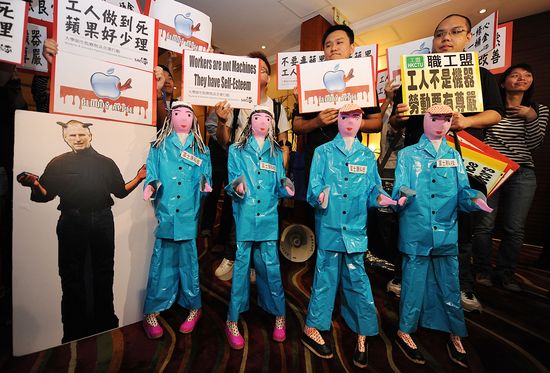
Students protest with model effigies of workers who have committed suicide at Foxconn in China during the companies' AGM in Hong Kong on June 8, 2010. The corporation Foxconn, which makes the Apple iPhone, has offered workers a large pay increase as it tries to deal with a number of suicides at the factory. By Mike Clark/AFP/Getty Images.