What Does An IED Cost?

Less than it used to:

[A]ccording to the Pentagon’s bomb squad, the average cost of an IED is just a few hundred bucks, pocket change to a well-funded insurgency. Worse, over time, the average cost of the cheapo IEDs have dropped from $1,125 in 2006 to $265 in 2009. A killing machine, in other words, costs less than a 32-gig iPhone.

A Defense Of Unenhanced Interrogation

Jennifer Bryson, who was an interrogator at Guantanamo Bay, explains why "enhanced interrogation techniques" actually sabotage interrogation:

A moment of violence might provoke a quick response, but the response is likely to be one of defense—doing, saying anything, no matter how false, to stop the violence—and a jolt in response to violence may at best only skim the surface of an individual. Interrogation is different altogether. An interrogator seeks depth and breadth of information. Getting to such depth and breadth requires finding a way to create an opening in the internal web of the detainee’s person. Perhaps an insecure young man craves having someone treat him with dignity. Perhaps a lonely detainee misses the attentive care and wisdom of a favorite aunt. Perhaps a proud warrior wants to feel respected for how hard he has fought for his beloved cause. These are the types of emotional openings a skilled interrogator can home in on and then build from in order to form a connection between the interrogator and the detainee.

US Grand Strategy: On The Right Track?

Thomas P.M. Barnett believes so:

Isn't this what we've always wanted in terms of a balanced world? Think about it: Libya was a case in which the US dared not act alone, but likewise one in which NATO clearly couldn't have pulled it off without us. The rebels never would have won without NATO's air cover, and within NATO, France couldn't have done it without the UK and vice versa. If you don't want unilateralism and you don't want interventions that aren't welcomed by the locals, this is exactly what it looks like. Yes, we can pull back the strategic lens and continue our worries about China's rising military might, but the only way that truly challenges is if you believe in that country's presumed linear economic growth trajectory lasting for a couple more decades – and that's just fantasy.

David Axe thinks this model is part of a general strategy of "offshore balancing." Hans-Inge Langø differs. For my part, I have yet to be convinced that the Libya intervention was wise. But as a way of empowering Europeans to tackle security problems ahead of the US, it was a strategic success – as with the ultimate toppling of Qaddafi. I'll repeat that I think foreign policy is becoming one of the Obama administration's real strengths – as potent and nuanced a management of global politics as anything since George H W Bush.

End Of Gay Culture Watch: A Hetero Grindr, Ctd

Hetero Grindr will apparently be more text than picture based. Bryan Lowder is skeptical that this will work:

[T]he real appeal of Grindr seems to be a kind of friendly/titillating voyeurism, spiked, perhaps, with a shot or two of narcissism. True, Grindr users certainly find friendship, sex, and even love through the app, but in my experience, grinding is really just a more advanced version of that old website “Hot-or-Not.” You look to see who’s cute or busted, you chat to see what people will say, and you criticize/praise profiles to your friends depending on your tastes. Then, you close it and check your email or, you know, talk to your friends in real life.

Forget Hetero Grindr; OK Cupid got there first, last month:

If you're particularly after the nerdlinger demographic, [OKC's] new geolocation feature ["Locals"] for Android and iOS apps will aid you in your search for true love. True love, or a hetero-shag a la Grindr, anyway. The apps will locate other OkCupid users within your proximity, whether they match your interests or not (you can toggle the security settings, obviously). Once you've found someone whose profile catches your eye, you can either chat with them, swap some photos and arrange a date.

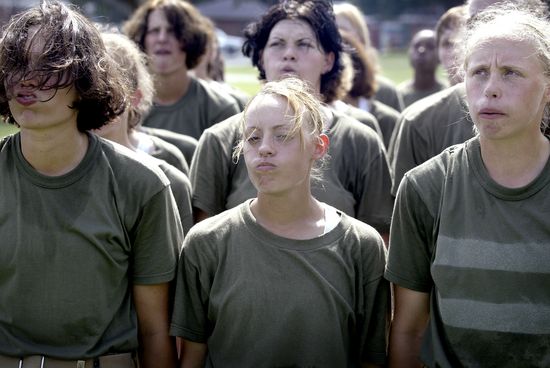
Why Shouldn’t Women Serve In Combat? Ctd

51000363

A reader writes: 

I think that the parallels to DADT are not as obvious as they may seem. Despite the amazing progress that women have made in many fronts on equality, they are still physically smaller, slower, and weaker than men. At the very least, one can look at the world records for just about any athletic event, and see how much faster men are. While this does not matter for pilots, or intelligence analysts, or ships captains, it matters very strongly to certain combat arms, such as the infantry. Carrying an 80-pound pack for miles is something where strength does matter. And while some may argue that this can be mitigated by sticking to motorized vehicles, this is not an effective strategy. From Korea to Iraq to Afghanistan, the battles have only been won by getting troops to engage the enemy and leave the comfort of their bases and vehicles, and engage the enemy. This, I think, is the fundamental stumbling block of putting women in the Infantry, or some of the other combat arms.

Bodenner, whose mother is retired military, addressed a similar argument from a reader during a guest-blog stint:

[O]nly individuals physically capable of combat will be sent to the battlefield, and women, on average, are not as capable as men. However, with our ever-increasing reliance on technology for combat, physical prowess is becoming more and more obsolete. In fact, given the rapid dominance of women in higher education, the battlefields of the future – reliant on robots – could be dominated by women as well. … Despite all the reader's objections, he still doesn't seem to reject the idea of women in combat units. He wrote: "[V]anishingly few women are capable of the physical performance that the mission requires for infantry combat." Few, but still some.

(Photo: Female Marine Corps recruits listen to instruction during hand-to-hand combat training at the United States Marine Corps recruit depot June 23, 2004 in Parris Island, South Carolina. Marine boot camp, with its combination of strict discipline and exhaustive physical training, is considered the most rigorous of the armed forces recruit training. By Scott Olson/Getty Images)

America Is Not Israel

Matt Steinglass compares Israel's and America's counter-terrorism policies:

In Israel, while terrorism itself is not an existential threat to the state or to the Israeli nation as it currently sees itself, it's part of the overall conflict with the Palestinians, which is a potentially existential threat to both. For America, on the other hand, terrorism is not part of any conflict that could conceivably pose an existential threat to either the state or the nation. Ten years after the September 11th attacks, it's overwhelmingly clear that the ideological and military threats posed by Islamic radicalism to the United States are trivial. So at the state level, our response to radical Islamic terrorism should have been less like the Israeli response; while at the private level, our response should have been more like theirs. We pretty much got it wrong on both counts.

Nicely put.

Whither Libyan Missiles?

C.J. Chivers reports on the disappearance of sophisticated missiles from Libyan stockpiles after Qaddafi's fall. Andrew Lebovich assesses the potential implications:

The sheer number of missiles that may have gotten loose is staggering, given Qaddafi’s procurement over the years, and the higher capability of missiles like the SA-24 mean they pose a real threat to aircraft in and even potentially beyond the region. However, there are  thousands of SAMs out in the open already, and past concerns about even advanced weapons like the Stinger have proved overwrought. After all, many of these weapons have a short shelf life, and as Twitter users @wjrue and @SahelLakes pointed out to me earlier today, these weapons may not have been maintained for years, and are difficult to keep operating in a harsh environment like the Sahel. But my hunch is that if these missiles make an appearance in something more than a propaganda video, it will not be Algiers, Abuja, or Paris, but will instead be somewhere along the Mali-Mauritania border.