Face Of The Day

124039819

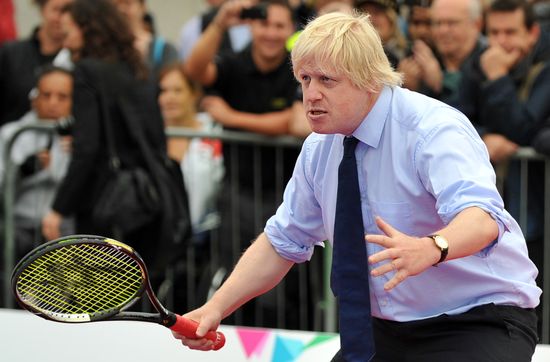
The mayor of London, Boris Johnson, plays tennis during the International Paralympic Day in Trafalgar Square on September 8, 2011. A full day of activity was planned to celebrate elite Paralympic sport and give the public a chance to find out about each of the 20 sports to take place at the London 2012 Paralympic Games and meet international athletes. By Ben Stanstall/AFP/Getty Images.

How We Create Terror

Jeremy Scahill recounts, in great detail, the US midwiving of Somali terrorist organization al-Shabaab:

In backing the Ethiopian invasion, the United States calculated that it could crush the “jihadist” elements of the [Islamic Courts Union], while encouraging a reconciliation between its more moderate members and officials of the [Transitional Federal Government]. While the government that would emerge after the invasion included many former leaders of the ICU, Washington grossly miscalculated the blowback from the invasion. “The end result of the US-backed Ethiopian invasion and occupation,” Buubaa, the former foreign minister, told me, was “driving Somalia into the Al Qaeda fold.”

Comfort Ero briefs us on a different African terrorist group, Nigeria's Boko Haram.

Al-Qaeda Defeated?

Will McCants and William Rosenau say yes:

Al-Qaeda has failed utterly in its efforts to achieve one of its paramount political objectives. From the 19th century through the present day, terrorists and insurgents — from transatlantic anarchists to Fanonists of the tiers monde to Nepalese Maoists — have spun insurrectionist fantasies of taking over. But the Salafist-jihadists' worldwide Islamic uprising, against perceived enemies of the faith, never materialized. The Muslim masses have refused to play their part in the al-Qaeda dramaturgy. The terrorism intended to generate  widespread rebellion has failed to arouse a global Muslim community. Most damningly, al-Qaeda has been irrelevant to the popular uprisings sweeping the heartland of the Muslim world.

Daveed Gartenstein-Ross counters:

The only chance a relatively small and weak actor like al-Qaeda has to beat a strong actor like the U.S. is by turning its strength against it. The group has managed to put the U.S. in a position where many of its offensive and defensive measures — armies deployed in far-away and hostile places, travel and commerce slowed by cumbersome security theater — do in fact make the U.S. more vulnerable by exhausting it. That might not be an assault of the sort we experienced on September 11, but it is still, unfortunately, all too effective.

J.M. Berger sides with Gartenstein-Ross.

Who Creates Jobs?

Last night, Perry, Romney and Huntsman jousted over their respective records on employment. In response, Edward Glaeser downplays politicans' ability to create jobs:

I would give more credit to Utah’s smart workers and entrepreneurs than to Huntsman for the state’s success during Huntsman’s tenure from 2005 to 2009. And I wouldn’t blame Romney, who served from 2003 to 2007, for Massachusetts’ slowdown after the tech boom. The economist Justin Wolfers has found that voters reward governors for lucky economic breaks, like oil price increases in energy states. We should guard against our tendency to give either governors or presidents too much credit for the economy.

Avent agrees, with caveats.

Making Websites Pay Taxes

Amazon has finally agreed to pay sales taxes in California. Alyssa Rosenberg expects the company to flourish regardless:

I wrote in July that I thought Amazon had shifted the market enough that charging sales tax wouldn’t actually put it at a disadvantage with competing retailers, online or off—it has better stock than brick and mortar stores, and volume and corresponding price advantages over other online stores. And I wonder if the largely positive news that’s greeted reports of Amazon’s planned tablet launch, whether it’s TechCrunch’s declaration that it’ll be “huge, potentially,” or Tim Carmody’s explanation of how Amazon is fulfilling Steve Jobs’ vision in a way even Apple can’t, has made the company feel more confident.

Alexis Madrigal frowns at Amazon's rhetoric during its battle with California. The Dish debated the issue of Internet companies paying sales tax when Borders went bust this summer.

Update from a reader:

"Amazon has finally agreed to pay sales taxes in California." Amazon has agreed to COLLECT sales taxes in California. Customers will actually pay the sales taxes. Most of the coverage makes this same mistake, I must say. Alyssa has it right; Alexis has it wrong.

Redefining Genocide, Ctd

A reader writes:

You Tumblr_kz5fk5RCFq1qzzhzdo1_1280 a swastika. You know: ironically."

I have a rather interesting view to this kind of stuff living in Greenpoint, Brooklyn, where the working-class Polish community that is still strong is nevertheless seeing an influx of the affluent twenty-something set spilling over from nearby Williamsburg.  I happen to like the change, as I can get gourmet coffee right after a nice hearty meal of kielbasa and pierogies. Still, it's hard not to wonder how clueless a skinny Sarah Lawrence grad with the scraggly beard must be to walk with a "CCCP" t-shirt through a neighborhood with streets and squares named after Lech Walesa and Jerzy Popieluszko.  In my more sinister moments, I hope for an encounter between said Sarah Lawrence with a burly Polish guy who lost family to the Gulag to see what happens.

The above photo is from the eminently enjoyable "Look At This Fucking Hipster," which captions, "Hitler is totally going to hate this." Another reader:

I dunno if Che was really advocating genocide. Alluding that he did kind of joins in the idiocy of all those ill-informed youngsters wearing his shirt as a way to seem "rebellious", don't you think?

You're just promoting the distortion of someone who did try to live by the principles he truly believed in. I dont even think he was a fan of the Soviets. His principles were wrong in my opinion, and I'm certainly no worshiper of Che. But of all of the "revolutionaries" in history, he was a guy who did try to put a positive and a decent foot forward in achieving what he believed would be good for his people. He lost that battle of course, but the man was not some bullshit behind the scenes power-hungry asshole, like say Castro was/is. 

The t-shirts with his name are horrific because they totally dismiss the fact that he saw the USA as a corporate capitalist devil that was obsessed with the oppression of its own people. The idiots that parade around with his face on their chests don't understand that. But let's not join them by jumping in the pot of distorting the guy's legacy even further by saying he was for Stalinistic genocide.

Alvaro Vargas Llosa provides a lesson for our reader:

Myth can tell you as much about an era as truth. And so it is that thanks to Che’s own testimonials to his thoughts and his deeds, and thanks also to his premature departure, we may know exactly how deluded so many of our contemporaries are about so much. 

Guevara might have been enamored of his own death, but he was much more enamored of other people’s deaths. In April 1967, speaking from experience, he summed up his homicidal idea of justice in his “Message to the Tricontinental”: “hatred as an element of struggle; unbending hatred for the enemy, which pushes a human being beyond his natural limitations, making him into an effective, violent, selective, and cold-blooded killing machine.” … It is hardly a surprise that during the armed struggle against Batista, and then after the triumphant entry into Havana, Guevara murdered or oversaw the executions in summary trials of scores of people—proven enemies, suspected enemies, and those who happened to be in the wrong place at the wrong time.

Che-Guevara (15)

In January 1957, as his diary from the Sierra Maestra indicates, Guevara shot Eutimio Guerra because he suspected him of passing on information: “I ended the problem with a .32 caliber pistol, in the right side of his brain…. His belongings were now mine.” Later he shot Aristidio, a peasant who expressed the desire to leave whenever the rebels moved on. While he wondered whether this particular victim “was really guilty enough to deserve death,” he had no qualms about ordering the death of Echevarría, a brother of one of his comrades, because of unspecified crimes: “He had to pay the price.” At other times he would simulate executions without carrying them out, as a method of psychological torture.

Luis Guardia and Pedro Corzo, two researchers in Florida who are working on a documentary about Guevara, have obtained the testimony of Jaime Costa Vázquez, a former commander in the revolutionary army known as “El Catalán,” who maintains that many of the executions attributed to Ramiro Valdés, a future interior minister of Cuba, were Guevara’s direct responsibility, because Valdés was under his orders in the mountains. “If in doubt, kill him” were Che’s instructions.

When Does Fictional Sexual Violence Become Gratuitous?

Alyssa Rosenberg posed the question and compiled responses. From Yashoda Sampath's contribution:

In lit, if it doesn't drive a character or the story forward, then it's gratuitous. Period. If it's described in unnecessarily loving detail, it's gratuitous. How do you judge whether it meets those conditions? It differs from person to person.