Who Agrees Social Security Is A Ponzi Scheme?

How popular is Perry's position? Weigel reads the polls:

Rasmussen Reports actually tried to ask, coming up with a poll on that question: Is Social Security a Ponzi scheme? So 27 percent say yes, 36 percent say no, and 37 percent, confronted with a weird Italian name and a concept that only comes up when Rick Perry or Bernie Madoff is in the news, are not sure. It's that last factor that makes me doubt the meaningfullness of the poll. In early 2009, Rasmussen asked voters what they thought of cap and trade. Only 24 percent could only say what it was. Two years later, even in death, it's one of the most-hated items in the Democratic agenda.

Will Palin Jump In?

Jonathan Bernstein builds off my aside:

Andrew Sullivan, who thought as I did that Perry did poorly, thinks (natch) that it "gives Palin an opening." I'll say one thing: whether it's Palin or Jeb or Thune or Barbour or Daniels or Huck, it's hard to believe that any of the sort-ofs (past and present) looked at the debate and couldn't picture themselves winning solidly. As regular readers know, I like thinking about the incentives that politicians see but don't try to get inside their heads beyond that…all I'd say is that if Palin is on the fence between becoming an all-in candidate or not, I'm pretty confident that the debate pushes her towards yes.

One reason I think she may well still run is not just that it's who she is, but the vehemence of the Republican political and media establishment's hostility to her candidacy. That'll goad her some more. And remember: her cult following is larger than Ron Paul's, her fundamentalist cred is deeper than even Rick Perry's, and her ambition and vanity are boundless.

Reading some "conservative" responses to Perry this morning – cheering him when he seemed to me to be throwing away any chance in a general election – it occurred to me they're protesting too much. They fear her too. Imagine a long primary campaign in which she tears apart the base and the establishment, wins and is unelectable or loses and runs as a Tea Party candidate instead. No Palin scenario is good for the GOP. Which is why they are quietly trying to strangle her candidacy (et vos, Ann and Laura?) before it can even begin.

Huntsman Is The Only True Conservative

J.D. Hamel made the case (prior to last night's debate):

Huntsman does a disservice to conservatism by branding himself as a moderate. He’s not a moderate. He believes in low taxes, free markets, balanced budgets, the importance of the family, and the wisdom of an active—but measured—American foreign policy. His career is a testament to the vitality of these ideas. He shouldn’t run from them.

Perry and Bachmann’s conservatism is defined by what it opposes: science, liberalism, and gays. Others insist that their conservatism is reflexively anti-government, but each supports the Federal Marriage Amendment, a proposal that would annul the marriages of gay couples—ripping apart new families, many of which count young children as members.

For a stark contrast between Huntsman and Perry on climate science, watch this clip.

Not Good For The Gay Rumors, Ctd

A reader chides:

I would be careful to follow up on that corndog eating picture you posted.  I received it via email on Tuesday, well ahead of your post. I am no fan of Rick Perry (and I live in San Antonio, TX) and I've heard rumors of him being gay from the local gay community, but I must question that picture.  The individual who sent it to me, once questioned, stated that the background was photoshopped.  You should check into the matter and remove it if it is a fake. 

Of course it was fake. It was meant to be a joke. Though perhaps in poor taste.

Debate Reax II: Can Perry Win?

Nate Silver spots Perry's Achilles heel: his likely weakness in the general election:

Electability does matter to primary voters. Historically, parties have rarely nominated the most ideologically extreme candidates in their field. Yes, George McGovern and Barry Goldwater won — but they have been more the exceptions than the rule as compared with a host of others (Howard Dean, Pat Robertson, Jesse Jackson, Pat Buchanan, Jerry Brown) who lost.

Yglesias is in the same ballpark:

[W]hen trying to think like a Republican base voter it’s worth remembering that one thing a Republican base voter wants to do is beat Barack Obama. If you came in to last night’s debate thinking that Perry would be the weaker general election candidate, nothing he said or did would tend to eliminate those fears. He gave a rambling, incoherent answer to a pretty straightforward question about climate change, insisted on making inflammatory statements about Social Security divorced from any policy point, etc.

Fallows:

To my eye: Romney moves smoothly ahead, Perry raises some of the "hey, wait a minute" doubts that have pulled down Bachmann since her early prominence. Romney and Huntsman, who sounded way smoother and more confident than he had before, were the two who seem as if they realize there is a campaign to run against Obama after the primaries. Obviously I am not part of the Tea Party base. But one of these people is going to have to run for non-Tea Party votes a year from now, and that's the standard I am applying.

Rod Dreher:

My big takeaway of the evening is that Rick Perry emerged (barely) as the winner, if “winner” is a word that can properly describe this crew. Perry seemed sure of himself most of the time, and projected gravitas, except for some stumbles that may not look like stumbles (more on which later). Romney seemed strangely insubstantial next to him. Why on earth didn’t Romney go after Perry more? 

David Frum:

The revelation from the Republican presidential debate: Rick Perry and his team utterly failed to prepare answers to utterly predictable questions on “military adventurism” and Social Security. Worse than that, Perry’s Social Security answer delivered President Obama the perfect clip for a 2012 negative ad: Rick Perry in his too-new suit and too-shiny tie denouncing Social Security as a Ponzi scheme. If Perry wins the nomination, expect to see that moment reiterated in as many TV ads as $1 billion in presidential campaign funds can buy.

Ed Morrissey:

Overall, I’d say that Romney and Perry did well, Romney perhaps a little more so, while Bachmann lost by not engaging, and the rest of the field didn’t make a case for their relevancy to the eventual outcome.  If Perry can work on his delivery a bit over the next two debates, this will become a two-man race.

Michael Tomasky:

[I]t looks to be a pretty straight-up Romney-Perry race. What will be interesting to watch is how the party establishment handles this matchup. You’d think from the way the media have framed it that the establishment will be totally behind Romney. I’m not so sure. A lot of the party’s establishment these days is in Texas

Matt Latimer:

[F]or [Perry's] first outing on the national stage, he did just fine. From the outset he stirred things up. This was, for example, the first debate I can think of when anyone on stage had the guts to criticize Mitt Romney for anything. Perry did just that—and with gusto. He dismissed Karl Rove as basically a nut. He even threw an elbow at Ron Paul just for kicks. Overall he added a little sizzle to a group whose idea of cutting-edge humor involves Al Gore discovering the Internet and Obama’s overuse of teleprompters (so 2009).

Alex Massie:

[I]t was when Perry talked about the death penalty that you saw how his candidacy can tap into the conservative soul: he was utterly untroubled by the thought he might have authorised the execution of an innocent prisoner (as he almost certainly did in the case of Cameron Todd Willingham) and, what's more, the audience cheered him to the echo. I thought it revolting but it was popular stuff, delivered in the appropriate "alpha male" style of a man with balls big enough to fry an innocent man. And, in the end, that's what a large part of Perry's appeal rests upon: an idea of how a conservative Presidential candidate should look, talk and walk. Never mind the substance, feel the attitude dude.

Amy Davidson focuses on the same moment: 

Is “justice” some sort of slot machine that works best, in terms of wins, when it turns out the most bodies? The applause will likely be cited as an example of our national bloodthirstiness. That’s not quite right, though; the truth is a little worse. Even a death-penalty supporter might be expected to remember that each execution is part of a story that involves the death of a victim, maybe more than one. For there to be a lot of executions, there have to have been a lot of murders—and that can hardly be cause for happiness. But one suspects that, for this audience, “death penalty” had ceased to be anything but a political symbol—a word disconnected from actual lives and deaths. It wouldn’t be the only sign of detachment from reality in the debate.

Jonathan Cohn:

Romney demonstrated a thorough command of issues, while Perry served up word salad, Palin style, once the questions got complicated. Romney defended Social Security, while Perry reaffirmed his belief that the program was a “ponzi scheme." I won’t pretend to know how their respective performances will affect the campaign, because I’m not a conservative. But if this were a contest of smarts, savvy, and polish, Romney would have won handily.

Steve Kornacki:

It's easy to read too much into a debate, but if Wednesday night did nothing else it proved that the biggest threat to Rick Perry's candidacy continues to be Rick Perry.

More reaction on last night's debate here and here. My live-blogging here.
Why Shouldn’t Women Serve In Combat?

Megan H. MacKenzie undermines the foundation of the case against women joining infantry units:

The cohesion hypothesis remains as the most significant set of arguments against GI Janes. There are two main premises to the cohesion hypothesis: 1. cohesion is causally linked to group (in this case military unit) performance; 2. women negatively impact cohesion and thereby negatively impact troop effectiveness. The trouble with these two premises is that they both have been largely discounted by researchers.

In her 1998 article on the Don't Ask Don't Tell policy in International Security, Elizabeth Kier concludes that "the results from more than five decades of research in group dynamics, organizational behaviour, small-group research, sports psychology, social psychology, military history, and military sociology challenge the proposition that primary group unit cohesion enhances military performance." Some research even indicates that high levels of cohesion can be detrimental to military performance as it results in conformity, groupthink, and a lack of adaptability.

The parallels with DADT are obvious. MacKenzie previously discussed the issue here. Previous Dish debate over women in combat and the Lioness Program (explained in the above video) here, herehere and here.

Disease Makes Us Dumb?

Does exposure to infectious disease during childhood cause IQ differences? New research:

So far, the evidence suggests that infectious disease is a primary cause of the global variation in human intelligence. Since this is a developmental cause, rather than a genetic one, it’s good news for anyone who is interested in reducing global inequality associated with IQ. If the primary factors were genetic, as some have suggested, IQ would be very difficult to change.

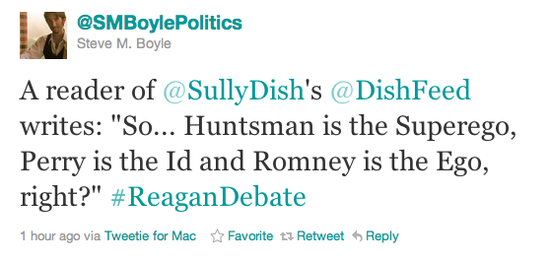
Debate Reax, Ctd

Screen shot 2011-09-07 at 11.49.00 PM

A variety of comments from the in-tray and our Facebook page:

Beyond the "lock box" argument, did I hear a candidate make a crack about Al Gore inventing the internet? The fact that these candidates are making cracks and pointing to policies from decades ago – as you noted with regard to welfare reform – shows how removed Republicans are from pressing political and economic realities. It's striking to see the way President Obama contrasts with this crew simply by being a serious adult, and then talk to friends and relatives (I'm originally from Pennsylvania) who believe the most far-fetched and backwards things about Obama. It is a real through-the-looking-glass experience.

That said, Huntsman also seems like a serious adult. I disagree with him, but he seems able to have a reasonable discussion. He seems like a member of the "reality-based community."

Another reader:

Listening to GOP Presidential candidates talk about science is like listening to children talk about sex: They know it exists, they have strong opinions about what it might mean, but they don't have a clue what it's actually about.

Another:

I don't understand this. The government doesn't have the power to vaccinate but it has the power to kill its own citizens? What?

Another:

Perry lost in my eyes. In the eyes of the in-laws, however, he won it big time. They like the idea of executions and hate the idea of Social Security. Perry's their guy. Thing is, they're both on Social Security and Medicare.

Another:

Who won? The guy who's not on stage but who's dwarfing them all: Reagan.

Another:

Romney won. Easily. Huntsman emerged, but it will only matter if talking heads give him the nod. Santorum, Paul and Cain can go home now. Bachmann has never been a serious candidate. Ever. She's ridiculous. Perry died in a way I've never seen anyone die in a debate. He was laughably poor. Which means Palin can jump in now and act like she's all magic and clever.

Blogger reax here. My live-blogging here.

9/11 Metacommentary

Susan Jacoby militates against overreading the event:

This mass murder did not change everything; it changed only some things. And what it did change, it generally changed for the worse. Sacralization and memorialization are not, and should not be, synonyous. Memorialization rightly recalls the names and lives of the individuals who died so senselessly on that day, not because they were all heroes but because they were all human beings worthy of remembrance. Sacralization and mythicization, by contrast, look for some sort of sense and transcendent meaning where there is none.

Linda Holmes asks us to think carefully about what sort of commemorations we choose to consume.

Free The Food Trucks!

Tim Carman reports on a libertarian think tank's fight to free mobile vendors from the constraints of overregulation:

The Institute for Justice, a self-described "libertarian public-interest law firm," launched its new National Street Vending Initiative early this year in Texas and has since expanded it to Atlanta (where city officials had decided to reserve all public property for a single vending company) and Chicago (where aldermen have proposed rules so severe, they could cut off vending in the entire downtown area).

The Institute for Justice's "Streets of Dreams" report from July looks at vending regulations in America's 50 most populous cities. The economic argument for more mobile vendors:

Due to the recent recession, interest in vending as a solution to job losses is growing once again. The co-director of New York City’s Street Vendor Project, Michael Wells, recently said he handled a surge of calls from people who were trying to find a way to make a living after losing their jobs or being laid off. He estimates that up to 10,000 jobs could be created if New York City increased the number of available permits to accommodate those who are currently on New York’s waitlist.

Katherine Mangu-Ward looks at cities where food trucks are thriving.