Not if they're male.
Month: September 2011
Will Egypt’s Elections Fail?
Marc Lynch fears they will:
It's no secret that many [Egyptian] activists are deeply disenchanted with the SCAF-led political process. They see street protests as the source of their power, and understand their identity as the "soul of the revolution." They have done little to prepare for elections and don't look likely to win. Some view the coming elections as themselves counter-revolutionary since they will likely produce a Parliament dominated by Islamists and ex-NDP fulul. When I was in Egypt in July, I already began hearing whispers that activists might boycott the elections. Those are now spilling out into public.
Will activists actually boycott? What would happen if they did? I think that it is distressingly likely, and growing more so, and that it would be a disaster.
The Young And The Jobless
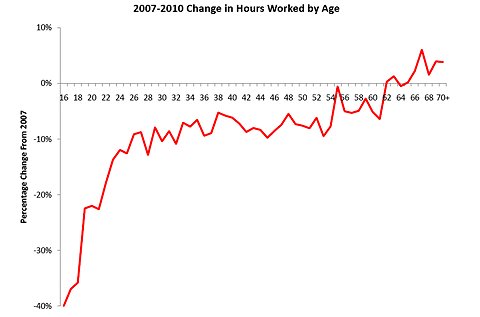
Casey Mulligan calculated average work-hours by age. He compared 2007 to 2010:
Seniority layoff practices would tend to reduce hours worked most for young people because, naturally, they tend to be employers’ more recent hires. You might think it would make sense for employers to retain their most experienced workers, but downsizing employers tend to offer and encourage early retirement to people in their 50s and early 60s, who are paid more than recent hires and are starting to think about leaving the workplace.
Yet the chart does not show especially large declines in hours for those age groups (nor can seniority practices by themselves explain why the elderly end up working more).
How Should We Approach Soldiers? Ctd
A reader writes:
A couple of weeks ago there was a discussion of the pros and cons of showing appreciation to servicemen and women in uniform. If I may contribute the following anecdote: A couple of nights ago, as my flight from Philadelphia to Seattle was waiting to take off, there was a uniformed serviceman (Airborne, I think) sitting in the row behind me in Coach. Just before take-off, a flight attendant came to tell the serviceman that a passenger in First Class wanted to switch seats with him. The serviceman seemed genuinely overwhelmed and grateful. "Wow", he repeated, "wow. It's been a hard couple of weeks. I really needed this. Wow."
My own view is that talk is cheap, and that tangible acts of kindness trump them every time. And I am willing to bet that spending five hours of that flight in First Class instead of Coach soothed more sores for that serviceman than any beer could have, much less any mere words from a stranger.
The Daily Wrap

Today on the Dish, Andrew live-blogged the GOP debate where all eyes were on Perry, who proved to be an "extreme, inarticulate, incurious W clone." We rounded up the full reax here, Andrew parsed the semantic implications of where and how Rick Perry and Marcus Bachmann consume corndogs, Silver assessed Bachmann's odds, and the left and right disagreed about what we're polarized about (wealth versus politics). Taibbi gave up on Obama's campaign promises, Andy McCarthy delivered a whopper on Obama's economy, and Erick Erickson was sick of Palin's games. Kevin Williamson continued to see nothing wrong with the death penalty even for the innocent, and Romney's new economic plan sounded quiet on the major problem of US unemployment. We tracked the conservative movement for criminal justice reform, and Joe Romm countered that green jobs aren't a scam.
Andrew recalled how Darwin lends the story of Adam and Eve even more importance and revisited his initial support for the war in Iraq in answer to the dissent of the day. Israel continued to be held up by Christianists Americans, and Andrew encouraged you to ask the next freshman you see in a CCCP t-shirt why he isn't wearing a swastika, ironically. Lawrence Korb tracked how 9/11 decimated our military, and readers shared their picks for the best 9/11 art, music and films, revisiting the 25th Hour rant. Captured Af-Pak militants may be exacting their revenge with the help of US drone attacks, Israeli girls were indoctrinated with the settler mentality, and the 9/11 memorial is organized by meaningful adjacencies. Iraq still can't run itself, and economic mobility could be an economic boon for the world.
We analyzed why land values beat home prices, readers pushed back against Andrew on why iPhones can't be made in the USA, and Andrew considered moral hazard and the bond markets, on the advice of Martin Wolf. Andrew welcomed Eli Lake to the Beast team along with other media news, Rod Dreher remembered that most Americans don't live in the NYC/ DC bubble, and James Murdoch was as screwed as ever. Tina Brown explained why insecure men act out with sexual antics, Alexis imagined charging your iPhone in a sunny part of the park, and Drudge sank to new lows with his image choice for a $300 billion stimulus.
Dan Savage and Joss Whedon enlightened us on how they got through high-school, readers debated dogs vs children in restaurants, and a dad saw the appeal of violent videogames for kids. Erick Schonfeld bowed down before TV on the internet, KJ Dell Antonia disapproved of a sperm donor allowed to have 150 kids, and heteros got their own version of Grindr.
Chart of the day here, VFYW here, FOTD here, MHB here, and WTF video of the day here.
— Z.P.
(Photo: Candidates U.S. Rep. Michele Bachmann, Mitt Romney and Texas Gov. Rick Perry take the stage before the start of the Ronald Reagan Centennial GOP Presidential Primary Candidates Debate at the Ronald Reagan Presidential Library on September 7, 2011 in Simi Valley, California. By David McNew/Getty Images)
Debate Reax
The media seems to consider Romney the winner. Pardon the condescension, but they’re not thinking like Republican base voters. Romney approaches every question as if he is in an actual debate, trying to provide the most intellectually compelling answer available, within the bounds of political expediency. Perry treats questions as interruptions. What scientists do you trust on climate change? I don’t want to risk the economy. Are you taking a radical position on social security? We can have reasons or we can have results. His total liberation from the constraints of reason give Perry a chance to represent the Republican id in a way Romney simply cannot match.
[O]n balance I'd say this was a strategic victory for Mitt Romney, even if it doesn't show up immediately in the polls. Mitt didn't do anything that amazing himself. But Perry doubled down, maybe tripled down on his frontal attack on Social Security and science in general. Romney moved in, in essence, to egg him on in that process. And the Romney press office let loose a fusillade of attacks in emails to the press.
[I]t is clear Perry is the front runner given the pile on from the other candidates. It was not just pushed by MBNBC and the Politico. The other candidates took willful potshots against Rick Perry. Perry, despite some stumbles and the pile on by the moderators and other participants, held his own and will only get stronger the more of these he does.
My overall impression: Perry did well enough, but he was surprisingly badly prepared for predictable questions about global warming and even his Texas record. He was confident and aggressive, but he lost altitude during the evening.
Perry just seemed generally unprepared and unwilling to really engage the issues. I guess now we know why he's been afraid to give any interviews since he announced his candidacy. He's afraid he'll look like a kid who got called in class after failing to study the night before. He needs to raise his game.
Easily Perry's worst moment in the debate: fielding a question on his understanding of climate science. He stumbles over his answer, and fails to present a convincing economic argument against emissions-reduction schemes. Works in one line about the preponderance of climatologists who believe in global warming — "Galileo got outvoted for a spell" — but that's not going to go far in winning over the folks he needs.
[E]ven if the general consensus confirms my sense that Perry didn’t do well, I’d strongly caution against reading very much into it. There are going to be a lot more of these, and there are lots of examples of candidates improving dramatically over the course of them. Most notably, the current president of the United States.
Perry elides the Social Security question with a line crafted with care and baked at 400 degrees in a clay oven: "I'm not responsible for Karl any more." But there is now video of Perry calling the promise of Social Security a "monstrous lie." Fantastic for the GOP primary. Untested in a general election since, what, 1964?
Perry’s biggest problem is the Fed Up! controversy. How did he handle it? He rightly framed his historical treatment of Social Security in Fed Up! as a reflection on the past–not the same as his policy answers for the present. But Perry didn’t back off of his “monstrous lie” and “Ponzi scheme” remarks, and that just might win him the nomination. Will it kill him in the general? I’m not so sure. Are there risks? Of course.
The problem with Social Security is that over the long-term, the flow into the pipeline is projected to be less than the flow out of the pipeline. Republican candidates should have been talking about ways to gradually phase in progressive reductions in that outflow to match the inflow. If instead they want to fix the projected imbalance with new revenues, they should have been talking about ways to separate that money from the rest of the government's budget with personal accounts.
Who would have thought being anti-vaccine policy would be so popular among candidates? Pretty much the whole country has previously agreed that an opt-out policy is the way to go, so to see so many argue that’s anti-American is dispiriting. You either have a policy, or you won’t get the full effects of the vaccine. We need herd immunity. You get your vaccines not just to protect you, but to protect others. This shouldn’t be political.
[W]hen Perry is asked about the two-hundred and thirty some people he’s executed on death row during his governorship, the audience bursts into applause. Torture, war, and death, and this is the “pro-life” party. I submit to you that this moment is perhaps the most telling since George W. Bush left office; that the modern Republican party is not only intellectually bankrupt, but morally bankrupt as well.
Mitt Romney looked like he had already won the Republican nomination. Rick Perry looked like he will win the Republican nomination. Michele Bachmann looked like she was beginning to realize she definitely wouldn’t win the Republican nomination.
DiA:
Overall, I thought Perry performed poorly and failed to justify and consolidate his position as the front-runner. Romney, it seemed to me, treaded water, gaining nothing and losing nothing. In sharp contrast to the first debate, Hunstman distinguished himself and showed he deserves to be considered a top-tier candidate, but I fear it's too late.
A Definition
From Wiki:
A Ponzi scheme is a fraudulent investment operation that pays returns to separate investors, not from any actual profit earned by the organization, but from their own money or money paid by subsequent investors.
The Ponzi scheme usually entices new
investors by offering returns other investments cannot guarantee, in the form of short-term returns that are either abnormally high or unusually consistent. The perpetuation of the returns that a Ponzi scheme advertises and pays requires an ever-increasing flow of money from investors to keep the scheme going.
The system is destined to collapse because the earnings, if any, are less than the payments to investors. Usually, the scheme is interrupted by legal authorities before it collapses because a Ponzi scheme is suspected or because the promoter is selling unregistered securities. As more investors become involved, the likelihood of the scheme coming to the attention of authorities increases.
The scheme is named after Charles Ponzi who became notorious for using the technique in early 1920. Ponzi did not invent the scheme (for example Charles Dickens’s 1857 novel Little Dorrit described such a scheme decades before Ponzi was born), but his operation took in so much money that it was the first to become known throughout the United States. Ponzi’s original scheme was based on the arbitrage of international reply coupons for postage stamps; however, he soon diverted investors’ money to support payments to earlier investors and himself.
(A recent, Rick Perry-sparked Dish debate over the term and if it applies to social security here, here, here and here.)
Live-Blogging The Third GOP Debate

9.57 pm. My take-away? Perry has proved himself an extreme, inarticulate, incurious W clone. He doubled down on the vicious attacks on social security; and his rhetoric was off-key. Huntsman emerged as an actual candidate; Romney kicked ass. Bachmann is wearing thinner and thinner. Paul is Paul. Santorum is a Vatican crank. Gingrich is an angry old man. Cain has no business being up there. Perry's poor performance gives Palin an opening. And an actual argument that people can understand about economic policy did not emerge.
Stay tuned for the Dish's trademarked summary of reaction from around the web.
9.52 pm. I still have no clear idea of what any of these candidates would do to turn the economy around. I'd support major tax reform, but all they have been offering is warmed over Reaganism. But Reagan is relevant for the 1980s, not the 20-teens. An entire generation has grown up and moved on. Tax receipts are at their lowest in fifty years; infrastructure is obviously vital; job growth was pathetic after the Bush tax cuts. Of course we all agree that only the private sector can truly spur economic growth, but, really: that's it?
9.51 pm. A reader writes:
So let me make sure I have this straight … Huntsman is the Superego, Perry is the Id and Romney is the Ego, right?
9.48 pm. A spontaneous round of applause for executing people! And Perry shows no remorse, not even a tiny smidgen of reflection, especially when we know for certain that he signed the death warrant for an innocent man. Here's why I find it impossible to be a Republican: any crowd that instantly cheers the execution of 234 individuals is a crowd I want to flee, not join. This is the crowd that believes in torture and executions. Can you imagine the torture that Perry would authorize? Thank God he's doing so poorly tonight.
9.47 pm. A shout-out to my colleagues' live-chat on the debate here.
9.44 pm. Does the president have the right to fire the Fed chairman tomorrow? Gingrich's belligerence is truly off the charts. Why is he up there? Listening to this debate, it seems as if American conservatism is now actively contemptuous of any environmental protection. Green conservatism is dead in this country.
9.40 pm. Huntsman walks the walk on evolution and climate science – in terms of electability. He's riding a wave tonight. Perry flails – associating climate science denial with Galileo! Then he seems robbed of speech in opposing any measures for green technology. An awful response. Then Bachmann wants to drain the Everglades. We're really reduced to this? And Bachmann thinks she is the defender of science in all this!
9.38 pm. Santorum seems to think that the end of the Soviet empire should mean any shift in American foreign policy. And then his assertion that the UN forced the US to invade Libya, when the US was lobbying the UN furiously, is nuts.
9.32 pm. Romney offers no digestible plans to get the economy moving. Perry insists that Keynes is finished, and argues that the stimulus created or saved zero jobs. And his inability to criticize Bush and Cheney's war in Iraq is somewhat pathetic – but very Republican. Bachmann, meanwhile, sounds more and more extreme. Her Christianist belief in Greater Israel for ever is striking. And then there is her inability to deal with argumentative logic. I agree with her on Libya, but she could at least concede, as I have, that the departure of Qaddafi is a good thing and a credit to Obama's strategy.
9.28 pm. The anti-tax extremism is really endemic. And the idea that Ronald Reagan would not raise taxes, when he did many times! And I love Huntsman's anti-pledge pledge. So why did he put his hand up last time? Then he wants to nation-build at home and withdraw troops from Afghanistan! Yes, this is a Republican.
9.25 pm. Some reader reaction: yes, Romney did make the Al Gore "lockbox" argument on social security; yes, Bachmann's hair looks like a flying nun attached to an electric socket; and yes, having this crew on Reagan's stage is not doing them any favors.
9.14 pm. You cannot really appreciate the difference between Reagan's GOP and this one until you look at immigration. Again, Perry is just off-key again: Obama as a possible "abject liar"? Please. Nice to hear Gingrich expressing some sympathy for long-time illegal immigrants who have worked and lived here for years. Bachmann has no answer to the question of mass deportation. Even when given two opportunities. She really is capable of staring past any actual question that might involve any difficulty. It's wide-eyed evasion.
Huntsman wins this, though, by embracing Reagan, advocating skills-based immigration and reforming the system of legal immigration, which is onerous, byzantine and hurting the US economy.
9.12 pm. I might be hallucinating but I think Gingrich just said something positive about Obama's education policy.
9.10 pm. It sounds to me like Perry is blaming Texas's appalling record in high school education on Mexicans!
9.08 pm. I loved Huntsman's line about the fortress mentality that is not American. I've been waiting a long time for a credible candidate to say that. He's having a much much better debate than last time around. He and Romney are winning this. Perry is losing this.
9.04 pm. Even when I think he's a little nuts, I still love Ron Paul. The federal government set the stage for 9/11! Wow. And then the moral hazard issue with FEMA. Gotta love it. Then removing the air conditioning from the Green Zone in Baghdad! Awesome.
8.57 pm. Ron Paul and Michele Bachmann both oppose mandatory vaccination. I have to say that public health vaccination seems to me to be a completely legitimate role for government. But then Perry boasts of spending billions to tackle cancer. That is a government role but basic health insurance mandates aren't? Perry really is becoming a Pinata. So far, this debate is helping Romney, it seems to me. Perry's appeal wears pretty thin pretty quickly. And Romney's condescending embrace of Perry was superb. As is his formula that Obama is a "nice guy" but doesn't have a clue how to run an economy. I disagree. But it's far, far smarter than the demonization of a president of character and decency.
8.53 pm. Social security is a "massive lie" and a "Ponzi scheme", according to Perry – and he disses Rove and Cheney as he does so. But the argument about the need to reform it somewhat to help make it viable is a legitimate one – and Romney deftly picks it up. Perry's rhetoric really is an electoral killer. And he is flailing badly.
8.51 pm. Scanning the audience, I see not a single brown or black face.
8.42 pm. "Medicare is a mandate." Then we have a defense of the silver dime! I love Ron Paul. Just for pointing out that Reagan initiated the deficits of our time.
8.37 pm. Perry completely ducks the question of economic inequality, by insisting that all that matters is a booming economy. But the economy, even when booming, has increased inequality to historic levels. It's not clear that Perry sees this looming reality. And it's odd that the question of poverty is addressed by Santorum and others by referring to the welfare rform of the 1990s. A decade and a half ago.
8.30 pm. Another lie from Bachmann: the notion that government has taken over all of healthcare in this country. But she's right that repealing universal health insurance will be a little more difficult than Romney suggests. Gingrich is also angry, nasty and testy, specifically attacking the media (again). I don't think personal attacks on this president are as effective as Gingrich thinks they are. And his concern for parliamentary procedure, considering his record, is a real piece of chutzpah.
8.26 pm. Finally, someone points out that in terms of health insurance, Texas is fiftieth of fifty states. And he gets a little tetchy when challenged on it, doesn't he? Huntsman again separates himself from the pack, in tems of polish, substance and clarity. No nerves tonight unlike last time.
8.24 pm. Perry jumps in to trash the individual mandate for health insurance. Romney makes the obvious case that emergency room care is a horribly inefficient way to have universal healthcare.
8.20 pm. Ron Paul believes we should never have bailed out the banks or the auto-companies. And then a weid diatribe against drug company lobbyists. And isn't the car industry an actual – and rare – industrial success right now?
8.19 pm. How big is Michele Bachmann's American flag brooch?
8.17 pm. A great Huntsman riposte to Romney's proposal of a trade war with China. A very strong start – especially the association with Reagan and the possibility of addressing the Chinese people in Mandarin. That would indeed be something. Totally different from his previous poor performance.
8.15 pm. So far, the only policies that have been mentioned are tax cuts or tax reform. It's as if government has been forbidden to do anything but lower taxes.
8.14 pm. Something tells me that Rick Santorum is not the best person to reach out to the Democrats in the Senate.
8.11 pm. Romney's off to a very polished stance. A nice demurral on "career politicians." And a swift response to Perry's tweak on job creation in Texas versus Massachusetts.
(Photo: David McNew/Getty.)
Can Bachmann Still Win?
Nate Silver gives long odds:
If I were to write a script involving Mrs. Bachmann winning the Republican nomination, it would probably require Mr. Perry’s campaign to be already in a somewhat weakened state prior to Iowa because of a gaffe or some other key misstep. Then, perhaps, a disappointing performance in Iowa could be more of a death blow to him, with Mrs. Bachmann getting her head-to-head match-up against Mr. Romney — a very challenging but not impossible task.
Has There Been A Great 9/11 Work Of Art? Ctd
A reader cites the original post:
"Often,” Rushdie said, “I think these great events have to rot down. Maybe another generation has to look at it.”
This is preposterous. Wouldn't you suppose art-as-catharsis has a pretty crucial role in public tragedies? Guernica was a few months after Guernica. Elie Weisel's "Night" was five years. Songs by the dozens about the Vietnam War – pro and con – were contemporary. But cherry-pick your examples of the "definitive" artwork to a tragedy and you can always find one sufficiently long afterward.
Another writes:
I'm surprised to see none of the commentaries you've posted on 9/11 art mention Spike Lee's 2002 drama The 25th Hour. (Though, to be fair, commenters on Bryan Appleyard's original piece do). It's the story of a drug dealer named Monty on his last day before heading to prison, so it may not be directly about the events of 9/11, but it absolutely deals with the emotional aftermath of the event.
One character's apartment has a view of Ground Zero; the camera stays fixated on the site as he talks about being unwilling to move, despite reports of unhealthy air in the area. The entire scene is a metaphor for post-9/11 despair. Later, Monty curses out the myriad cultures and ethnicities of the city, trying to blame his problems on bin Laden, Jesus, his friends, and anyone else he can think of before accepting his ownership of his problems. The film ends with Monty's father offering him an idealized vision of being a runaway – a vision of America that felt so much more impossible in the days and months following 9/11.
If you want a work of art that deals directly with 9/11, Paul Greengrass's United 93 is that work of art – a punishing, intense, visceral experience. But nothing I've seen, read, or heard since that day matches up to The 25th Hour in exploring the despair, confusion, frustration, anger, and grief myself and millions of others felt after 9/11. Any discussion of post-9/11 art that doesn't mention it is missing out.
Another:
I agree with Spielberg that it will be some time before we see a truly great 9/11 film that's actually about 9/11. But for an exploration of the societal PTSD we've suffered since 9/11, one need look no further than Chris Nolan's The Dark Knight. Fear, terror, the battle between order and chaos. The role of cruel chance. The frustration and impotency of being unable to "hit back" (see Batman and the Joker in the interrogation room…). Allegory though it may be, I can think of no other work of the last decade that has struck as close to 9/11 as The Dark Knight. And given the changes to the political landscape we've seen since the film released in 2008, I'm dying to see what kind of mirror The Dark Knight Rises holds up next summer…
 The Dish