Craving The Kingdom

Elizabeth Rubin reports on a high school that indoctrinated girls with fanatical settler ideology:

Rav Gadi’s inspiration—what makes him an innovator, if you like—was to encourage girls to become front-line troops in the family combat between the settlers and the state. In an interview with a settler magazine, Rav Gadi says that the role of the body is "to express and reveal after contemplation the entirety of man’s internal infinite essence." By now, the state and nation should be the macro for this private expression. That’s what his mentor Rav Kook had envisioned. But it hasn’t happened yet, and Rav Gadi is impatient to get there. "I crave the kingdom," he writes. "Don’t wait until the Lord, blessed be he, brings us redemption. Get up and initiate." Rav Gadi and his flock have to work harder to build a physical home for the divine presence. And who better to serve as the handmaidens of God’s kingdom on earth than a flock of adoring, fervent teenage girls?

The parallels with Islamist extremism are not exactly reassuring, are they?

An Organic “Web Of Meaning”

911_Names

How the names on the 9/11 memorial were arranged:

The planners of the memorial, which will be dedicated this weekend where the Twin Towers once stood, solicited requests from victims' loved ones for "meaningful adjacencies"—names that should appear together on the memorial. Roughly 1,200 responses came back, asking that a victim's name be grouped with specific colleagues, with family members or with friends who also perished in the attacks. The web of meaningful adjacencies at firms such as Cantor Fitzgerald were large and complex—loved ones made half a dozen or so adjacency requests for some victims.

(Photo from the 9/11 memorial website)

No Way This Can End Poorly

Azmat Khan interviews Steven Grey about a US military "capture/kill" campaign in the Af-Pak region and discovers this little gem:

From a senior US intelligence source, we also learned that a critical part of the targeting process for the CIA drone strikes in Pakistan came and comes from JSOC, and is very coordinated. Of Taliban prisoners captured by JSOC who are “turned” so as to be cooperative, some are trained at Bagram Airbase — which houses the main interrogation center — to read satellite images and video feeds to help find targets. 

Chris Albon suggests an alternative title for the interview: "Captured militants train JSOC to JDAM political rivals, settle petty family disputes"

Conservatives For Criminal Justice Reform

GT_OVERCROWDEDPRISON_110906

Erica Grieder assesses recent Republican efforts at the state level. Among the larger lessons: 

[S]ometimes the most influential political moves come from the party that does not "own" the issue…if a movement comes from the "wrong" party, its framing reflects that party's concerns and has been reality-tested by its base (as in Bill Clinton's welfare reform, which was described as enhancing dignity and employment). 

Eve Conant reported on the GOP's "Nixon-in-China" positioning on prison reform in July. Douthat moved the cold political case along two years ago. 

(Photo: Inmates at the Mule Creek State Prison interact in a gymnasium that was modified to house prisoners in Ione, California. By Justin Sullivan/Getty Images.)

Whopper Of The Day

From (who else?) Andy McCarthy:

Furthermore, when the federal treasury brushed up against its statutory debt limit, and Congress resisted the notion that adding $2.4 trillion to a bankrupt nation’s credit line was the way to go, Obama threatened to raise the limit and issue bonds unilaterally. In his defense, he offered a tortured construction of the 14th Amendment that melted against the Constitution’s express assignment to Congress of the power to borrow money. The president’s threat may not have passed the laugh test, but it worked. GOP opposition softened, the president got his new trillions to spend . . . and Standard & Poor promptly downgraded the nation’s credit rating for the first time in history.

It's hard to overemphasize how fantastical this history is – for starters, Obama ruled out using the 14th Amendment. The piece ends with this Malkin-worthy bit:

American constitutional republicanism has been strong enough to survive over two centuries of revolutionary self-governance, civil war, world war, terrorism, social upheaval, and periodic economic calamity. But can it survive a Ruler of Law and his trusty pitchforks?

McCarthy, of course, was a strong defender of the imperial executive and torture under the last administration.

All Eyes On Rick Perry

Mark McKinnon previews tonight's debate:

Perry has the least and the most to prove. And the stakes are huge. If he does okay, his status as frontrunner will be cemented. If he blows it, he could claw his way to the bottom fast. The game plan for Perry? Just come across as calm, thoughtful, and most of all, reasonable.

Molly Ball reviews old footage:

A close viewing of Perry’s debates — one each in 2002 and 2006, and two in the GOP primary in 2010 — and interviews with some of his past rivals reveal a candidate who is unlikely to be remembered as a great debater, but rarely makes a mistake and almost always manages to win by not losing.

Jonathan Bernstein outlines what to watch for:

[I]f Michele Bachmann, Newt Gingrich, Herman Cain, Ron Paul, and Rick Santorum still think they can be the nominee, expect them to attack Perry. If, on the other hand, Bachmann and the rest are really running for the role of Conservative Hero — and not for the nomination — then it makes more sense to just go ahead and attack Romney for his various deviations from the True Faith.

I'll be live-blogging.

Listening To The Bond Markets

They are telling us to borrow and spend now. Martin Wolf:

[The markets] are saying: borrow and spend, please. Yet those who profess faith in the magic of the markets are most determined to ignore the cry …

Contrary to conventional wisdom, fiscal policy is not exhausted. This is what Christine Lagarde, new managing director of the International Monetary Fund, argued at the Jackson Hole monetary conference last month. The need is to combine borrowing of  cheap funds now with credible curbs on spending in the longer term. The need is no less for surplus countries with the ability to expand demand to do so.

It is becoming ever clearer that the developed world is making Japan’s mistake of premature retrenchment during a balance-sheet depression, but on a more dangerous – far more global – scale. Conventional wisdom is that fiscal retrenchment will lead to resurgent investment and growth. An alternative wisdom is that suffering is good. The former is foolish. The latter is immoral.

But isn't some suffering good for the sake of moral hazard? Is it not important to learn that gamely sucking prosperity from the future into the present and then whining loudly when the future arrives deserves some kind of penalty? I guess this payback can apply collectively but the individual impacts are brutally unfair, especially as hedge fund managers continue to gamble for billions while many thrifty skilled workers are in the financial shitter for good.

But the evidence of the past couple of years does suggest Wolf is onto something. If hyper-inflation were around the corner, the bond markets don't look as if it has occurred to them yet. If borrowing even more is reckless for short-term stimulus, why are borrowing rates so astonishingly and persistently low?

What we need, obviously, is some short term stimulus, tax reform to encourage investment and hiring, combined with a long-term debt reduction plan. It's doable. My sense is that Obama is going to propose exactly such a policy blend Thursday night. And tonight, we'll see what actual policies the GOP candidates propose for turning the economy around. Or not.

Did Osama Win?

The anger endures, as evidenced in the NSFW rant of post-9/11 culture above. Jonathan Freedland, meanwhile, lands in a place similar to my own:

The [post-9/11] mindset has to go. In those dazed days after the attacks, a new foreign policy doctrine was hastily assembled. It said that the world faced a single, overarching and paramount threat in the form of violent jihadism. Every other battle had to be subordinated to, or subsumed into, that one…

Such talk has been a constant of the 9/11 decade but its time has passed. For one thing, it's predicated on a mistake. The right way to regard the 2001 attacks was as a heinous and wicked crime – not a declaration of war. As Eliza Manningham-Buller, the former head of MI5, argued in her first Reith lecture calling it a war "legitimises the terrorists as warriors". It's exactly what al-Qaida wanted – feeding their fantasies of grandeur – and we gave it to them.

Readers on our Facebook page are tackling the same question. One writes:

I think Osama did win. His goal was to take the United States down. Look at what's happened to us since 9/11: economic disaster, political disarray, and we've forgotten what it means to work together as Americans. Yes, these are the results of what happened on 9/11. I'd say he achieved his goal.

I wouldn't and didn't go that far. Many more factors contributed to the catastrophes, foreign and domestic, of the Bush administration. Another writes:

He won in the US by flying planes into our towers and our hearts, thereby denying us our freedoms through war and legislation and the TSA. But he's lost himself with the Muslim and Arab community. The Arab Spring was all about pushing Bin Laden and all other despots aside who wanted to lead by force, intimidation, and manipulation of the Muslim faith.

My point entirely. 9/11 as a tactic worked in baiting the US into self-destruction; but al Qaeda's global strategy failed spectacularly – because of its own inherent contradictions and brutality and because of good, old-fashioned, pains-taking intelligence work, new drone technology, and a president who finally wanted to save face in getting the hell out of Afghanistan. Another:

For bin Laden to win, he would need to show expanded positive influence, most Muslims dislike his views and orthodoxy. So, no he didn't win. But the US blundered into the very trap he set, and so we absolutely LOST.

Another:

He didn't win; he was neutered for years before he was ultimately killed in fairly humiliating fashion. That said, I agree with the Sullivan/Frank Rich theory that we didn't exactly "win" either – a classic lose-lose. If I had to pick a winner(s), the Iranian regime and the "too big to fail" Wall St. banks seemed to have a pretty good decade…

From a 2002 review of the NSFW scene above:

[Director Spike] Lee worked closely with [David] Benioff on updating 25th Hour to a post-9/11 New York City. "My fear was that someone who didn't know New York would direct it, so I was thrilled," says Benioff, adding that Lee assuaged his fear that key moments in the novel would fail to make the transition to screen: "When we met, he had the script and the book all underlined — and he wanted to put the 'fuck you' rant back in the movie." The scene is a diatribe in which Monty vents his rage at virtually every human element of the city he loves, invoking familiar stereotypes in a raw, emotional outpouring that's at least as much self-hate as hate itself. 

The top YouTube comment:

This clip uses what I call the "South Park Rule". As long as you insult/offend all groups equally, no one can call you out for being a bigot. Equal opportunity? ranting.

Redefining Genocide

Ugur Ümit Üngör critiques the U.N. definition:

The genocide convention of 1948 was drafted as a result of deliberation and negotiation Che-guevara-tee between the western Allies and the Soviet Union. Raphael Lemkin, the man who invented the concept of genocide, wanted to include social classes, but the Soviets lobbied the UN and succeeded in excluding this aspect from the definition – probably because they knew that they had committed genocide based on social class.
But genocide has not only been about ethnic groups but also about social groups, elites, peasants, any social or economic class you can think of.

Norm Geras comments:

It's often asked why being an apologist for Nazism puts the person who is that beyond the pale of respectable opinion, so to speak, whereas doing the same for Stalinism, while widely regarded as a bad choice, still falls inside the boundary of respectability. Might this differentiation cease to be as sharp once the meaning of genocide is extended so that it encompasses every 'mass elimination of a group based on its collective identity'?

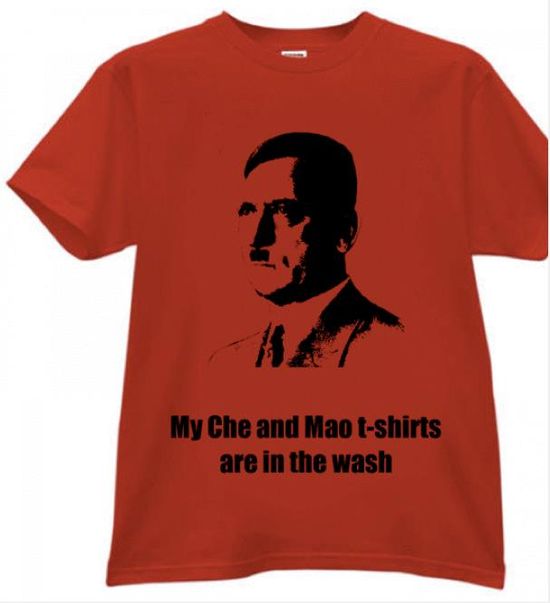
I would hope so. The double standards, perpetuated by ageing lefties, are repellent. And next time you see a freshman in a CCCP t-shirt, ask him why he doesn't wear a swastika. You know: ironically.

Update: A reader sends an image that nails it:

Photo

Disaffected Liberal Watch

Taibbi accuses the president of recycling old campaign promises:

Listening to Obama talk about jobs and shared prosperity yesterday reminded me that we are back in campaign mode and Barack Obama has started doing again what he does best – play the part of a progressive. He's good at it. It sounds like he has a natural affinity for union workers and ordinary people when he makes these speeches. But his policies are crafted by representatives of corporate/financial America, who happen to entirely make up his inner circle. I just don't believe this guy anymore, and it's become almost painful to listen to him.