The iPhone And US Unemployment, Ctd

110897805

A reader writes:

You wrote, "Apple could manufacture the iPhone in America, but its profit margin would drop from 64 percent to 50 percent".   Isn't this the real problem?  As long as the ultimate goal is the highest profit margin available, how can the US ever expect unemployment to be reduced?  Every policy strategy that I hear talked about is how to make it more profitable for these corporations here – tax cuts, no taxes, tax incentives,  tax amnesty, etc.  What will it take, whether it's policy or political pressure, to make Apple decide, that 50 percent profit margin is enough?

But in the global economy, companies can simply relocate anyway. Trying to prevent this process requires forcing water to run uphill. You could for a while, but unless you really wanted to kill off a free economy, you'd have to keep upping the ante. Another writes:

You mention "brutal protectionism," and I’d be interested in exploring that a bit more. 

Isn’t the real problem with our current economy that we allow these corporations (like Apple and Cisco) access to our high-end commercial markets while allowing them to export labor to communist China, Oligarchic India, and Indonesia?  Meanwhile, in 2004 and currently, our congress is considering passing a law to allow these same corporations to "repatriate" massive corporate profits earned here by bled through a loophole to foreign subsidiaries.  See Matt Taibbi’s discussion on the topic here.

So the corporations overcharge U.S. consumers for electronics (iPhones, etc.) in part driving up their profits by using cheap foreign labor, and our government's going to let them bring that money back at a substantially reduced tax rate (or tax-free) with no promise that those tax-free monies will go to U.S. job creation.  It seems to me that if corporations are not going to act responsibly, then the government should tariff the shit out of those companies who use cheap foreign labor but benefit from our markets.

Another:

Why must you assume protectionism would be brutal (or that only a brutal form would help)?  I actually found it encouraging to read that building iPhones in the US would only reduce Apple's profit margin from 64% to 50%.  That's a hefty chunk for sure, but it could be mitigated some by (yikes!) a modest price increase.  And if their competitors had to do much the same, then Apple wouldn't lose market share.  Sure, they have a responsibility to their shareholders.  But they need to do it within the law, and lawmakers have a responsibility to citizens.

Of course Apple's never going to change anything without the "brutal protectionism" thing kicking in.  But is it brutal to compensate for China's currency manipulation with a tariff to offset some of the resulting price advantage (until China floats their currency and does it the right way)?  Is it brutal to require some kind of international minimum wage in countries that we sign free trade agreements with – or that we allow our companies to send their jobs to?  Ditto minimal environmental regulations?

I guess these are left-wing suggestions, but they're not particularly brutal.  And if the right can't come up with anything better than third-world wages (or unemployment) for US workers, then it's a left-right issue.  You seem to be taking the left side of it as far as the results are concerned, but you're hung up on the right-wing rhetoric that all protectionism is inherently brutal (even when justified by bad-faith actions of our trading partners).

(Photo: A shopkeeper shows a golden accessory of Iphone at a shopping mall on March 25, 2011 in Qingdao, China. By ChinaFotoPress/Getty Images.)
Did We Execute An Innocent Man?

Kevin Williamson defends Perry's criminal justice record:

Ari Kohen slams Williamson:

Williamson’s implicit argument (if one can call this an argument) makes no sense. Listen to the clip: he claims it’s certainly possibly that innocent people are being executed (even likely) but this doesn’t bother him in the least. But beyond the callousness of what he says and how he says it, and beyond the fact that he doesn’t care in the least about investigative reporting on the Willingham case, it’s important to note that he believes that executing people is precisely what the government ought to be doing; it’s “right at the top of the list.” He’s not too worried about it because he has yet to see a single systemic problem with the death penalty. My guess is that he has never looked at a single death penalty in any detail beyond the minimal news coverage of some execution or other. Otherwise, I just can’t imagine how he can make this claim.

Earlier discussion of the New Yorker article Fernholz mentions here and here.

End Of Gay Culture Watch: A Hetero Grindr

Or rather the total homosexualization of straights so that the distinction ceases to exist. Launching this week:

[W]hile gay men have no problem hooking up on a moment’s notice and without much fanfare, that’s not the case with straight women (or lesbians, for that matter). Simkhai says the straight version is not a dating site but a way to make connections. “Facebook does a great job keeping you connected with people you already know,” says Simkhai, “but how do you meet new people? How do you make new friendships?” Simkhai is hoping the new app will do just that. 

When asked whether women might feel skittish about advertising their location to any creep with an iPhone, Simkhai says members of the new app will have control over the accuracy of their location.

The Origin Of Sin, Not Species

Tubal_Pregnancy_with_embryo

This is really another post-script to our series on Adam and Eve and Darwin. My own view is that there can be no conflict between eternal truth and empirical facts, because God is without error. And so the Genesis story is not disproven by Darwin; Darwin actually helps us understand its deeper spiritual, metaphorical truth.

That truth is that at some point in human history, as homo sapiens emerged, a human mind and soul struggled sporadically into existence. The first homo sapiens who saw a bison, as this terrific post from Michael O'Flynn notes, and thought of "bison" as an idea to represent the collective reality of bison, might have been a lonely fellow. But he and those women like him would eventually find each other and civilization as we know it will have begun its epic and tortuous journey:

Adam is different.  Having a rational human form in addition to his sensitive animal form, he is capable of knowing the good. As Paul writes in Romans 2;12-16,  the law is written in the heart. God being the author of natures is, in the Christian view, the author of human nature in particular; hence the law "written in the heart" was written there by God.  But for Adam to know the good means that Adam is now capable of turning away from the good.  Thus, when Adam wills some act that is contrary to what his intellect tells him is good, he is acting in disobedience to "God's commands written in his heart."  A turning away from the good is called "sin" and, since no one had ever been capable of doing so before, it was the original sin.

This is what Genesis is about: how homo sapiens came to know what it was to know, to think, to reflect, to be aware, above all, of impending death, to rise above mere instinct and feeling into the "thinking reed" that Pascal so beautifully limned. And in this world-historical shift, the terrible responsibility of moral reasoning, existential dread, and thrill of life emerged from the goop.

And what Genesis is really about is the danger of human pride in this transition. It is a warning against the notion that because evolution gave us these extraordinary gifts, we are masters of the universe. (The same can be said of that other myth, "The Tower Of Babel"). But we are not masters of the universe. We are ni ange ni bete. We are in between heaven and earth, the first creatures to imagine a higher conciousness still, and find ourselves longing for it, while running away from it because of our weakness and pride:

Whilst this Deity glows at the heart, and by his unlimited presentiments gives me all Power, I know that to-morrow will be as this day, I am a dwarf, and I remain a dwarf. That is to say, I believe in Fate. As long as I am weak, I shall talk of Fate; whenever the God fills me with his fullness, I shall see the disappearance of Fate. I am defeated all the time; yet to Victory I am born.

"To Victory I am born" is what Jesus taught us was possible. "I am defeated all the time" is what Genesis is trying to remind us, to warn against hubris and a man-centered world. All of this isn't just compatible with modern science, it is made more explicable, more profound, more wondrous given what we know about how we came to be.

One day, Christianity will see science as the wondrous gift it is, rather than as a threat to a cultural neurosis masquerading as faith.

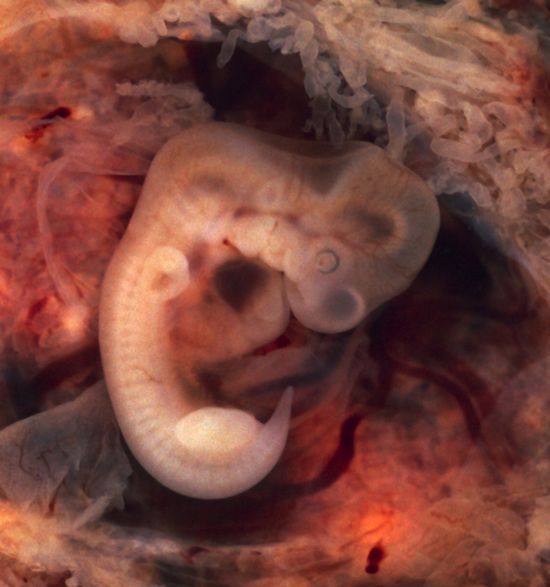
(Photo: Human Embryo, 7th week of pregnancy.)

Land Goes Up In Value, Not Houses

An obvious-in-retrospect insight:

There are lots of perfectly ordinary reasons for land to go up or down in price. A house, by contrast, is a large decaying physical object.

Ryan Avent nods:

High housing costs reflect the high value of access to productive cities — you can’t take advantage of the high wages in Silicon Valley unless you live in a housing unit that provides you with reasonable access to Silicon Valley. When broader shifts increase the economic potential of a place like Silicon Valley, land with easy access to that place also rises in value.

Has There Been A Great 9/11 Work Of Art? Ctd

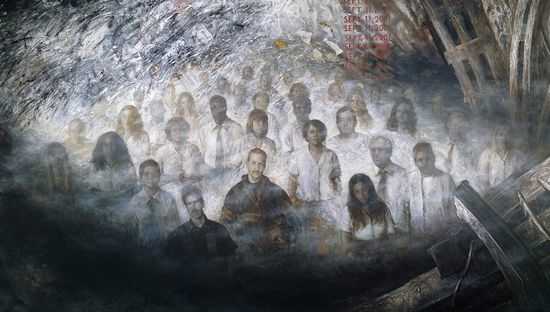
Bruno Surdo, Tragedy, Memory, Honor (center)

A reader recommends:

Bruno Surdo's Tragedy, Memory and Honor. I saw it on exhibit in the Federal Building in Chicago and it was utterly overwhelming, all 35 feet of it.

Seen above. Another states that "Paul Chan’s '1st Light' (at the Whitney) is the best piece of 9/11 art I’ve seen (though you have to sit and watch the whole thing play out)." Another writes:

That article you linked to didn't discuss music, and I think that's where some of the best 9/11-related art has been made over the last ten years (and, naturally, also some of the most banal, but what can you do?).  If I had to pick one, it would be On the Transmigration of Souls by John Adams. The New York Philharmonic commissioned it for the one-year anniversary of 9/11, and Adams wrote something almost shockingly gentle, and quiet, and compassionate.  He uses New York street sounds and pre-recorded voices (reading text culled from missing-persons signs posted at Ground Zero) in addition to the large orchestra, chorus, and children's chorus. The number of performers is massive, but the music is almost always quiet, sparse, contemplative.  

That said, it is most definitely not easy listening. There's one moment, late in the piece, when the chorus sings the words of a 9/11 widow and it's among the most emotionally difficult moments in music I know of: "The man's wife says, 'I loved him from the start. I wanted to dig him out – I know just where he is."  Even writing it hurts.

Adams has said that, instead of a requiem, he wanted to create a "memory space," a place where people could go and be alone with their thoughts, sort of like an old cathedral.   You can hear the complete piece on YouTube herehere, and here, and it's available on a Nonesuch recording on iTunes.

Another echoes many:

Look, I don't know how we measure a "great work of art," but the first thing I think about when reflecting on artistic responses to 9/11 is Bruce Springsteen's "The Rising."

Not only the fabulous CD in which every song touched on themes emerging from the horror and the aftermath, but a video, nearly perfect in its simplicity, of Springsteen and the E Street Band performing the song, "The Rising," as the rain begins to pour (and cleanse). I can't imagine that anyone but the most hardened Springsteen haters watched that video in the months that followed the tragedy without tears coming to their eyes. It may not meet the Upper East Side's conception of "great art," but it was raw, real, and beautiful.

Unembeddable version here. Another:

As I know you are often interested in the Catholic imagination, I recommend Prof. Christoper Pramuk's article on "The Rising" in America magazine.

Another:

It is worth noting that the New York Philharmonic will be offering the world premiere of John Corigliano’s One Sweet Morning for mezzo-soprano and orchestra next month.  Corigliano, best known for his work with The Red Violin, is a composer whose compositional output reflects on society as a whole.  For instance, his first symphony was an artistic response to the AIDS crisis.  It is a compelling and beautiful reflection on pain, anger, and loss, experienced within communities of individuals.  His recent masterwork, Symphony No. 3: Circus Maximus, is an attempt to create parallels of Ancient Rome with today.  His thesis (if you will) suggests that the Coliseum was a spectacle of entertainment, meant for escaping daily life.  In it, we lost a part of our humanity through mindless killing and diversions.  In today’s society, technology has destroyed our attention spans, and we often engross ourselves in movies, television, internet surfing, and the like, to escape everyday life.  Is our virtual world any different of a distraction than Ancient Rome?  It is an incredible work for wind band, antiphonal trumpets, saxophone trio and string bass in the lower orchestra, a mezzanine horn duo, percussion throughout the hall, and a small marching ensemble which parades through the audience during the climactic movement.

One Sweet Morning is a work written in commemoration of the tenth anniversary of 9/11.  Is it a great work of art?  That remains to be seen.  But Corigliano is a blockbuster composer who thrives in societal reflection, and the opportunity exists for a great work of art with regards to 9/11.  The New York Philharmonic Website describes the new Corigliano work as such:

When Alan Gilbert asked John Corigliano to write a large-scale commemoration of the 10th anniversary of 9/11, the composer realized that the audience would have images of the event indelibly imprinted on their minds, and he didn’t want the piece to become a tone poem about that unimaginable day. ‘Yet how could I instruct the audience to ignore their own memories?’ So he decided to write a piece with words that would provide other images, ‘both to refute and complement the all-too-vivid ones we’d bring with us into the concert hall…. I needed a cycle of songs that would embed 9/11 into that larger story.’

One Sweet Morning is John Corigliano’s response to the challenging task. Each of its four movements is set to a poem from a different age and country, sung by mezzo-soprano Stephanie Blythe. The first is Czeslaw Milosz’s ‘A Song on the End of the World,’ written in Warsaw in 1944; though tranquil in feel, there is a hint of ‘chaos to come,’ says the composer. A section of Homer’s Iliad provides the words for the brutal second movement: a description of a massacre led by the Greek prince, Patroclus. The 8th century Chinese poet, Li Po’s ‘War South of the Great Wall’ seems coolly removed from the battle, until we realize that the narrator’s husband and sons are fighting on the field. ‘Her anguish, and the battle that is its cause, surge in an orchestral interlude,’ explains John Corigliano. ‘One Sweet Morning’ ends the composition with the dream of a world without war—an impossible dream, perhaps, but certainly one worth dreaming.’ Best known as the lyricist of The Wizard of Oz and Finian’s Rainbow, E. Y. (‘Yip’) Harburg’s poem evokes a beautiful time when ‘the rose will rise…spring will bloom…peace will come….one sweet morning.'

A performance by the Young People's Chorus of New York City:

“Polarized About Polarization”

Andrew Gelman's research (pdf) finds that both left and right worry about polarization but "we can’t always agree on what exactly we’re polarized about":

On the left are concerns about economic polarization, the widening divide between the haves and the have-nots and the increasingly unequal distribution at the high end, with the richest one-tenth of 1 percent of Americans taking 7 percent of the income, which is associated with the declining influence of labor unions and a political tilt toward the rich. From the right come concerns about social polarization, Red America versus Blue America, a clash of values so strong that liberals can no longer talk to conservatives, a country in which ordinary people struggle with a liberal media and a decadent cultural elite (“Hollywood versus America,” in the words of movie critic Michael Medved).

Television Drifts To The Cloud

Erick Schonfeld imagines the Internet as a DVR with a better interface: 

[D]oes anyone really doubt that eventually the Internet will triumph here to smash the rigid program guide that cable and satellite companies shove down our throats? Most of us only watch a few dozen channels regularly, yet we pay for 500. If we could subscribe on a per channel or per show basis, many of would.

It’s just so obvious that the better experience starts with letting people watch what they want, when they want, on whatever device they want—whether that’s their TV, laptop, iPad, or mobile phone. But that is not enough. TV in the cloud isn’t just about shifting distribution. It is about making it easier to find and share new shows, and change the way we consume them. 

One pioneering way to do so: Boxee. Christina Warren surveys it and other connected devices.