9/11 Reverberates

Democracy has put together an excellent symposium on the impact of 9/11. Corey Robin distills what we've learned about the role of fear in our politics. Lawrence Korb thinks our overreaction "decimated" the U.S. military:

 From 2005 through 2008, the Army could not achieve its goal of ensuring that 90 percent of its new enlistees were so-called Tier I recruits (those with high school diplomas and who scored at least average on the Armed Forces Qualification Test). The Army compounded the problem by issuing 80,000 of what it called moral waivers between 2005 and 2008. These waivers allowed individuals with criminal convictions and even felonies to enlist.

Finally, repeated tours to combat zones without sufficient dwell time, or time between deployments, also took a toll on the individual men and women serving and their families. Close to 500,000 soldiers have developed mental problems, and divorce and suicide rates have skyrocketed.

Full symposium here.

Defending Violent Video Games

A gaming dad makes an attempt:

[I]t’s not the violence itself that is attractive to kids. It’s the opportunity to develop and master skills and have the freedom to make choices in the game universe. … [T]he games with the most emotional appeal just happen to have violent content in them. When kids can have these in-game options that are enhanced by violent content’s emotional draw, it’s a powerfully seductive combination. Preteen boys tend to enjoy games with exaggerated violence that they can’t do in real life. The “can’t do in real life” realization is the key phrase here. Again, just as with the weapon in games issue, violent games attract this age group because there is more action, more challenge and more options.

Surviving Your Awkward Years

Rookie Magazine collects advice from famous people about making it through high school. Joss Whedon gives four rules. Among them:

High school is, among other things, school. If you have teachers worth a damn, stop worrying about where you fit in and work for them. Knowledge will serve you long after you’ve forgotten the names of everyone you feared or admired. And will prove subtly invaluable the next time you find yourself in a new situation, trying to fit in. You know the old saying: Knowledge is power. And it’s always, always about power.

Along the same lines, changing schools greatly changed Dan Savage's grades:

Sometimes the problem isn’t who you are, despite what you’re being told by everyone around you, but where you are. And sometimes the solution can be as simple as finding a new place, a better place, the kind of place where a kid like you can thrive.

The Daily Wrap

IMG_0266

Today on the Dish, Andrew assessed what how the economic and international front after his breather, but glimpsed the silver lining for Obama. He pressed Douthat on the radical theological politics that dominates the GOP, exemplified by Francis Schaeffer's Christianist advice to Bachmann. Andrew refused to decode Palin's rambling nonsense, Perry exemplified the GOP's over-reach into a platform far removed from reality, and we remembered that Romney remains the default, as he's easy on suburban eyes and ears. Ron Paul attacked Perry by comparing himself to Reagan, and Andrew compared Texas' population without health insurance at 27.2% with Massachusetts' 5.2 percent. The iPhone can't save the US economy, we analyzed the US government's green investments, and if driving is subsidized, then we're all socialists now. Bruce Bartlett warned Democrats not to cave in too much to the GOP, and Andrew was grateful to have left certain life-consuming hyperboles behind for a couple of weeks. Andrew's 9/11 take here and his hope for HRC's future here.

Around the world, we examined where doctors are needed, China was addicted to smoking, and James Traub put the brakes on overspending to prevent a war with China. Zadie Smith contemplated how 9/11 changed the perception of Muslims in the UK, Maximilian Popp feared Germany's Islamic parallel justice system, and many Muslims don't believe Arabs were behind the 9/11 attacks.

Pareene let Matthew Vadun have it over ACORN, and Balko compared Perry on capital punishment to the last two administrations on issues like torture and rendition. Our education system has its roots in securing a docile workforce, Lewis McCrary defended Civil War reenactments, and even transgendered people mix up their pronouns. Rob Horning disagreed with Jaron Lanier on similarities between the Tea Party and internet users, a college student prepared to be humbled by the job market, and Willy Staley defended Detroit's ruin porn. Happyplace collected hilarious captions for nonsensical signs, Sam Biddle didn't want to rent his bathroom to strangers, and we updated our approach to predicting the future.

Cool ad watch here, chart of the day here, FOTD here, MHB here, VFYW here and VFYW contest #66 here.

–Z.P.

Chart Of The Day

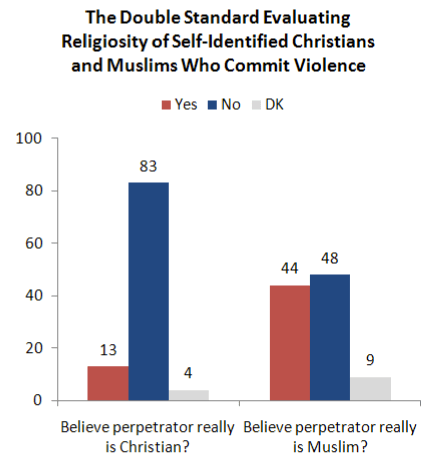
From a new report, "What It Means to Be American: Attitudes in an Increasingly Diverse America Ten Years after 9/11," by Brookings and the Public Religion Research Institute:

Screen shot 2011-09-06 at 5.37.32 PM

Dish coverage of this double standard as practiced by Bill O'Reilly in his reaction to Breivik here, here and here. My take at the time:

[I]t is obvious that Christians can commit murder, assault, etc. They do so every day. Because, as Christian orthodoxy tells us, we are all sinners. To say that no Christian can ever commit murder is a sophist's piffle. Did Scott Roeder stop being a Christian when he assassinated a man repeatedly demonized by Bill O'Reilly, George Tiller? Do the countless criminals who have gone to church or believe in Jesus immediately not count as Christians the minute they commit the crime? Of course not. What O'Reilly is saying is complete heresy in terms of the most basic Christian orthodoxy.

In Defense Of Civil War Reenactments, Ctd

Lewis McCrary responds to the Dish reader who challenged his take on fake battles:

I didn’t intend to suggest that reenactors are experiencing some kind of false consciousness, or on the other hand, holding seminars around the campfire. Their narrative of the war is often grounded in trying to understand the motivations of individuals, both good and evil, and thus relies upon some assumptions about why people go to war. This is a somewhat different issue from what the Dish reader describes: what strikes me as very conscious peer pressure to appear authentic.  He may be right that this is a distraction, but I’m not sure it tips the scales toward the argument that reenactments are a pernicious activity.

Speaking of pernicious, a reader writes:

I offer up on Civil War reenactors in Germany, where the Confederacy is overwhelmingly the more popular choice. It's a reminder that there are often darker subtexts coursing through the popular hobby:

Among military reenactors, the chance to fight on the losing side or to struggle against overwhelming odds exercises a particularly powerful appeal. That, after all, is an essential component of the romance of Gone with the Wind; after exalting it, the Nazis found themselves forced to ban it in the nations they occupied, where audiences cast themselves – and not the Germans – in the role of the wronged. If even the Resistance in Europe was inspired to identify with the South, why read anything sinister into the existence of German Confederates?  

Wolfgang Hochbruck, a Professor of American Studies at the University of Freiburg and a Union reenactor, is less charitable. "I think some of the Confederate reenactors in Germany are acting out Nazi fantasies of racial superiority," he told author Tony Horwitz. "They are obsessed with your war because they cannot celebrate their own vanquished racists." It's an unsettling thought.

Switching gears and wars, check out a great radio piece by Laura Nahmias ("War Games") about Iraq veterans and veteran wannabes performing reenactments with airsoft guns on military bases, reenactments that are encouraged by the Army as a means for recruitment. Text version of the story here. An excerpt central to the thread:

The Green Mountain Rangers aren’t exactly the kind of guys who re-do Gettysburg on the weekends but what they’re doing is something similar. … It’s a sensitive subject because the motivations aren’t always clear. Rationale is often provided in the form of honoring history, but what the guys are reluctant to talk about is the ways in which, if they are vets, the act of redoing it makes them feel…better. And, if they’ve never been in a war, its an opportunity to engage in a defining act of manhood.  Paul, the quiet, brooding "Ronin," has a backstory like this. S2 tells me his parents wouldn’t let Ronin join military until after he’d completed college. By the time he graduated, joining seemed like a death wish. "He missed his chance."

Another money quote:

Here at Fort Hamilton, [Special Agent Brian Liebelt] lives a self-imposed Spartan existence in the land of plenty, mere miles away from DiFara Pizza and Madison Avenue. There is nothing to decorate his office except a framed magazine cutout of John Wayne. "It used to be Donald Rumsfeld," he says, with a sharp, testing look at me. "Now, I think John Wayne is a better hero."

Where The Doctors Are

Www.savethechildren.org.uk-en-docs-HealthWorkerIndexmain.pdf

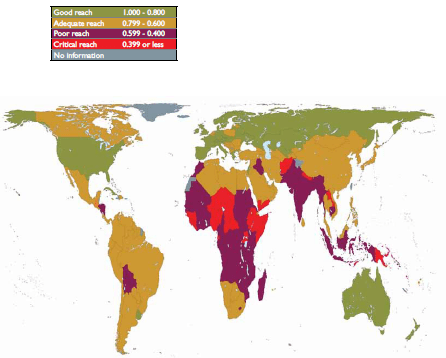
Save The Children UK, who produced the map, explains:

The index measures not only how many health workers there are, but also their reach and impact. It shows that children living in the bottom 20 countries — which fall below the WHO minimum threshold of just over two health workers for every thousand people – are five times more likely to die than those further up the index.

Sarah Boseley provides commentary.

9/11’s Warping Effect

Zadie Smith reflects on how the attack changed our thinking:

The end of the world for nearly three thousand innocent people. The beginning of a different sort of world for the rest of us. From the epicenter in Manhattan, shock waves rippled across Europe. In North West London, a small but significant change: the stereotype of the Muslim boy was transformed. From quiet, sexless, studious child—sitting in the back of class and destined for an engineering degree—to Public Enemy No. 1.

Why So Many Muslim Truthers?

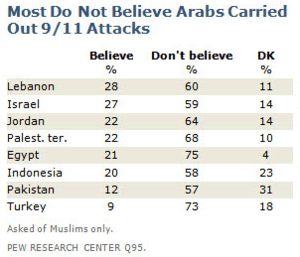
Eric Trager reports on the beliefs reflected in the below chart:

Most alarmingly, 9/11 revisionism also remains alive and well within Egypt’s transitional government, despite its ostensible strategic alignment with the United States. In late 6a00d83451c45669e2014e8b513875970d-800wi August, I called Egyptian Minister of Social Solidarity Gouda Abdel-Khalek and asked him who he thought was responsible for 9/11. I assumed that Abdel-Khalek, a former Fulbright scholar who has taught economics at USC and UCLA, would dismiss my query as both ridiculous and obvious, but he took the question seriously instead: “I don’t know if anyone can answer this question,” he said. “Can you?” After a few digressions, he finally responded. “From what I read—and I don’t have the capacity of information gathering that intelligence agencies have—my follow-up led me to believe that the theory that Al Qaeda did it lacks evidence. The United States made it look like Al Qaeda did it. And you must have seen some of the works by Michael Moore—Fahrenheit 9/11.”

Meanwhile, Jeremy Stahl traces the roots of American trutherism.

Don’t Overspend On China

James Traub counters a new report from the conservative Project 2049 Institute demanding a significant increase in military spending to prevent nuclear war with China:

Americans are, understandably, much too obsessed with the economy right now to spare a thought for national security. But the debate is waiting in the wings. The threat of terrorist attack is very real, but diminishing. Al Qaeda is not the national nightmare it once was. Are Americans going to replace it with a new nightmare — or rather, a recycled one from the depths of the Cold War? I certainly hope not. China's regional ambitions do need to be checked. But if America bankrupts itself in the process, we'll win the battle and lose the war.