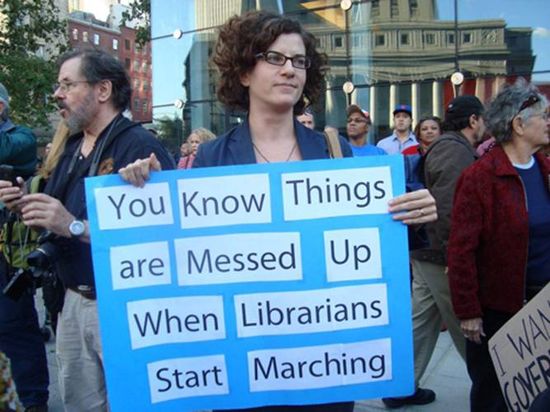
A reader writes:
I was interested, and glad, to see this sentence in Gregory Djerejian analysis of the Occupy movement: "They are acting to secure conservative aims of re-balancing a society that is becoming dangerously unmoored and increasingly bent asunder." Why? Because it reasonably identifies a truth about today's Conservative/Liberal political environment – that many on the Liberal side of the political equation are often quite philosophically conservative. And that today's "conservatives" are anything but.
As a long time resident of that liberal political hotbed Madison, Wisconsin, I've often said that it is in fact one of the more conservative places you'll find.
Why? Because even most of the more radical lefties living here (and there are far fewer than some would like others to believe) are living essentially conservative lives; they want a safe place to raise their kids, value their monogamous relationships (gay or straight), support law and order, have decent middle-class jobs, and want their world to be primarily stable and fairly predictable. They surround themselves with generally like-minded neighbors, talk to them over their fences (or across their hoes at the community gardens), and politely wait for their children in the pick up zone of their schools.
Do they vote Democrat or even Green? Sure. But at their core, they want what traditional philosophical conservatives seem to want: community, neighborliness,
predictability. When hundreds of thousands of them marched daily around our Capitol last spring in response to the new "conservative" governor's radical policy changes, it was because they felt the changes were moving too fast and the rules weren't being respected. The foundations of their lives – built generally on following the rules, respecting their contracts and following what seemed to be reasonable and stable career paths – were being shaken too vigorously and unfairly. You don't have to agree with their take on the situation to agree that the core of their complaint was about as traditionally conservative as you can get. I say this as a fairly classic liberal who embraces change and thinks throwing a wrench into the works – personally and societally – is rarely a bad thing.
I think this is a vital phenomena to understand, especially given the way the Republican right in the USA has taken to painting anyone who opposes them as radical Leninists who want to destroy the conservative fabric of the country. Somehow, I fail – and I think many others do and/or will – to see how demanding to take part in a traditional American middle-class life does that. I fail to see it because it doesn't. The only things really threatening that fabric, ironically, are the radical Corporatists and Christianists who dominate today's Republican party.
(Photo of a Wall Street occupier via Ouno Design. Map of similar sit-ins by Mother Jones.)
 The Dish