Morton Abramowitz and Thomas Pickering keep tabs on the military junta's surprising liberalization:
When we visited in May, talk of reform was in the air but few concrete measures had been taken. The new government has now released dissidents, met with pro-democracy leader Aung San Suu Kyi, known as ASSK, at the highest levels, created a National Human Rights Commission, somewhat eased media censorship, welcomed back overseas exiles and more publicly emphasized dialogue with ethnic-minority groups focused on a national reconciliation. Following some uncharacteristically open debate, President Sein suspended a controversial, Chinese-backed mega-dam project that would dislocate thousands of villagers, harm the environment, and contribute to ethnic conflict. Equally important for accelerating change, the new government recognizes its serious economic troubles and is reaching out to the IMF and other international financial institutions to help reorient its economy.
Russ Wellen flags an assessment (pdf) of the Burmese opposition by Roland Watson:
[S]trategy for the Burma pro-democracy movement is relatively simple, albeit complex to implement. The movement has two arms, non-violent protestors and ethnic rebels. But, rather than opposing each other, they can instead complement and work together, creating what chaos theory calls a feedback loop where the pressure inside Burma on the regime becomes so great that it breaks. If the people start protesting, and the ethnic groups launch offensive operations wherever and whenever possible, the regime will not be able to handle it. What worked in Libya will work in Burma, too.
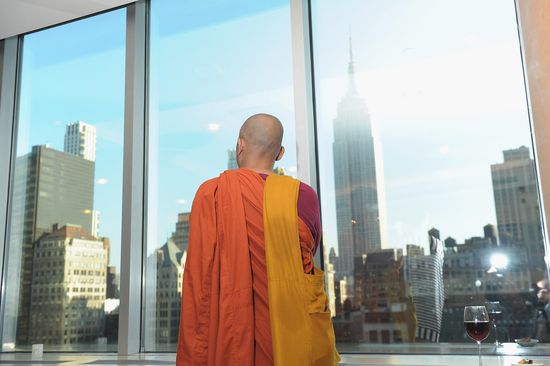
(Photo: A Burmese Monk looks at the Manhattan skyline during the HBO Documentary screening of 'Burma Soldier' at HBO Theater on May 12, 2011 in New York City. By Michael Loccisano/Getty Images for HBO.)
 The Dish
