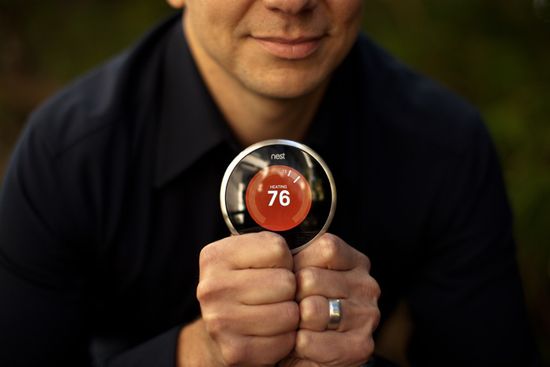
Tony Fadell, hardware designer for the iPod, saw an opportunity with the ubiquitous device:
Thermostats, [Fadell] found, had not changed much in decades. The most popular model is known as the Honeywell Round, a white sphere circle with tiny meters indicating actual and desired room temperatures. When legendary designer Henry Dreyfus designed it, it was an instant hit — but that was 1953! More recent, upscale programmable thermostats were not only hideous — displays were straight out the DOS era — but programming them was reminiscent of getting a 1970s VCR to tape a football game. …
The government estimates that the average home has a $2,200 energy bill, half of which is under the control of the thermostat. That means every household was losing hundreds of dollars because of that oblique gizmo on the wall. It was an industry ripe for disruption.
Katie Fehrenbacher is pretty impressed with Fadell's version, "Nest":
[It] has a feature called "time to temperature," which shows the home owner how long it will take to heat or cool the home. Say, you set the thermostat for 75 degrees, the Nest interface could read, 75 degrees in 25 minutes, letting you know how long it will take. The idea behind that feature is that most people set a thermostat like an accelerator, says Fadell, increasing the temperature or cooling way above or below the actual desired setting. But giving the user more feedback can help curb this problem — think of it like seeing how long a download of a file will take.
The Nest also learns your behavior over time.
 The Dish