Why The Super Committee Might Fail

The cuts don't take effect until 2013:

[I]f the trigger kicks in, the resulting cuts can be undone by the next Congress. And if either party is convinced that it will win in 2012 and control all the branches of government, then it has an incentive to let the Joint Select Committee fail, wait out the clock, and then impose their own preferences after the election.

The Daily Wrap

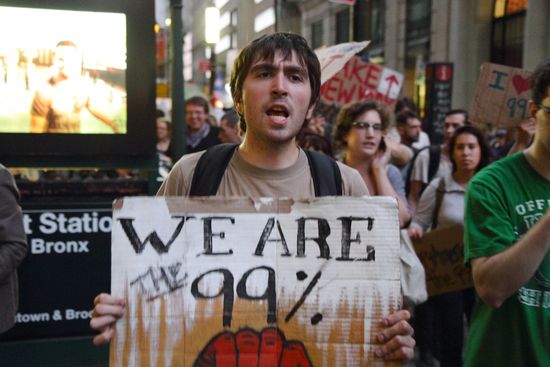
Weare99percent
Today on the Dish, Obama's jobs bill was proclaimed dead on arrival, and Andrew wondered if the GOP's cynical partisan destruction would prove to be as successful in the long-term as it has been in the short. The Tea Party is better at politics than the Wall Street occupiers, who don't really have a purpose but might actually re-center the debate. Chait skewered Cheney's absurd attempts at vindication, a Republican casualty of the Tea Party begged for climate science sanity, and a country music star came out for marriage equality. Andrew remembered the evening of June 23, 1993, when he found out he had HIV.

In election news, Chris Christie is sitting this one out, but his fatness warranted more discussion. Readers packed the in-tray with more definitions of "niggerhead," Perry honed his position on immigration but collapsed in the polls, and Cain, the "GOP's black friend," surged. Naturally, Bachmann received the Bad Lip Reading treatment, and an angsty Sarah Palin had a 100-second meltdown (but there's still a chance she'll declare in the coming weeks). 

We compared 2011 to 1948 and parsed Bibi's demand for an official "Jewish state," and readers reacted to settler fundamentalism. Awlaki's assassination carries heavy implications for Muslim-Americans and the fate of the Yemeni dictator. We experienced the front-lines of the Libyan war, Egyptian democracy remains fragile, and shrinking the U.S. military simply makes strategic sense. In Europe, Greece is the new Lehman, and in the U.S., pro-lifers are the new prohibitionists

The mystery of the impossible Oxford interview was unlocked, we need our "little bugs," and Steven Pinker elaborated on the historic trend toward pacifism. Educating a workforce doesn't create high-skilled jobs, and small business isn't all it's cracked up to be. We weighed the economic theories of Darwin and Smith and checked out the new iPhone. Exercise fuels creativity, a hearing implant introduced a 29-year-old to the miracles of our ordinary life, and "fuck" continued to surprise. A cashier smiled as a man attempted to rob his gas station, and we're psyched for the new season of South Park.

Cool ad watch here, MHB here, FOTD here, VFYW here, and VFYW contest winner #70 here.

M.A.

(Photo by Flickr user _PaulS_.)
Who Is Behind Occupy Wall Street?

A reader writes:

Given your readers' anger at Occupy Wall Street, I thought I would add something to it.  A friend sent me over a well thought-out critique of the event from Mother Jones. Adbusters
When I saw the third word in the article, "Adbusters," I immediately looked away from my screen and said out loud "Oh dear God.  The poor kids…" The article clearly states Adbusters' hand in perpetuating this into being, which is exactly the problem.  Adbusters makes caviar socialists like Dominique Strauss-Kahn look like the salt of the earth, saviors of the working class.  They basically prey on college students and twenty-somethings unsure of themselves but with distrust in authority, selling their massive and expensive glossy magazine.  The pages reek of anarchist navel-gazing and wankery and self-important "down with corporations/big business/capitalism" screeds that really say little if anything at all.  

But worst is Adbusters' method of "protesting," called "culture jamming."

It's a cross between an elaborate prank and choosing not to do something voluntarily.  "Buy Nothing Day," a protest to Black Friday by buying…nothing?  "Digital Detox Week," a protest to technology by not using it for a week?  To anyone else, these "culture jams" look really silly.  But Adbusters sincerely believes that performing these acts of "protest," rather than confronting and attacking the institutions that harm culture directly, is the best way of changing the culture.  Really.  And when you ask how the culture should change, they blather without outlining a specific agenda.  Hell, Adbusters' whole existence seems bent on the hopes that nobody will notice that when challenged, they are incapable of making a coherent and compelling argument defending their beliefs and politics, or seeing that their actions may not have an impact.  They live in a detached fantasy world similar to Sarah Palin's, only much bigger.

Were Occupy Wall Street an organic creation, then I'd be slightly more sympathetic to the cause.  But this is Adbusters' wet dream: Twisting and diluting the positive and overwhelming force of the Arab Spring (even name-checking Tahrir in their announcement of Occupy Wall Street), even going as far as warping the definition of civil disobedience, to create a slightly more advanced form of culture jamming that might give them the attention they so crave.  Of course the people in Occupy Wall Street don't have clear reasons or goals.  Adbusters made it that way.  And that alone fills me with rage. 

Hopefully, this event will expose Adbusters for the overwrought attention-whoring joke it is.  At least the Teabaggers have an actual purpose.

Understanding The Oxford Entrance Interviews

A peek behind the curtain of the famous trial. I still remember mine: from the very low armchair that had my legs tipping into the air at the get-go to the hobo I saw on the street an hour before who turned out to be my professor. Hey, he studied Carolingian history and had hair growing profusely from his ears.

How Many Soldiers Do We Need?

A new study from the Center for a New American Security (CNAS) advocates trimming the military:

CNAS has a hard time believing that a massive Army is necessary to combat realistic global threats, post-Afghanistan. Instead, “naval and air forces will go increasingly important in the future strategic environment,” the report advises. That’s because the most important region of the world, from the perspective of U.S. interests, is the “Western Pacific and Indian Ocean.” You can’t garrison lots of soldiers there.

The Consequences Of Awlaki’s Assassination

American Muslims have one less image problem:

Awlaki was a malignant cancer on the reputation of Arab- and Muslim-Americans. He was also frequently cited by those who would stigmatize these communities as a potentially dangerous fifth column requiring discriminatory special treatment from the government. The bottom line is that Awlaki preached that all Americans, of whatever origin, were fair game and should be killed at every possible opportunity. That, of course, includes Arab- and Muslim-Americans. So Awlaki not only threatened the reputation of these communities, but also potentially their members as well. This man wanted us all dead, so eliminating him was, quintessentially, an act of self-defense.

Joshua Hersh worries that the US will start cozying up to Yemen's recently returned dictator:

According to a count by The New York Times, 40 people were killed in attacks by government forces against the opposition movement the day after Saleh came home, amid an ongoing spike in violence. Less than a week later, American forces finally tracked down al-Awlaki, a wanted figure who had been at large in the country for several years. "In my mind it is no coincidence this happened after his return," Christopher Boucek, an expert on Yemen with the Carnegie Endowment for International Peace, told CNN Friday, arguing that paving the way to the strike may have been part of an attempt by Saleh to reinforce his indispensability in the war on terror.

This Isn’t What Democracy Looks Like?

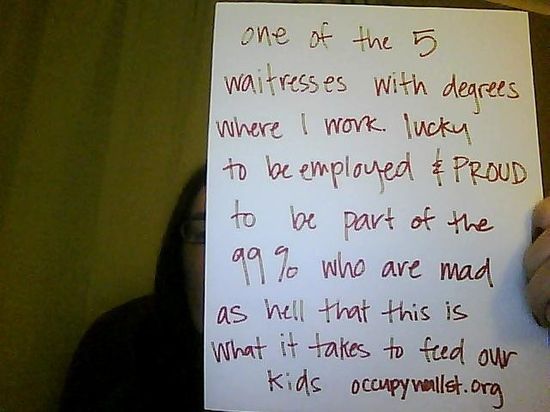
Waitress_Degree

R.M. at DiA is unimpressed by the Wall Street occupiers:

Many of these aggrieved youth believe that the government has become unresponsive, that their voices have been silenced, and therefore protest is the only option. But this strikes me as a fundamental misreading of the past three years. It is likely that few of the protesters have actually taken part in the more mundane aspects of the system they'd like to take down—for example, only 24% of 18- to 29-year-olds voted in the 2010 mid-term elections. And while they were quietly seething, the tea-party movement was showing America what democracy actually looks like, pushing their candidates forward and holding them accountable. When liberals complain that the Republicans are beholden to the tea-party movement, is that not an admission that the system is responsive?

This ruffles ED Kain's feathers. Matt Steinglass recalls that the beginnings of the Tea Party. And Felix Salmon recommends Ezra's Klein's understanding of the protesters.

(Photo from We Are The 99 Percent tumblr)

Christie Bows Out

Douthat is sad:

From Jeb Bush to Haley Barbour, Jon Thune to (especially) Mitch Daniels, we’ve watched the party’s leading lights and most experienced national figures repeatedly pass the buck, all of them hoping that somebody else would step forward to supply a credible alternative to Mitt Romney. Individually, their choices were understandable; collectively, they have represented a significant institutional failure — even a generational failure, you might say, which left conservatives scrambling to promote the next generation (Christie, Paul Ryan) ahead of schedule.