"Cheney’s bizarre misapprehension about the current administration simply reflects his failure to even conceive of the possibility that the fight against Al Qaeda might be waged, not just less, but better," – Jon Chait, on Cheney's ridiculous demand for an apology post-Awlaki.
Month: October 2011
Are Small Businesses Overrated?
If you’re looking for a lot of good-paying, stable jobs, you’d better hope there are some big companies around that want to hire. Kansas City Federal Reserve economist Kelly D. Edmiston’s analysis of U.S. data found that each year, 22 percent of staff in companies with fewer than 100 employees quit or are fired, compared with only 8 percent for companies with 2,000 or more workers. Edmiston also found that the jobs offered at large businesses were better than those at small businesses. Hourly wages at the largest companies, those with more than 2,500 employees, average around $27, compared with $16 in companies with payrolls of fewer than 100. Companies with more than 100 workers are almost twice as likely to offer retirement benefits and insurance, and considerably more likely to offer health care.
Creative Calisthenics
Why artists should exercise:
Studies now prove that aerobic exercise both increases the size of the prefrontal cortex and facilitates interaction between it and the amygdala. This is vitally important to creators because the prefrontal cortex […] is the part of the brain that helps tamp down the amygdala's fear and anxiety signals. For artists, entrepreneurs, and any other driven creators, exercise is a powerful tool in the quest to help transform the persistent uncertainty, fear, and anxiety that accompanies the quest to create from a source of suffering into something less toxic, then potentially even into fuel.
The Bugs They Need
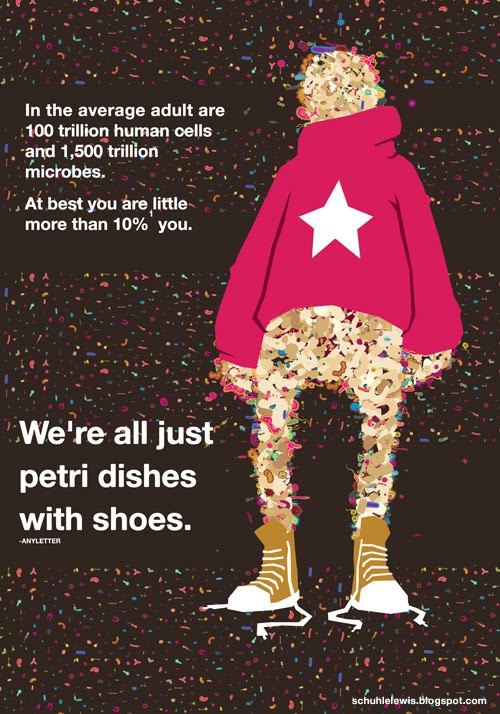
Emma Marris eyes one technical hurdle to cloning extinct animals not addressed in Jurassic Park:
Mammals like mammoths and humans host thriving, complex communities of microbes on their skins, in their mouths and, especially, in their guts. This "gut flora", when behaving normally, doesn’t hurt us but helps us break down our food and train our immune systems. … When the mammoth went extinct, so, presumably, did all its little bugs. A cloned mammoth born vaginally from an elephant would likely end up with elephant microflora. One delivered by caesarean might have no bugs at all. What do we make of a mammoth superoganism if only one out 100 of its genes are authentic to the ecosystem that roamed the earth inside a hairy proboscidean skin 13,000 years ago?
(Image by Jake Lewis)
The Best Investment You Can Make, Ctd
Contra Derek Thompson, Christopher Beha reconsiders the necessity of college:
Education does provide many individuals with a pathway out of poverty, but educating a workforce doesn’t change what jobs are available to society as a whole. As [John Marsh, author of Class Dismissed: Why We Cannot Teach Our Way Out of Inequality] writes, our economy produces more jobs that do not require degrees than jobs that do, and "a college degree will not make those jobs pay any more than the pittance they already do." Barring radical changes in our economy, the vast majority of those extra 40,000,000 college graduates Obama hopes to produce in the next decade will end up in jobs that don’t require degrees, and don’t pay.
Disturbed by the proliferation of for-profit schools, Beha notes that a "society that can’t increase its roll of college graduates without sending billions of dollars in grants and loans to proprietary schools has problems that will not be fixed by the classroom."
Darwin: A Better Economist Than Adam Smith?
That's Robert H. Frank's charge:
It’s just not true that individual interests are always in harmony with group interests, which is the presumption that modern disciples of Adam Smith start from: that if there’s competition, each individual — greedy though he may be — can go out and ruthlessly pursue his own interests and we’ll end up with the best outcome for society as a whole. It sometimes does turn out that way, but Darwin saw clearly that oftentimes you could have perfect competition and still you would get results that would be very different from what the group wanted.
He offers as an example the exorbitant amount of funds the financial industry spends on computer modeling systems: "You’re spending a lot of money for something that’s not really worth anything — getting the price 10 seconds earlier isn’t worth anything to society, but it's worth a lot to the guy who gets the right price 10 seconds earlier."
Hearing For The First Time
Allahpundit sets up the video:
What this is, in fact, is a legit viral sensation and assuredly the most affecting thing you’ll see today. Her name is Sloan Churman; she’s 29 and has been deaf since the day she was born — until very, very recently. Eight weeks ago she had surgery to have the Esteem hearing aid implanted in her ear. This is the moment when they turned it on.
Another feel-good video, this one of an impaired infant hearing his mother for the first time, here.
Start Paying For Dinner, Ladies, Ctd
A reader counters the others:
Of course women with PhDs are likely to earn less than men with PhDs. Women are overwhelmingly earning PhDs in liberal arts, while men earn more PhDs in hard science and business. Hard sciences and business PhDs pay a lot more, for two simple reasons (and neither of them gender-related):
(1) If you earn a PhD in one of those fields, you can be employed by something other than a university (like a Fortune 100 company, a tech start-up, or the research lab at a major defense contractor), and (2) supply and demand: there are far fewer people earning science/business PhDs, so if a university is hiring, they have to offer a competitive salary (as opposed to an English department which can probably choose among hundreds of PhDs for a single position).
Dr. Warren Farrell wrote a masterful book, Why Men Earn More, which explains the perceived "wage gap"- 98% of the wage gap can be explained by choices people make in college and in careers. For example, men are far more likely to: work in dangerous professions, work outdoors, commute long hours, work 50+ hours a week, travel at work’s behest, and enter fields that are less personally satisfying (e.g., accountant vs. kindergarten teacher). All of these choices increase the salary men earn over women for jobs requiring the same amount of education.
Further, many young women will choose a career path in college (when they are 19) in anticipation of balancing work and family demands that may not arise for a decade or more. For example, they may choose a safer, less risky career track like Human Resources rather than Finance, when they would be better served aggressively climbing the corporate ladder until and if they are actually faced with such a choice between work and family demands (see this excellent TED talk by the COO of Facebook, Sheryl Sandberg).
The real culprit seems to be that few US businesses offer true family-friendliness; it is NOT that businesses are sexist. After all, it would be really inefficient to discriminate against half the labor pool, as companies that did not discriminate would gain an immediate upper-hand in the search for talent.
The Daily Wrap
Today on the Dish, the media descended on Paint Creek and turned up an ugly stone in Rick Perry's pasture, and a reader explored the peculiar meanings of "niggerhead." Obama upped the ante on gay rights and social issues, and Andrew perceived a tipping point. In our video installment, Andrew predicted that the Republican electorate will probably nominate Perry and will probably regret it. Michael Gerson berated Romney for a sinister and incoherent attack on the Texas governor's immigration record. Looks do matter in a president, and it happens that Chris Christie looks like much of America.
Andrew reiterated his stance on the assassination of al-Awlaki, he wants our troops out of Iraq this year, and Dick Cheney won't give up his panicked struggle to rewrite history (and the rule of law). A pastor physically attacked his own son and his boyfriend in church, a Perry-affiliated Christianist was convinced Israel would ultimately be "saved," and we witnessed a disturbing view into the fundamentalist settler mentality. Israeli politicians are like investment bankers, Ron Kampeas traced the GOP's conversion to the U.S. party of Likudniks, and Goldblog blamed Turkey for Israel's settlements. Kevin Williamson explained why China hawkery is misguided, we needn't worry about an Iranian blockade, and a reader shared a harrowing story of female genital mutilation in Somaliland. Another reader introduced us to the new documentary Tahrir, and territorylessness leads to indiscriminate forms of violence in civil wars.
Robert Spencer and David Horowitz tried to explain away the term Islamophobia as an elaborate enemy invention, and Roseanne Barr unleashed an unhinged attack on guilty bankers. We've lost the physiological capacity to self-regulate, added conspirators undermine conspiracies, and Mike Konczal outlined an agenda for the Wall Street protestors as the movement entered DC. Walter Russell Mead fawned over Thomas Friedman and Michael Mandelbaum's new book, and the MSM continued to dismiss Joe McGinniss's. Immigration won't be the silver bullet that will save Social Security, the film American Teacher's case for higher teacher salaries stopped short of raising the hard questions, and a libertarian woke up.
Biking is for everyone, and Americans migrated South in record numbers. Parenthood ruined Dreher's appetite for dramatic violence, rogue DNA spurred the evolution of modern human pregnancy, and moms are getting older. We marveled at the curiosity of children, men with master's degrees out-earn female PhDs, and in general women tend to be more precise about their "number." Credit histories don't predict how reliable an employee will be, a PB&J sandwich isn't "non-obvious" enough to be rewarded with a patent, and a solar company has devised a smarter payment plan for its service. Pundits can't seem to tell the truth, and we couldn't resist hot Wall Street occupiers and the most well-hung characters on TV.
FOTD here, VFYW here, MHB here, and creepy ad watch here.
— M.A.
Get. Them. Out.

Douglas Ollivant demands that zero American troops be left in Iraq after this year:
The debate over the U.S. military presence is distracting policymakers from the real issues in the United States' future relationship with Iraq — the role of the State Department (and particularly its ambitious police-training mission) and of the American business community. It is these two instruments of U.S. "soft power" that will shape U.S.-Iraq relations going forward, and to put it frankly, the sooner the military can get out of their way, the better.
Amen. I hear the Pentagon is relentless in wanting another satrapy – but that we may be able to get away with 3,000 trainers out of Iraq to help train the Iraqi military. They key thing for me is their departure from Iraqi soil entirely. We can still help if necessary – but from a distance. It's vital we signal to the world that we have left, never to return again.
(Photo: As soldiers clean and repair military vehicles before their departure to the United States a gun hangs from truck door at U.S. military base Kalsu on July 18, 2011 in Iskandariya, Babil Province, Iraq. By Spencer Platt/Getty Images.)
 The Dish