Civil Rights In 1919

Clay Risen reviews Red Summer: The Summer of 1919 and the Awakening of Black America by Cameron McWhirter:

Spurred by the horrors of lynching and anti-black rioting, membership in the NAACP doubled that year, and subscriptions to its magazine, The Crisis, soared. Hundreds of thousands of African Americans, including many who had recently returned from serving in World War I, refused to back down in the face of white intimidation. … Most important, their varied goals remind us that the black struggle was about more than just access to public accommodations and voting booths. It was, and is, a struggle for equal access to all the things that white America often takes for granted: safe neighborhoods, decent education, and a fair justice system, to name a few.

Chasing Luxury

In a reflection on the American abandonment of thrift, Patrick Deneen relays David Cloutier's thoughts on "luxury":

Cloutier not only pointed out that the word “luxury” went from having a negative to a positive set of connotations, but that it came largely to mean items that are expensive or rare. According to a more ancient understanding, however, “luxury” includes not only expensive items, but the effort to accumulate goods that are extraneous and unnecessary, as well as any use or employment of items in a way that is wasteful or irresponsible. Thus, he argued, even the purchase of Wal-Mart socks can be considered the purchase of a “luxury” item, particularly in an age in which we no longer repair (or “darn”) worn socks.

The Pink Hijab Generation

2228491909_48384c9b30_b

Robin Wright spoke with Dalia Ziada, an Egyptian survivor of female genital mutilation. A staggering 97 percent of Egyptian women between the ages of 15 and 49 have suffered some sort of genital mutilation:

In 2006, when she was 24, Ziada had a long debate with an uncle about her seven-year-old cousin Shaimaa, the family’s youngest female child. “We talked most of the night. He was shocked at the blunt discussion,” she recalled. “I told him that he had no right to circumcise her. I said I’d cut off Shaimaa’s finger if he went through with it. He looked at me with surprise and said that would ruin her life—and I said, ‘Now you get it.’ I thought I’d lost. But he called me the next day and said I’d convinced him. …

Ziada soon became a leading activist among the pink hijab generation, young women committed to their faith, firm in their femininity, and resolute about their rights. With three college classmates, she launched a campaign to educate women about genital mutilation and domestic violence. Then she moved on to human rights. And she ended up at Liberation Square.

(Photo by Flickr user Swamibu)

Seeking A New Time-Logic

We're more efficient than we've ever been, but extreme efficiency has drawbacks:

More efficient forestation means running through forests faster. More efficient fishing methods means running through natural fishing stocks faster. … The truth is that we have limits. True connections between family, friends and colleagues can not be compressed down to tightly scheduled "quality time." The relentless logic of efficiency can unintentionally strip the most valued qualities of human life just as easily as it strips forests.

Death Needs A Place In Life

Mark Vernon contemplates "futile care," for those "living with dying":

Might a good death be defined as one in which the dying are helped and allowed to depart in such a way that they become peaceful, benign energies in the lives of the still living? The living, in turn, can say to the dying, we will grieve, we long for you not to go; but we will join you in time, and in the meantime, will live as well as we can remembering you. Something like this is behind many of the rituals of death, from lighting candles to laying places at the meal table for the recently departed and praying for them. I wonder whether a lack of such rituals in a secular world compounds the problems that organisations like health services face; might be another way in which hospital chaplains could save money?

Google As Primary Document

Jon Stokes heralds Google's digitalization of the Dead Sea Scrolls:

[I]t’s rare that scholars get to compare a a high-quality, full-color facsimile of a source text to the edited critical edition that forms the basis of their work. But what’s even rarer is the opportunity to compare a high-quality image of a source text to the transliteration and/or transcription that underlies the critical edition. (A transliteration is where a scholar tries to copy the source text exactly, misspellings and all; a transcription is a cleaned up version of the transliteration, where spelling, punctuation, diacriticals, and the like are all normalized.) Transcriptions and transliterations are almost never released; all scholars see is the resulting, cleaned-up edition.

During my ten years of grad school, I had occasion to compare a number of scholarly transcriptions (and a few transliterations) to images of sources, and I, my classmates, and my professors were routinely shocked at the parts of their work that scholars failed to flag as questionable. There would be words and passages that clearly should’ve been marked in the transcription with a dot under them, to signify that the text was pretty much illegible and the scholar was just guessing, but they weren’t.

Zenpundit applauds the news, and notes that the Nag Hammadi Archive can be explored via the Claremont Colleges Digital Library.

Why Do Only Athletes Have Coaches?

Atul Gawande wants to expand the purview of coaches. Gawande, a surgeon, recruited a retired surgeon to coach him:

In the past year, I’ve thought nothing of asking my hospital to spend some hundred thousand dollars to upgrade the surgical equipment I use, in the vague hope of giving me finer precision and reducing complications. Avoiding just one major complication saves, on average, fourteen thousand dollars in medical costs—not to mention harm to a human being. So it seems worth it. But the three or four hours I’ve spent with [my coach] each month have almost certainly added more to my capabilities than any of this.

The Pendulum Of Anti-Science

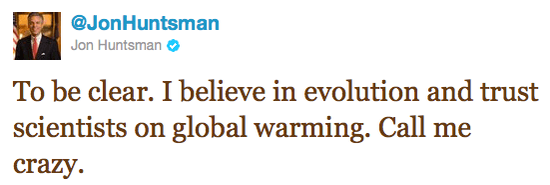
Huntsmantweet

Kenneth Green tried to argue it swings both ways:

[T]he way I see the ledger, the religious Right gets a handful of anti-science points for views on evolution (and related rationalizations about the age of the earth, etc.), and for some dismissal of climate change theory, but the Left gets many more anti-science points for exaggerating the health and ecological risks of POPs; DDT; GMOs; plastics and plasticizers; pesticide residues; conventional agriculture; low-dose EM radiation; high-tension powerlines; climate change; population growth; resource depletion; chemical sweeteners; species extinction rates; biodiversity decline; and I’m sure the list could go on.

Chris Mooney draws an important distinction:

On the left, we eat alive our own allies when they make false claims. That’s precisely what happened on vaccines and autism. We don’t follow the leader—any leader. This is part of our inherent disunity (often a political liability) and anti-authoritarian psychology. On the right, the dynamic is different and authority is too often followed, even when it is dead wrong. And you stand up for your friends. That’s a virtue in many instances—but not when those friends need calling out and correcting.

Phil Plait expands the political point:

To say you think evolution might be true is political suicide if you’re a Republican candidate right now. It’s that simple, and that bad. I think that, like on the left, the majority of voters on the right are not antiscience, but if you look to the leaders in Congress, in State legislatures, and at the Presidential candidates, that’s all you see.