"In the present we have only one day at a time, each offering a minute at a time. But all the days of the past will come to your call: you can detain and inspect them at your will—something which the preoccupied have no time to do. It is the mind which is tranquil and free from care which can roam through all the stages of its life: the minds of the preoccupied, as if harnessed in a yoke, cannot turn round and look behind them. So their lives vanish into an abyss, and just as it is no use pouring any amount of liquid into a container without a bottom to catch and hold it, so it does not matter how much time we are given if there is nowhere for it to settle; it escapes through the cracks and holes of the mind," – Seneca.
Month: October 2011
A Poem For Sunday
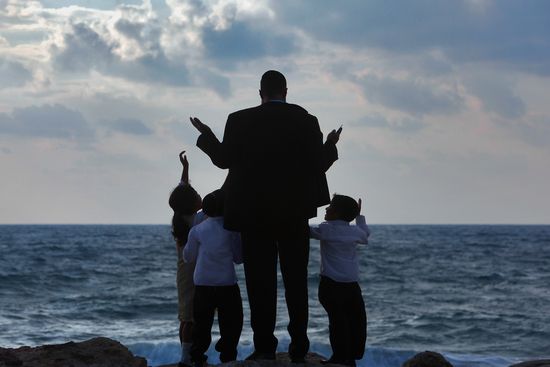
"For I Will Consider Your Dog Molly" by David Lehman:
For it is customary on the first day of Rosh Ha'shanah to cast a stone into the depths of the sea, to weep and pray to weep no more.For the stone represents all the sins of the people.For I asked you and Molly to accompany me to Cascadilla Creek, there being no ocean nearby.For we talked about the Psalms of David along the way, and the story of Hannah, mother of Samuel, who sought the most robust bard to remedy her barrenness.For Isaac said "I see the fire and the wood, but where is the lamb for the offering?"For as soon as I saw the stone, white flat oblong and heavy, I knew that it had summoned me.For I heard the voice locked inside that stone, for I pictured a dry wilderness in which, with a wave of my staff, I could command sweet waters to flow forth from that stone.For I cast the stone into the stream and watched it sink to the bottom where dozens of smaller stones, all of them black, gathered around it.For the waterfall performed the function of the chorus.For after the moment of solemnity dissolved, you playfully tossed Molly into the stream.For you tossed her three times, and three times she swam back for her life.For she shook the water off her body, refreshed.
The poem continues.
(Photo: An ultra-Orthodox Jew performs the Tashlich prayer with his children while facing the Mediterranean Sea at sunset of the second day of Rosh Hashanah, the Jewish new year, on September 20, 2009 in Tel Aviv, Israel. Tashlich, which means 'to cast away', is the practice by which Jews go to a flowing body of water and symbolically 'throw away' their sins during the days of repentance between Rosh Hashanah and the upcoming day of atonement, or Yom Kippur, the holiest day in the Jewish calendar. By David Silverman/Getty Images)
The View From Your Window
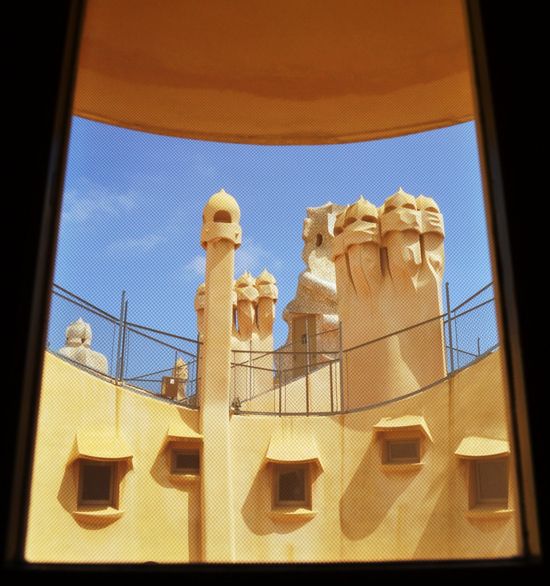
Barcelone, Spain, 2.05 pm
The Survivor’s Redactions
Werner Gundersheimer explores why his mother tried to shield him from the past:
Some survivors can talk freely about their experiences; others prefer silence. Whether you fall into the first or second group has nothing to do with wanting to get on with your life after the trauma is past. Everyone wants to get on with life, even though the trauma is never past. Mother read Elie Wiesel and Primo Levi, but she couldn’t imagine doing what they did—talking and writing about the experience of having survived, or evoking and re-presenting the attendant losses. Those were her private, even secret, griefs.
Rescuing God And Love

Tony Woodlief contemplates the degradation of love:
[T]here is this old word called love, and what can we say of it, now? It has been perverted, by songs and books and perhaps worst of all by that variety of Orwellian preacher who crafts a hateful god and calls him Love. It has been perverted by every one of us who has whispered it without meaning it, who let it become passive feeling instead of convicted action.
(Image by Aaron Eiland via Still Life)
Have The Rich Always Been Healthier Than The Poor?
Nope (pdf):
For the ducal families up to 1750, life expectancy was no higher than, and sometimes lower than, the life expectancy of the general population. …Why is this important? The absence of a gradient before 1750 shows that there is no general health benefit from status in and of itself, and that power and money are useless against the force of mortality without weapons to fight.
(Hat tip: Bill Gardner.)
The Happiest Day Of The Week

Multiple Yous
What the old folks know:
You might look inside yourself and think you know yourself, but over many decades you can change in ways you won’t see ahead of time. Don’t assume you know who you will become. This applies all the more to folks around you. You may know who they are now, but not who they will become.
The Next Chapter
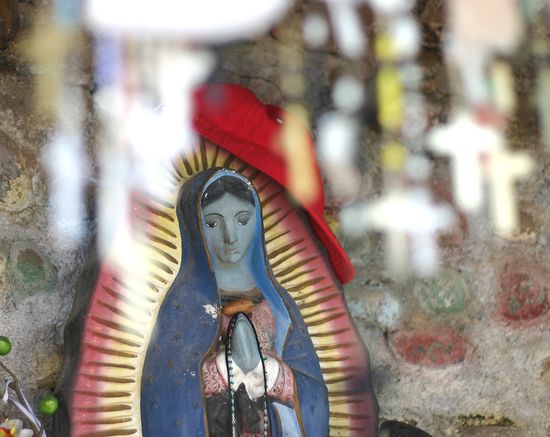
Within about a decade, Latinos are set to comprise a majority of the roughly 70 million Catholics in the US. Rocco Palmo, who runs Whispers in the Loggia, thinks it's the great story of our time:
Historically speaking, the last time we’ve seen a shift of this magnitude came in the 1840s, when the first major waves of immigration (above all Irish) transformed the US church from a relatively small, English-dominated group into the nation’s largest religious body.
(Photo: In Guad We Trust by Flickr user bloomgal)
Fulfillment, Not Happiness
The difference:
Philosophers such as Aristotle had a much richer conception of fulfillment than our word happiness suggests. The Greek term eudaimonia connotes the best way of life, or human flourishing. Aristotle was a biologist. He thought of human beings as living organisms that can wither if our being is not properly nourished or live well and thus blossom and flourish. Just as health is an objective state of the body when it is thriving, so flourishing is an objective state of the human person––the psycho-physical organism––when we are fulfilling our unique potential.
For Aristotle, happiness or flourishing is not a feeling or a state but an activity of living. It is the way of living that expresses all we are meant to be. Pleasure or joy is the subjective dimension of this experience. When we live well, we feel pleasure or joy.
 The Dish