Flat Tax, RIP?

Douthat calls the flat tax a "fantasy":

A Republican politician could have all the eloquence, charm and charisma in the world, and he still wouldn’t be able to sell the American public — or even, I suspect, the Republican electorate, Herman Cain’s current poll numbers notwithstanding — on the notion that their own taxes should go up to pay for a tax cut for the top 10 or 5 or 1 percent of earners. (It’s fun to imagine the attack ads: “Rick Perry: He’s Ronald Reagan for the rich, and Walter Mondale for the rest of you.)

But a simpler tax? With, say, three rates? A post-card tax return that kills the lobbying industry? Sellable. I'd buy in a heartbeat.

The Failed States Are Expecting

As world population figures pass the 7 billion mark, Jack Goldstone worries about the next three billion people. He says they will almost all "be growing up in countries that today are rated by the George Mason University Fragile States Index as having governments that have serious, high, or extreme fragility":

[I]n the next century, the fastest population growth will take place in the world’s least advanced economies and some of its worst-governed countries. A global effort to improve governance and education in those countries, allowing the world to benefit from the human potential of billions of additional people, could again usher in a new stage of global prosperity. But failure to meet this challenge may consign billions of people to live in countries with failing states, brimming with angry and frustrated youth, prone to high levels of violence, and recurrent humanitarian disasters on ever-larger scales. There is still time to build partnerships and make investments to respond to this challenge, but every week, another 3 million children are born in the poorest countries, and the clock ticks on.

Hogmanwhat? Ctd

A reader writes, "This hilarious video was my Glaswegian friend's response to Siri's linguistic short-comings":

Another writes:

I’m a Londoner with a very neutral British accent living in the US and my (American) Siri doesn’t understand me either. 

I have to repeat myself numerous times and in an increasingly bad American accent to make myself understood.  And since I am the Dick Van Dyke of American, this can get very tedious.  Why not use British Siri, you ask?  British Siri understands me perfectly, but unfortunately it has been programmed to say "I can only search for businesses, maps and traffic in the United States, and when you’re using US English’,  which seems very unreasonable to me. Why can’t I search for US businesses in British English?

Still, I look forward to seeing all the American tourists in London being forced to use British Siri and British English to search for local information. That should be extremely funny.

“Iran’s Victory In Iraq” Ctd

R.K. Ramazani adds value:

Iran’s build up of influence is limited … for two major reasons. First, Iraqi nationalist sentiments place serious limits on the exercise of Iranian power. Even the pro-Iranian political factions are quite sensitive about foreign impingement on Iraqi sovereignty. The fellow Shia Iraqi forces, contrary to Iranian expectations, did not rise up against Saddam Hussein in the Iran-Iraq war; they fought against Iran. The other reason pertains to numerous disputes between the two countries. Many of these have been inherited from the Iraq-Iran war. They range from war reparations to border problems and continental shelf delineation in the Persian Gulf. For example, in 2009 Iranian forces penetrated Iraqi territory, as they had in 1982, and occupied the disputed Fakka oilfield for a few days. A more serious dispute between the two countries concerns Iranian border crossing. Iran repeatedly pursues an Iranian Kurdish separatist group into Iraqi territory.

Fred and Kim Kagan shrilly declare Iranian victory after the withdrawal. Matt Duss is as exasperated as Ted Galen Carpenter:

As for the idea that the U.S. withdrawal will "unquestionably benefit Iran," newsflash: The Iraq war unquestionably benefited Iran. As an Iraqi friend put it to me at a conference in 2008, “America has baked Iraq like a cake, and given it to Iran to eat.” As the New York Times reported earlier this month, Iran’s influence in Iraq — which was always primarily political, not military — has actually declined over the past two years (as with Al Qaeda in Iraq, the U.S. has benefited from our adversaries’ ability to alienate their own allies), but it’s worth noting that Iran’s influence was at its height when there were over 100,000 U.S. troops in Iraq. Does anyone seriously imagine that a few thousand extra U.S. troops would make the difference here? 

What Are Cain’s Chances? Ctd

Against criticism, Nate Silver defends electoral uncertainty:

[W]hile I think the conventional wisdom is probably right about Mr. Cain, it is irresponsible not to account for the distinct and practical possibility (not the mere one-in-a-thousand or one-in-a-million chance) that it might be wrong. The data we have on presidential primaries is not very rich, but there is abundant evidence from other fields on the limitations of expert judgment.

Hans Noel, co-author of The Party Decides, counters:

Our best understanding of how these things work says Cain isn’t the next nominee. I don’t think pundits who say he has essentially no chance are really wrong. They are no doubt responding to the equally loud voices that keep calling Cain the front-runner. The evidence we have so far is that popular support without insider support isn’t good enough. It’s good journalism to communicate that.

When Ads Fail By Succeeding

Martin Lindstrom charts the rise and fall of Axe's ad campaign:

[T]he brand's early success soon began to backfire. The problem was, the ads had worked too well in persuading the Insecure Novices and Enthusiastic Novices to buy the product. Geeks and dorks everywhere were now buying Axe by the caseload, and it was hurting the brand's image. Eventually (in the United States, at least), to most high-school and college-age males, Axe had essentially become the brand for pathetic losers and, not surprisingly, sales took a huge hit.  

The Prescience Of Russell Kirk

"The conservative movement is enfeebled, intellectually and in backing, at the very hour of its popular ascendancy… This may become a fatal impoverishment. For the most pressing need of the conservative movement in America is to quicken its own right reason and moral imagination. The rising generation, already won to a kind of unthinking conservatism on nearly every college campus, must be made aware that conservative views and policies can be at once intellectually reputable and pleasantly lively. 

The ideologue cannot govern well; but neither can the time-server. So it is that thinking folk of conservative views ought to reject the embraces of the following categories of political zealots … Those who instruct us that “the test of the market” is the whole of political economy and of morals. Those who fancy that foreign policy can be conducted with religious zeal, on a basis of absolute right and absolute wrong … Those who assure us that great corporations can do no wrong," – Russell Kirk The Intercollegiate Review, 1986. 

The Untold Story Of The Actual Obama Record, Ctd

Steve Walt takes issue with Drezner's positive spin:

Dan's broader point about Obama's foreign policy successes is insightful: the president has done well in those relatively minor areas where domestic politics do not loom large and where he can exercise unilateral authority. But on the more important and more difficult issues where you would have to convince the American people to follow a new path, he's come up mostly empty.

Drezner is unconvinced:

I'd like the Steve Walt of this post to reconcile these arguments with… the Steve Walt who just published "The End of the American Era" in The National Interest. See, that Steve Walt views American decline as both inevitable and structural, which implies that these outcomes aren't a function of Obama's leadership per se but impersonal forces of history. Many of the cases Walt cites as Obama "failures" in his blog post look are treated as ineluctable outcomes of relative American decline in his TNI essay.  Which is it?    

Good point.

Cutting Defense: Painful But Necessary

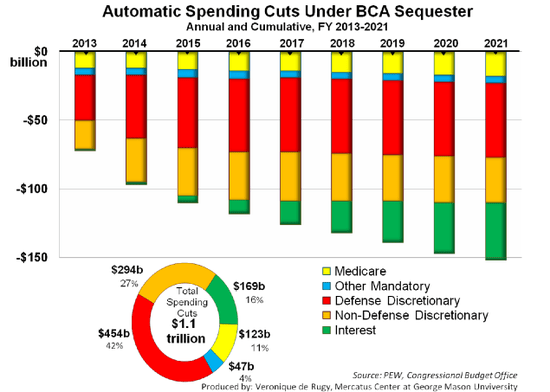
Spending cuts

If the debt commission fails, automatic spending cuts will slash defense. A new report, put out by the aerospace industry, claims that such an outcome could cost America a million jobs. Ackerman is unimpressed:

While there’s no doubt that defense cuts will mean job losses, there’s also no doubt that a report prepared for an industry so reliant on defense cash will paint a stark picture of what happens if that cash is threatened. Congressmembers looking to get reelected pay attention, since fighting for defense money as a jobs program is easier than making a case for what a sensible, appropriately funded defense strategy ought to be. That’s the problem with reports like these: They make it easy to ignore structural economic and defense problems and imply that all will be well if the cash keeps flowing.

Dylan Matthews takes a closer look at how much cutting defense would hurt the economy in the short term. Yglesias addressed this issue a couple of weeks ago:

I think our high level of spending on the national security state is very wasteful. We should have many fewer people designing and building military robots and many more working on household and industrial applications. We should have fewer soldiers and more police officers. But the good time to try to shift people out of one sector into another is when unemployment is low. 

(Chart: from a Mercatus Center report (pdf))

Victories In Libya

Marc Lynch is tired of all the negativity in current assessments of the war: 

[T]he intervention in Libya should be recognized as a success and real accomplishment for the international community.  The NATO intervention did save Libya’s protestors from a near-certain bloodbath in Benghazi. It did help Libyans free themselves from what was an extremely nasty, violent, and repressive regime.  It did not lead to the widely predicted quagmire, the partition of Libya, the collapse of the NTC, or massive regional conflagration.  It was fought under a real, if contestable, international legal mandate which enjoyed widespread Arab support. It did help to build — however imperfectly and selectively — an emerging international norm rejecting impunity for regimes which massacre their people.  Libya’s success did inspire Arab democracy protestors across the region. And it did not result in an unpopular, long-term American military occupation which it would have never seemed prudent to withdraw.

Richard Cleary pushes back against the “we attacked a friend” line:

Being an American “ally”—and this term is a stretch for Gaddafi’s regime—does not entitle one to butcher one’s own people, however. We agreed to do business with Gaddafi because of what Condoleezza Rice called a “strategic change of direction”; beginning with Tripoli’s giving up WMD aspirations, renouncing terrorism and compensating the families of victims of the Lockerbie bombing. These acts were never sufficient to absolve Gaddafi of future crimes. Rather, Gaddafi’s improved behavior was understood as the first steps of a new Libyan foreign policy.