Just Do It

Holly Pervocracy tries to nip sexual evangelicalism in the bud:

What kind of relationship you have is your choice, and one choice isn't better than another.  What's important is that you make a choice.  That even if you're you're monogamous, vanilla, and heterosexual–you're doing it because it's what you want and because you and your partner have agreed to it, not because that's what people do. … Who cares how many people you fuck or how you do it?  The only thing worth being evangelical about is consciousamory.

Start Paying For Dinner, Ladies

Doctorates
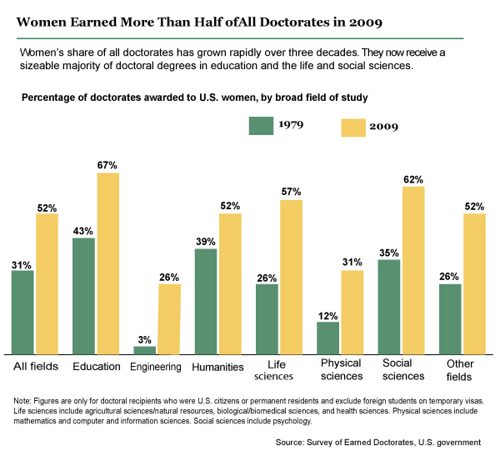
Taylor Marvin reads the above chart as an implication that cultural dating norms may change as well-educated women out-earn men:

What’s the point of an expectation that a high-earning man buys a female date dinner if there’s a good chance she makes more than him? This may just be male solidarity talking, but it’s hard to argue that this practice fits any definition of fairness. Similarly the traditional requirement of engagement rings, and by extension traditions that place the burden of proposing on men, is hard to justify in relationships where the female is the higher earner. As woman educational attainment continues to increase, we can expect these practices to become less common.

Pumpkin Beer: A History

Waits

Lisa Grimm traces the origins of the seasonal brew:

Before it was deemed a health tonic, pumpkin beer was a popular component in cups of flip—something akin to a cocktail that typically mixed rum, beer, and sugar. Pumpkin beer and brown sugar were more easily found in early America than their all-malt and refined counterparts, so they became part of the go-to recipe. But the main reason pumpkin was adopted as a beer ingredient during the early colonial period was simple availability—pumpkins were a native plant (one completely unknown to most Europeans before the 16th century), while good malt was not so readily accessible—fermentable sugars had to be found where they could, and in the first pumpkin beers, the meat of the pumpkin took the place of malt entirely.

Erik Loomis looks at how pumpkin beer is perceived by today's foodies.

(Photo of "Tom Waits pumpkin" by Flickr user abbyladybug.)

The Origins Of Synthetic Weed

Pharmacologist and blogger David Kroll offers a primer:

Every area of CNS pharmacology has chemists who try to figure out the smallest possible chemical structure that can have a biological effect. In fact, this is a longstanding practice of any area of pharmacology. Huffman was an excellent chemist who in the 1990s was trying to figure out the most important part of the active component of marijuana that might have psychotropic effects. These compounds made by him and his students, surprisingly simple ones, I prefer to call cannabimimetics since they mimic the effect of the more complex cannabinoids in marijuana. … But since they are simple, they are relatively easy to make – some of Huffman’s work at Clemson was actually done by undergraduate chemistry majors.

So, it was no surprise that they would be picked up by clandestine drug marketers, even though cannabis (UK) and marijuana (US) are freely available. The attraction to users was, until recently, that Huffman compounds (prefixed with “JWH-” for his initials) could not be detected in urine by routine drug testing. Hence, incense products containing these compounds have been called “probationer’s weed.”

The LA Times has more on why the DEA has recently cracked down on "stealth marijuana" products such as "Spice," "K-2," and "Skunk" which are based on Huffman's compounds. The ultimate irony:

Huffman supports banning them. But he also favors legalizing and taxing marijuana. "You can't overdose on marijuana, but you might on these compounds," he said. "These things are dangerous, and marijuana isn't, really."
“As British As Rain”

Ginlane

A historical overview of drinking in the UK:

A well-documented body of Civil War literature depicts the conflict between Royalists and Parliamentarians as a battle between sophisticated wine and provincial ale. After the Restoration, both Whig and Tory satirists continued this tradition contrasting, depending on allegiance, suspiciously Francophile (or admirably sophisticated) wine with dull (or reliably English) beer.

(Image: William Hogarth’s 1751 engraving Gin Lane)

Taking Your Husband’s Name

If you're female, it could influence your job prospects:

Even after controlling for education levels and work hours, a woman who took her husband’s name earns less — €960 compared to €1156.

In one study, participants judged a hypothetical woman who had kept her own name or not:

Despite the fact that other than their name choice the women were identical, the participants overwhelmingly described the woman who had taken her husband’s name as being more caring, more dependent, less intelligent, more emotional and (somewhat) less competent. Not necessarily qualities you would seek in a potential employee.

The Cynic’s Truth

Stefany Anne Golberg reviews Ambrose Bierce's The Devil’s Dictionary a century after its publication:

Cynicism, for Bierce, was not just an attitude; it was his life force. It’s ironic then that The Devil’s Dictionary is seen today primarily as a delightful little book of irreverent (if now anachronistic) witticisms. … As much as anyone, Bierce saw things as they really were and knew that there had to be another way. He had seen America in the depths of hell, had seen love from the bottom of a pit. He had shaken hands with greedy governors and jaded journalists, saw how men and women could abuse each other in the name of freedom and justice and altruism. For all its humor, The Devil’s Dictionary is a damnation of human hypocrisy, avarice, and selfishness. No one gets out clean — not even Bierce.

A Poem For Saturday

6155913754_8db7486b50_b

"All Watched Over by Machines of Loving Grace" by Richard Brautigan:

I like to think (and
the sooner the better!)
of a cybernetic meadow
where mammals and computers
live together in mutually
programming harmony
like pure water
touching clear sky. …

I like to think
(it has to be!)
of a cybernetic ecology
where we are free of our labors
and joined back to nature,
returned to our mammal
brothers and sisters,
and all watched over
by machines of loving grace.

Continued here.

(Photo by Flickr user Stephan Geyer)