The Three-Meals-A-Day Myth

Anneli Rufus unravels it by pointing to the past and various contemporary studies:

For most of history, meals were very variable. A medieval northern European peasant "would start his morning with ale or bread or both, then bring some sort of food out into the fields and have a large meal sometime in the afternoon," [Yale professor Paul] Freedman says. "He might have what he called 'dinner' at 2 in the afternoon or 6 in the evening, or later" — depending on his work, the season and other factors. "He wouldn't have a large evening meal. He would just grab something small and quick. Dinner back then tended not to be as distinct as it has become in the last two centuries."

And it tended to be eaten in daylight — not because eating earlier was considered healthier, but because cooking, consuming and cleaning up is difficult in the dark or by firelight. "People who were not rich tried to get all their meals eaten before dark. After electricity was discovered, initially only the rich could afford it," Freedman says. "From that point onward, one mark of being rich became how late you ate. Eating way after dark because you could afford electric lights was a mark of high status, urbanity and class."
Draining The Cartels’ Cash Flow

GT_CRACKCOCAINE_110929

Hard drugs account for around 80 percent of Mexico's drug-trafficking revenue. Mark Kleiman says that to solve the problem we would need to eliminate the heavy use of about 3 million Americans:

Frequent or random drug testing [of those on parole or probation], with a guaranteed short jail stay (as little as two days) for each incident of detected use, can have remarkable efficacy in reducing offenders' drug use: Hawaii's now-famous HOPE project manages to get 80 percent of its long-term methamphetamine users clean and out of confinement after one year. The program more than pays for itself by reducing the incarceration rate in that group to less than half that of a randomly selected control group under probation as usual. HOPE participants are not forced to receive drug treatment; instead, they are required to stop using. … If HOPE were to be successfully implemented as part of routine probation and parole supervision, the resulting reduction in drug use could shrink the market — and thus the revenue of Mexico's drug-trafficking organizations — by as much as 40 percent.

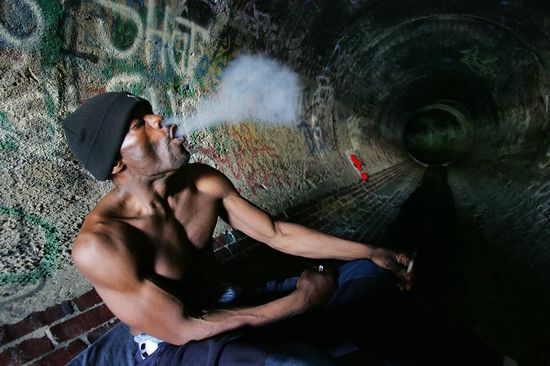
(Photo: Donald Rayfield, known on the street as 'Detroit', smokes crack cocaine in an underground storm drain on January 18, 2006 in Los Angeles, California. Detroit became homeless when he began smoking crack as he grieved the sudden death of his mother ending four years of drug-free living. By David McNew/Getty Images)

Campaign Echoes

In The Populist Persuasion, Michael Kazin draws parallels between the current election season and the one of 1896. Conor Williams spotlights an economic similarity:

It wasn’t until the 1940s that the United States had the regulatory apparatus in place to guard against panics like 1893's and to balance excessive economic inequality. Since we’ve spent much of the last few decades dismantling the public framework that safeguarded the American middle class, it’s perhaps not surprising that we’re revisiting the late 19th century’s problems.

Eric Boehlert notices a more recent parallel:

The comparison with Reagan in '83 is especially helpful because, like Obama, Reagan was in the third year of his presidency, his approval rating was in the 40s, his party had suffered midterm election losses the year prior, the U.S. economy was faltering, and the opposition controlled the House of Representatives. Those are the similarities. The difference? Reagan’s political opposition had not embraced the radical notion of complete and utter obstructionism.

Steve Benen nods.